 Add to Chrome
 Add to Firefox
 Add to Edge
MVM-IOD: An Industrial Object-Centric Benchmark Dataset for the Evaluation of 3D Reconstruction Methods
Jun 15, 2026
3D object reconstruction, and camera pose estimation in industrial applications are challenging tasks, as errors are costly while the computation time is often limited. The complexity of typical industrial objects further complicates these tasks. Most of the existing datasets in this context do not depict realistic industrial scenarios. Therefore, we introduce the Machine Vision Metrology Industrial Object Dataset (MVM-IOD). Images of typical industrial objects are captured systematically, by moving a camera, mounted at the end effector of an industrial robot arm, on a hemisphere around the objects. MVM-IOD contains reference camera poses and reference 3D point clouds, the acquired RGB images of 9 objects and 2 background choices resulting in 18 scenes, which allows evaluation of all image based methods that compute a 3D reconstruction, camera poses, or novel views of a scene. Based on MVM-IOD, we extensively evaluate current SOTA 3D reconstruction and camera pose estimation methods, such as Structure from Motion, Multi-View Stereo, recent feed forward methods (Visual Geometry Grounded Transformer, π3), and 2D Gaussian Splatting and report our findings as a baseline for future research. The experiments show that capture setups like ours generate out-of distribution images for feed forward methods, leading to suboptimal point clouds and camera poses. However, these out-of-distribution images can be shifted closer to the training distribution by applying simple preprocessing steps. Consequently, in certain industrial applications, feed forward methods should be used with caution.

Uncertainty Quality of VGGT: An Analysis on the DTU Benchmark Dataset
Jun 15, 2026Visual Geometry Grounded Transformer (VGGT) has already attracted a great deal of attention in a short period of time, not least due to the Best Paper Award at CVPR-2025. Similar to DUSt3R and MASt3R, VGGT aims to bring about a paradigm shift by replacing established methods like bundle adjustment and feature matching with a simple, unified, feed-forward neural network that predicts camera poses, depth maps, and dense 3D structure directly from multiple images of a scene in a few seconds. A key aspect is its ability to process an arbitrary number of views consistently in a single forward pass without any post-processing or iterative optimization. For photogrammetry, this opens new possibilities for real-time, scalable, and accessible 3D reconstruction. In this context, not only high reconstruction accuracy but also high-quality uncertainty estimates are crucial, as they foster trust and enable robust quality assurance. This paper therefore investigates the quality of VGGT's uncertainty predictions. The analysis identifies an effective confidence threshold for filtering VGGT's raw output and demonstrates that enhancing uncertainty quality holds strong potential for improving the accuracy of its 3D reconstructions.
MooMIns -- Monocular 3D Reconstruction and Object Pose Estimation from Multiple Instances
Jun 12, 2026Simultaneous 3D reconstruction and 6D object pose estimation from a single monocular image is an inherently ill-posed problem. In industrial settings, however, multiple instances of an object are often randomly arranged in bins, implicitly providing several views of the same object within a single image. We show that this implicit multi-view geometry can be exploited to simultaneously reconstruct the object in 3D and estimate the 6D pose of each visible object instance. We present MooMIns, a new Gaussian-splatting-based approach that inverts the original Gaussian splatting formulation: instead of rendering a single scene from multiple cameras, we render multiple object instances from a single camera. Our method is initialized with SAM3 instance segmentation masks and a modified Structure from Motion (SfM) pipeline. In contrast to learned monocular depth estimation, we perform true geometry-based reconstruction from image evidence, avoiding hallucinations caused by training data priors. We evaluate MooMIns on synthetic and real bin-picking scenarios, and demonstrate accurate reconstruction of previously unseen objects as well as reliable pose estimation of individual instance
Rethinking Semi-supervised Segmentation Beyond Accuracy: Reliability and Robustness
Jun 06, 2025Semantic segmentation is critical for scene understanding but demands costly pixel-wise annotations, attracting increasing attention to semi-supervised approaches to leverage abundant unlabeled data. While semi-supervised segmentation is often promoted as a path toward scalable, real-world deployment, it is astonishing that current evaluation protocols exclusively focus on segmentation accuracy, entirely overlooking reliability and robustness. These qualities, which ensure consistent performance under diverse conditions (robustness) and well-calibrated model confidences as well as meaningful uncertainties (reliability), are essential for safety-critical applications like autonomous driving, where models must handle unpredictable environments and avoid sudden failures at all costs. To address this gap, we introduce the Reliable Segmentation Score (RSS), a novel metric that combines predictive accuracy, calibration, and uncertainty quality measures via a harmonic mean. RSS penalizes deficiencies in any of its components, providing an easy and intuitive way of holistically judging segmentation models. Comprehensive evaluations of UniMatchV2 against its predecessor and a supervised baseline show that semi-supervised methods often trade reliability for accuracy. While out-of-domain evaluations demonstrate UniMatchV2's robustness, they further expose persistent reliability shortcomings. We advocate for a shift in evaluation protocols toward more holistic metrics like RSS to better align semi-supervised learning research with real-world deployment needs.
FeatureGS: Eigenvalue-Feature Optimization in 3D Gaussian Splatting for Geometrically Accurate and Artifact-Reduced Reconstruction
Jan 29, 20253D Gaussian Splatting (3DGS) has emerged as a powerful approach for 3D scene reconstruction using 3D Gaussians. However, neither the centers nor surfaces of the Gaussians are accurately aligned to the object surface, complicating their direct use in point cloud and mesh reconstruction. Additionally, 3DGS typically produces floater artifacts, increasing the number of Gaussians and storage requirements. To address these issues, we present FeatureGS, which incorporates an additional geometric loss term based on an eigenvalue-derived 3D shape feature into the optimization process of 3DGS. The goal is to improve geometric accuracy and enhance properties of planar surfaces with reduced structural entropy in local 3D neighborhoods.We present four alternative formulations for the geometric loss term based on 'planarity' of Gaussians, as well as 'planarity', 'omnivariance', and 'eigenentropy' of Gaussian neighborhoods. We provide quantitative and qualitative evaluations on 15 scenes of the DTU benchmark dataset focusing on following key aspects: Geometric accuracy and artifact-reduction, measured by the Chamfer distance, and memory efficiency, evaluated by the total number of Gaussians. Additionally, rendering quality is monitored by Peak Signal-to-Noise Ratio. FeatureGS achieves a 30 % improvement in geometric accuracy, reduces the number of Gaussians by 90 %, and suppresses floater artifacts, while maintaining comparable photometric rendering quality. The geometric loss with 'planarity' from Gaussians provides the highest geometric accuracy, while 'omnivariance' in Gaussian neighborhoods reduces floater artifacts and number of Gaussians the most. This makes FeatureGS a strong method for geometrically accurate, artifact-reduced and memory-efficient 3D scene reconstruction, enabling the direct use of Gaussian centers for geometric representation.
Evaluation of Multi-task Uncertainties in Joint Semantic Segmentation and Monocular Depth Estimation
May 27, 2024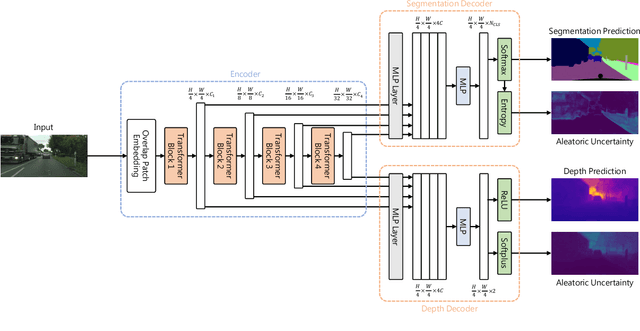
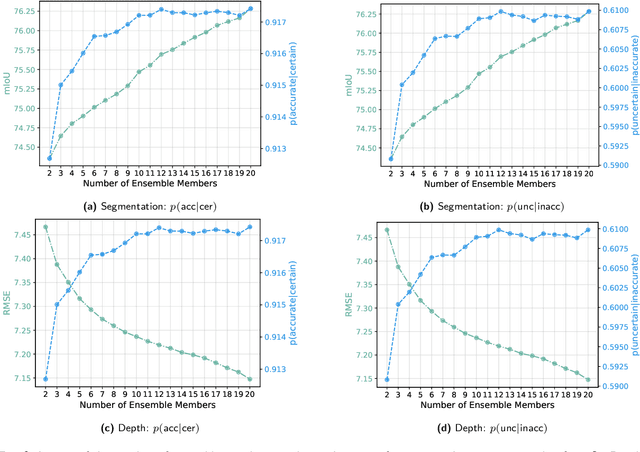
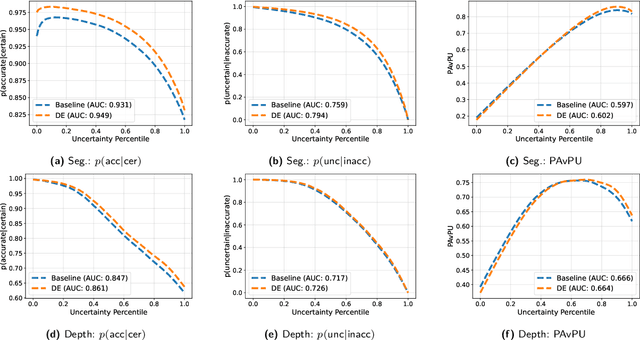
While a number of promising uncertainty quantification methods have been proposed to address the prevailing shortcomings of deep neural networks like overconfidence and lack of explainability, quantifying predictive uncertainties in the context of joint semantic segmentation and monocular depth estimation has not been explored yet. Since many real-world applications are multi-modal in nature and, hence, have the potential to benefit from multi-task learning, this is a substantial gap in current literature. To this end, we conduct a comprehensive series of experiments to study how multi-task learning influences the quality of uncertainty estimates in comparison to solving both tasks separately.
Novel View Synthesis with Neural Radiance Fields for Industrial Robot Applications
May 07, 2024Neural Radiance Fields (NeRFs) have become a rapidly growing research field with the potential to revolutionize typical photogrammetric workflows, such as those used for 3D scene reconstruction. As input, NeRFs require multi-view images with corresponding camera poses as well as the interior orientation. In the typical NeRF workflow, the camera poses and the interior orientation are estimated in advance with Structure from Motion (SfM). But the quality of the resulting novel views, which depends on different parameters such as the number and distribution of available images, as well as the accuracy of the related camera poses and interior orientation, is difficult to predict. In addition, SfM is a time-consuming pre-processing step, and its quality strongly depends on the image content. Furthermore, the undefined scaling factor of SfM hinders subsequent steps in which metric information is required. In this paper, we evaluate the potential of NeRFs for industrial robot applications. We propose an alternative to SfM pre-processing: we capture the input images with a calibrated camera that is attached to the end effector of an industrial robot and determine accurate camera poses with metric scale based on the robot kinematics. We then investigate the quality of the novel views by comparing them to ground truth, and by computing an internal quality measure based on ensemble methods. For evaluation purposes, we acquire multiple datasets that pose challenges for reconstruction typical of industrial applications, like reflective objects, poor texture, and fine structures. We show that the robot-based pose determination reaches similar accuracy as SfM in non-demanding cases, while having clear advantages in more challenging scenarios. Finally, we present first results of applying the ensemble method to estimate the quality of the synthetic novel view in the absence of a ground truth.
HoloGS: Instant Depth-based 3D Gaussian Splatting with Microsoft HoloLens 2
May 03, 2024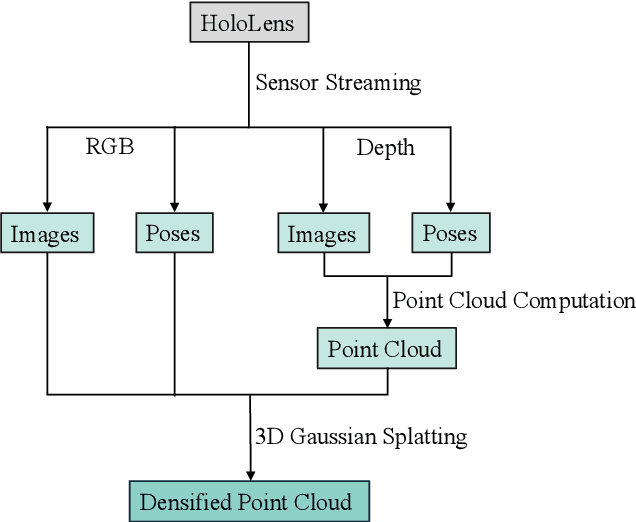
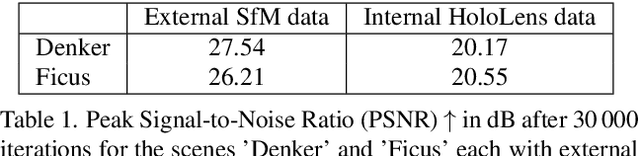
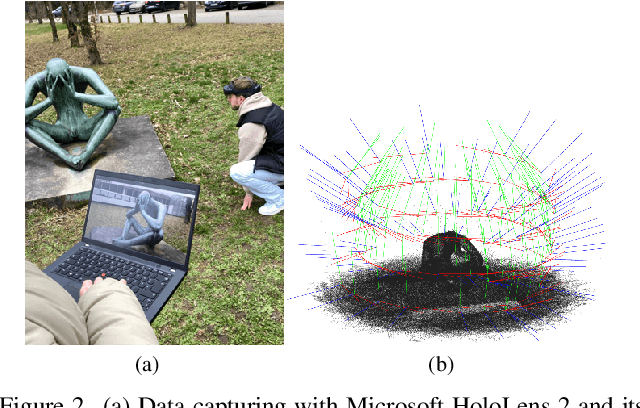

In the fields of photogrammetry, computer vision and computer graphics, the task of neural 3D scene reconstruction has led to the exploration of various techniques. Among these, 3D Gaussian Splatting stands out for its explicit representation of scenes using 3D Gaussians, making it appealing for tasks like 3D point cloud extraction and surface reconstruction. Motivated by its potential, we address the domain of 3D scene reconstruction, aiming to leverage the capabilities of the Microsoft HoloLens 2 for instant 3D Gaussian Splatting. We present HoloGS, a novel workflow utilizing HoloLens sensor data, which bypasses the need for pre-processing steps like Structure from Motion by instantly accessing the required input data i.e. the images, camera poses and the point cloud from depth sensing. We provide comprehensive investigations, including the training process and the rendering quality, assessed through the Peak Signal-to-Noise Ratio, and the geometric 3D accuracy of the densified point cloud from Gaussian centers, measured by Chamfer Distance. We evaluate our approach on two self-captured scenes: An outdoor scene of a cultural heritage statue and an indoor scene of a fine-structured plant. Our results show that the HoloLens data, including RGB images, corresponding camera poses, and depth sensing based point clouds to initialize the Gaussians, are suitable as input for 3D Gaussian Splatting.
Uncertainty Quantification with Deep Ensembles for 6D Object Pose Estimation
Mar 12, 2024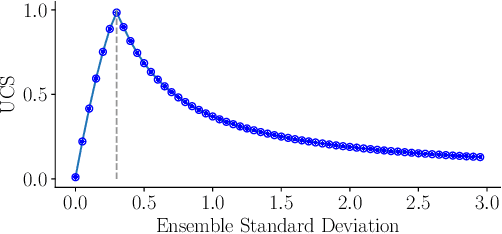
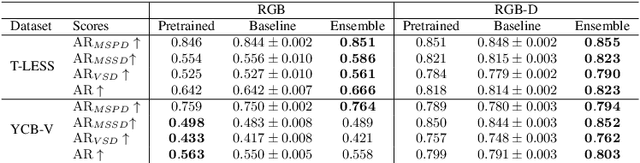
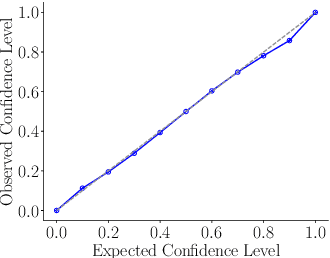
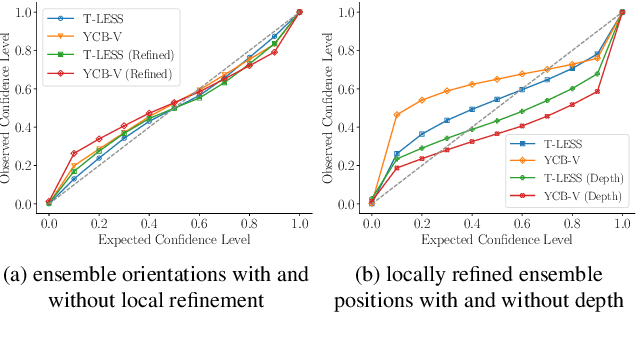
The estimation of 6D object poses is a fundamental task in many computer vision applications. Particularly, in high risk scenarios such as human-robot interaction, industrial inspection, and automation, reliable pose estimates are crucial. In the last years, increasingly accurate and robust deep-learning-based approaches for 6D object pose estimation have been proposed. Many top-performing methods are not end-to-end trainable but consist of multiple stages. In the context of deep uncertainty quantification, deep ensembles are considered as state of the art since they have been proven to produce well-calibrated and robust uncertainty estimates. However, deep ensembles can only be applied to methods that can be trained end-to-end. In this work, we propose a method to quantify the uncertainty of multi-stage 6D object pose estimation approaches with deep ensembles. For the implementation, we choose SurfEmb as representative, since it is one of the top-performing 6D object pose estimation approaches in the BOP Challenge 2022. We apply established metrics and concepts for deep uncertainty quantification to evaluate the results. Furthermore, we propose a novel uncertainty calibration score for regression tasks to quantify the quality of the estimated uncertainty.
Efficient Multi-task Uncertainties for Joint Semantic Segmentation and Monocular Depth Estimation
Feb 16, 2024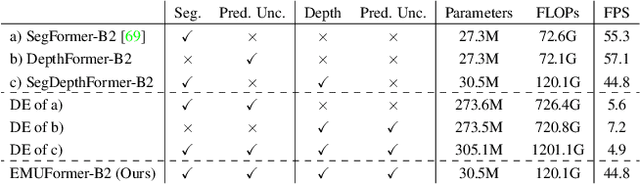
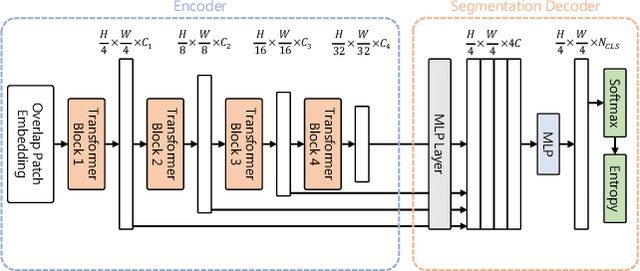
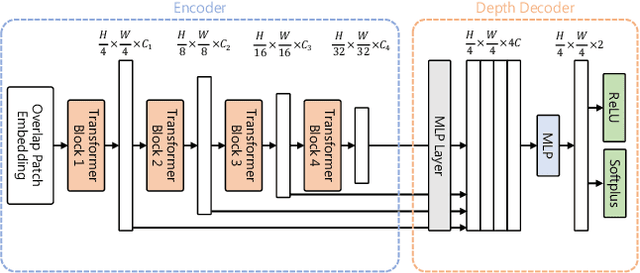
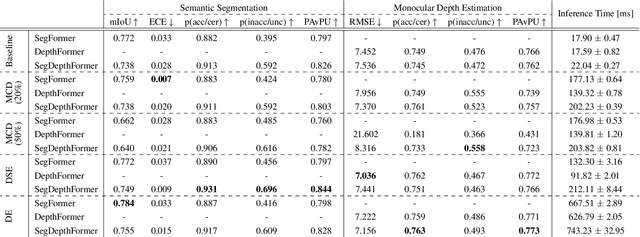
Quantifying the predictive uncertainty emerged as a possible solution to common challenges like overconfidence or lack of explainability and robustness of deep neural networks, albeit one that is often computationally expensive. Many real-world applications are multi-modal in nature and hence benefit from multi-task learning. In autonomous driving, for example, the joint solution of semantic segmentation and monocular depth estimation has proven to be valuable. In this work, we first combine different uncertainty quantification methods with joint semantic segmentation and monocular depth estimation and evaluate how they perform in comparison to each other. Additionally, we reveal the benefits of multi-task learning with regard to the uncertainty quality compared to solving both tasks separately. Based on these insights, we introduce EMUFormer, a novel student-teacher distillation approach for joint semantic segmentation and monocular depth estimation as well as efficient multi-task uncertainty quantification. By implicitly leveraging the predictive uncertainties of the teacher, EMUFormer achieves new state-of-the-art results on Cityscapes and NYUv2 and additionally estimates high-quality predictive uncertainties for both tasks that are comparable or superior to a Deep Ensemble despite being an order of magnitude more efficient.