 Add to Chrome
 Add to Firefox
 Add to Edge
Don't double it: Efficient Agent Prediction in Occlusions
Jan 29, 2026
Occluded traffic agents pose a significant challenge for autonomous vehicles, as hidden pedestrians or vehicles can appear unexpectedly, yet this problem remains understudied. Existing learning-based methods, while capable of inferring the presence of hidden agents, often produce redundant occupancy predictions where a single agent is identified multiple times. This issue complicates downstream planning and increases computational load. To address this, we introduce MatchInformer, a novel transformer-based approach that builds on the state-of-the-art SceneInformer architecture. Our method improves upon prior work by integrating Hungarian Matching, a state-of-the-art object matching algorithm from object detection, into the training process to enforce a one-to-one correspondence between predictions and ground truth, thereby reducing redundancy. We further refine trajectory forecasts by decoupling an agent's heading from its motion, a strategy that improves the accuracy and interpretability of predicted paths. To better handle class imbalances, we propose using the Matthews Correlation Coefficient (MCC) to evaluate occupancy predictions. By considering all entries in the confusion matrix, MCC provides a robust measure even in sparse or imbalanced scenarios. Experiments on the Waymo Open Motion Dataset demonstrate that our approach improves reasoning about occluded regions and produces more accurate trajectory forecasts than prior methods.

Scaling Planning for Automated Driving using Simplistic Synthetic Data
May 30, 2023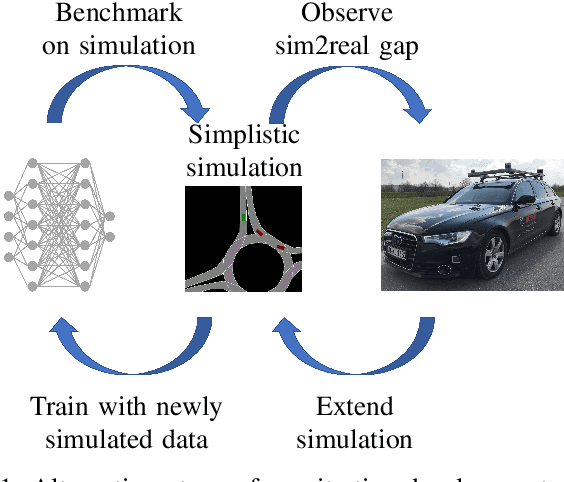
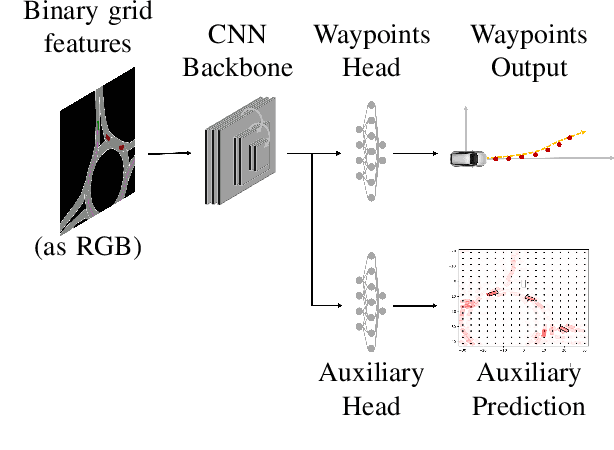
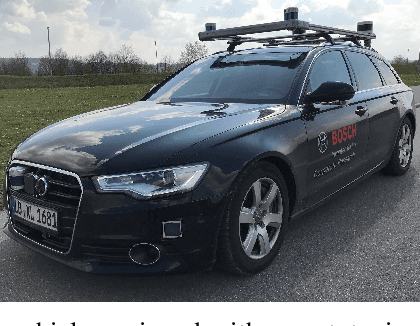

We challenge the perceived consensus that the application of deep learning to solve the automated driving planning task requires a huge amount of real-world data or a realistic simulator. Using a roundabout scenario, we show that this requirement can be relaxed in favour of targeted, simplistic simulated data. A benefit is that such data can be easily generated for critical scenarios that are typically underrepresented in realistic datasets. By applying vanilla behavioural cloning almost exclusively to lightweight simulated data, we achieve reliable and comfortable real-world driving. Our key insight lies in an incremental development approach that includes regular in-vehicle testing to identify sim-to-real gaps, targeted data augmentation, and training scenario variations. In addition to the methodology, we offer practical guidelines for deploying such a policy within a real-world vehicle, along with insights of the resulting qualitative driving behaviour. This approach serves as a blueprint for many automated driving use cases, providing valuable insights for future research and helping develop efficient and effective solutions.