 Add to Chrome
 Add to Firefox
 Add to Edge
SuperADD: Training-free Class-agnostic Anomaly Segmentation -- CVPR 2026 VAND 4.0 Workshop Challenge Industrial Track
May 14, 2026
Visual anomaly detection (AD) for industrial inspection is a highly relevant task in modern production environments. The problem becomes particularly challenging when training and deployment data differ due to changes in acquisition conditions during production. In the VAND 4.0 Industrial Track, models must remain robust under distribution shifts such as varying illumination and their performance is assessed on the MVTec AD 2 dataset. To address this setting, we propose a training-free and class-agnostic anomaly detection pipeline based on the work of SuperAD. Our approach improves generalization through several modifications designed to enhance robustness under distribution shifts. These adaptations include using a DINOv3 backbone, overlapping patch-wise processing, intensity-based augmentations, improved memory-bank subsampling for better coverage of the data distribution, and iterative morphological closing for cleaner and more spatially consistent anomaly maps. Unlike methods that rely on class-specific architectures or per-class hyperparameter tuning, our method uses a single architecture and one shared hyperparameter configuration across all object classes. This makes the approach well suited for industrial deployment, where product variants and appearance changes must be handled with minimal adaptation effort. We achieve segmentation F1 scores of $62.61\%$, $57.42\%$, and $54.35\%$ on test public, private, and private mixed of MVTec AD 2 respectively, thereby outperforming SuperAD and other state-of-the-art methods. Code is available at https://github.com/LukasRoom/SuperADD.

Bidirectional Cross-Attention Fusion of High-Res RGB and Low-Res HSI for Multimodal Automated Waste Sorting
Mar 14, 2026Growing waste streams and the transition to a circular economy require efficient automated waste sorting. In industrial settings, materials move on fast conveyor belts, where reliable identification and ejection demand pixel-accurate segmentation. RGB imaging delivers high-resolution spatial detail, which is essential for accurate segmentation, but it confuses materials that look similar in the visible spectrum. Hyperspectral imaging (HSI) provides spectral signatures that separate such materials, yet its lower spatial resolution limits detail. Effective waste sorting therefore needs methods that fuse both modalities to exploit their complementary strengths. We present Bidirectional Cross-Attention Fusion (BCAF), which aligns high-resolution RGB with low-resolution HSI at their native grids via localized, bidirectional cross-attention, avoiding pre-upsampling or early spectral collapse. BCAF uses two independent backbones: a standard Swin Transformer for RGB and an HSI-adapted Swin backbone that preserves spectral structure through 3D tokenization with spectral self-attention. We also analyze trade-offs between RGB input resolution and the number of HSI spectral slices. Although our evaluation targets RGB-HSI fusion, BCAF is modality-agnostic and applies to co-registered RGB with lower-resolution, high-channel auxiliary sensors. On the benchmark SpectralWaste dataset, BCAF achieves state-of-the-art performance of 76.4% mIoU at 31 images/s and 75.4% mIoU at 55 images/s. We further evaluate a novel industrial dataset: K3I-Cycling (first RGB subset already released on Fordatis). On this dataset, BCAF reaches 62.3% mIoU for material segmentation (paper, metal, plastic, etc.) and 66.2% mIoU for plastic-type segmentation (PET, PP, HDPE, LDPE, PS, etc.).
Bayesian Optimization of Process Parameters of a Sensor-Based Sorting System using Gaussian Processes as Surrogate Models
Jul 30, 2025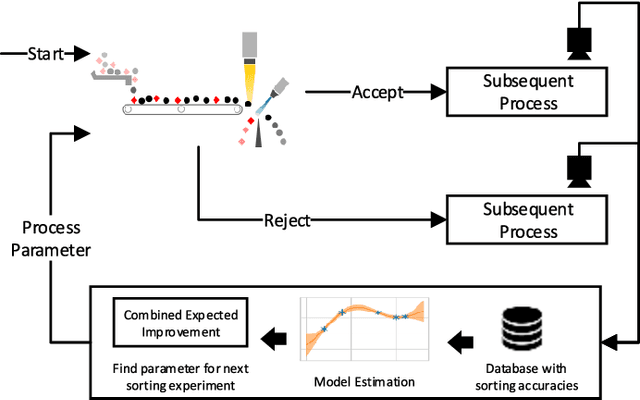
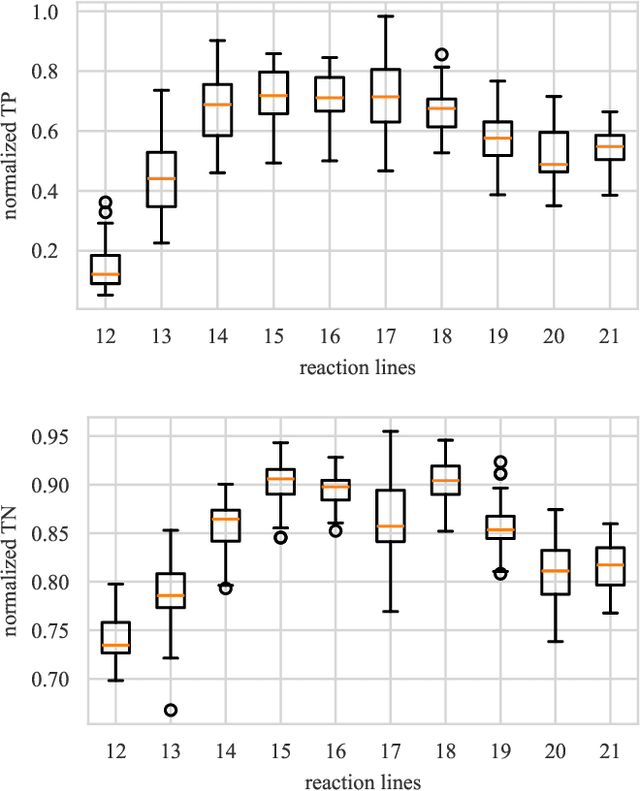
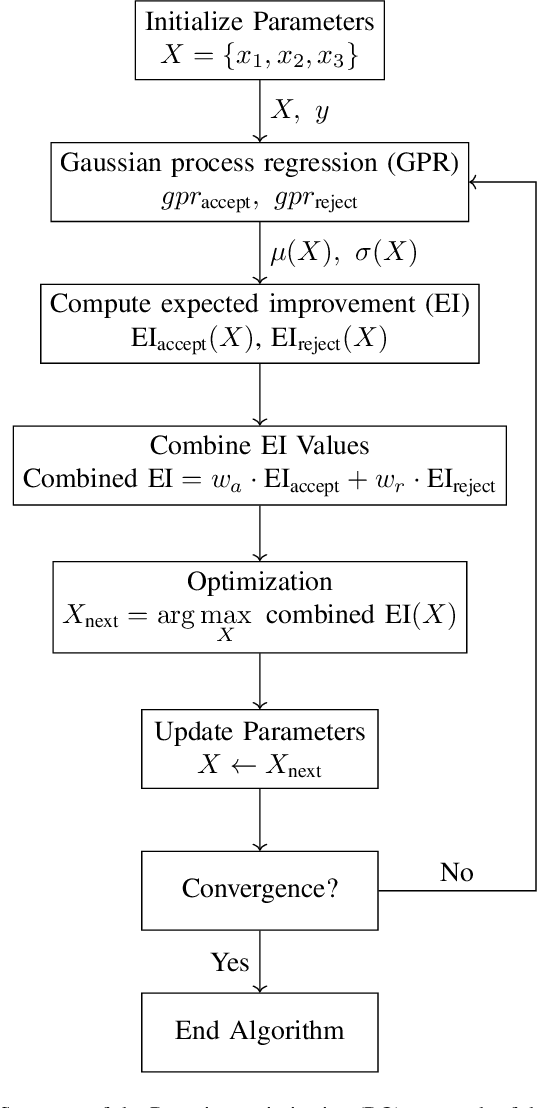
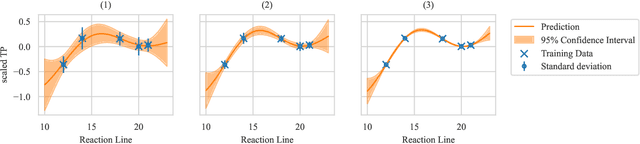
Sensor-based sorting systems enable the physical separation of a material stream into two fractions. The sorting decision is based on the image data evaluation of the sensors used and is carried out using actuators. Various process parameters must be set depending on the properties of the material stream, the dimensioning of the system, and the required sorting accuracy. However, continuous verification and re-adjustment are necessary due to changing requirements and material stream compositions. In this paper, we introduce an approach for optimizing, recurrently monitoring and adjusting the process parameters of a sensor-based sorting system. Based on Bayesian Optimization, Gaussian process regression models are used as surrogate models to achieve specific requirements for system behavior with the uncertainties contained therein. This method minimizes the number of necessary experiments while simultaneously considering two possible optimization targets based on the requirements for both material output streams. In addition, uncertainties are considered during determining sorting accuracies in the model calculation. We evaluated the method with three example process parameters.