 Add to Chrome
 Add to Firefox
 Add to Edge
Microcosmos: Reimagining Artificial Life for the GPU Era
Jul 03, 2026
Most artificial life simulators either operate on abstract substrates disconnected from physical reality, or simulate physically grounded worlds that do not scale to the population sizes required for open-ended evolution. We present Microcosmos, a simulation engine in which artificial lifeforms are modeled as elastic filament chains inhabiting a two-dimensional viscous fluid world, designed from the ground up for modern GPU hardware and end-to-end differentiable simulation. We validate the engine through four experiments. Hand-designed locomotion strategies confirm that the fluid coupling respects known physical constraints. Gradient-based optimization of filament folding demonstrates both the full differentiability of the simulator and the expressivity of the filament encodings. Neuroevolution and quality-diversity search produce a wide range of swimming and chemotaxis behaviors automatically. Linear scaling with particle count confirms the engine supports large-scale simulation. Microcosmos is released as an open platform with the long-term goal of supporting large-scale open-ended evolutionary simulations, designed to be physically plausible and computationally scalable.

Teacher Guided Architecture Search
Aug 04, 2018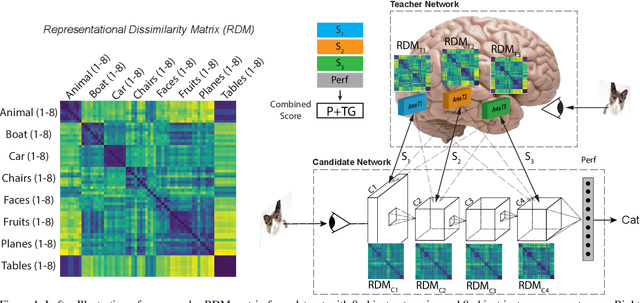
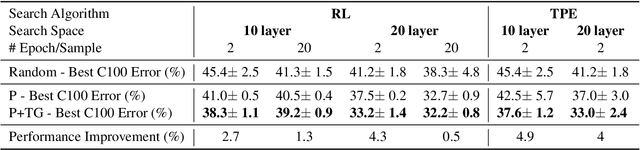
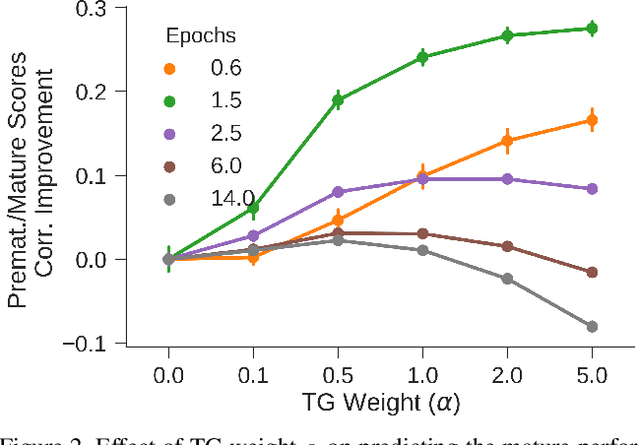

Strong improvements in network performance in vision tasks have resulted from the search of alternative network architectures, and prior work has shown that this search process can be automated and guided by evaluating candidate network performance following limited training (Performance Guided Architecture Search or PGAS). However, because of the large architecture search spaces and the high computational cost associated with evaluating each candidate model, further gains in computational efficiency are needed. Here we present a method termed Teacher Guided Search for Architectures by Generation and Evaluation (TG-SAGE) that produces up to an order of magnitude in search efficiency over PGAS methods. Specifically, TG-SAGE guides each step of the architecture search by evaluating the similarity of internal representations of the candidate networks with those of the (fixed) teacher network. We show that this procedure leads to significant reduction in required per-sample training and that, this advantage holds for two different search spaces of architectures, and two different search algorithms. We further show that in the space of convolutional cells for visual categorization, TG-SAGE finds a cell structure with similar performance as was previously found using other methods but at a total computational cost that is two orders of magnitude lower than Neural Architecture Search (NAS) and more than four times lower than progressive neural architecture search (PNAS). These results suggest that TG-SAGE can be used to accelerate network architecture search in cases where one has access to some or all of the internal representations of a teacher network of interest, such as the brain.