 Add to Chrome
 Add to Firefox
 Add to Edge
Unifying quantum measurement constructions via a relative-entropy minimum change principle
Aug 04, 2026
The minimum change principle provides an information-theoretic characterization of the Bayes reversal channel in classical probability theory and has recently been proposed as a framework for extending Bayes' rule to quantum information theory. Using quantum relative entropy, we investigate a minimum change principle for the setting of quantum statistical inference. Specifically, we consider a forward process based on a classical-to-quantum preparation channel and a reverse process based on a quantum-to-classical measurement channel. We establish a closed-form characterization of measurements that are optimal for this principle, and this optimal measurement can be found via a dual formulation involving a single unconstrained Hermitian variable. This perspective allows us to recover some notable measurements within the same framework, including pretty good measurements and Fermi-Dirac thermal measurements, and we use it to discover a novel family that we call softmin thermal measurements. We further show that softmin thermal measurements arise as optimal solutions to entropy-regularized semidefinite optimization problems, demonstrating that they play a role for measurements analogous to that of thermal states in statistical mechanics. Finally, we prove an additivity property for the relative-entropy minimum change principle and investigate the performance of Fermi-Dirac thermal measurements for quantum hypothesis testing.

Canonical quantization of neurons
Jul 06, 2026Canonical quantization provides a systematic procedure for constructing quantum models from classical Hamiltonians. Here, we apply this principle to a fundamental computational primitive of machine learning: the neuron. Specifically, by viewing a neuron as a composition of an energy function and an activation function, we quantize this model by replacing the energy function with a quantum Hamiltonian and applying the activation function to it through matrix functional calculus. This results in an activation observable that can be measured on an input quantum state. We investigate the use of these quantized neurons for function approximation, where the objective is to learn an unknown observable from labeled quantum data. For this purpose, we develop hybrid quantum-classical algorithms for training and evaluation, including procedures for measuring the activation observable and estimating gradients of the squared loss error. Our algorithms for gradient estimation rely on basic primitives like classical random sampling, the Hadamard test, and Hamiltonian simulation, and those for measuring an activation observable rely on quantum algorithms known as the power of one qumode and Schroedingerization. Numerical experiments demonstrate that our quantized neurons exhibit enhanced expressive capabilities relative to corresponding classical neurons on representative learning tasks. Our work establishes canonical quantization as a principled framework for constructing quantum machine learning primitives and provides a foundation for developing neural architectures tailored to quantum data.
Quantum Spectral Anomaly Detection
Jul 06, 2026A core task in quantum anomaly detection is to compute an anomaly score that quantifies how strongly a test quantum state deviates from a given quantum dataset assumed to be normal. Classically, principal component analysis (PCA) for centered data computes the anomaly score by evaluating the test sample relative to the subspace spanned by the selected leading eigenvectors. However, for quantum data that lack a standard centering, explicitly recovering principal eigenvectors, constructing full Gram matrices, or loading quantum-random-access-memory-style data can be more costly than estimating the anomaly score itself. To avoid these costs, we propose Quantum Spectral Anomaly Detection (QSPADE), which computes PCA-like anomaly scores directly from the spectrum of the average state of the normal dataset. By replacing hard PCA rank selection with a smooth, temperature-controlled spectral threshold, QSPADE makes near-threshold spectral components contribute partially to the anomaly score. This makes the score vary continuously rather than jump when a borderline component is included or excluded, and makes it less sensitive to noise or arbitrary hard cutoffs near the threshold. In the zero-temperature limit, QSPADE recovers the hard-projector PCA score. The proposed measurement-based quantum detector can be calibrated with a sample complexity independent of the data dimension. Numerical simulations show that QSPADE behaves like kernel-PCA on encoded classical data and detects changes across a transverse-field Ising transition without predefined order parameters. Consequently, QSPADE gives an efficient framework for both quantum-kernel anomaly detection on encoded classical data and the monitoring of quantum-native systems where diagnostic observables are unknown.
Quantum principal component analysis without eigenvector recovery
May 27, 2026Principal component analysis (PCA) is traditionally implemented through a covariance or kernel matrix, leading-eigenvector extraction, and hard rank-$k$ projection. These steps can be computationally costly in high-dimensional and quantum-data settings, sensitive to small eigengaps, and unnecessary when downstream tasks only require principal-subspace scores. Such score-based objectives are important in applications such as anomaly detection, spectral-energy profiling, and other postselection tasks. To address these needs, we introduce a measurement-based soft PCA framework replacing the hard top-$k$ projector with an entropy-regularized Fermi--Dirac filter. This filter is the unique optimizer of an entropy-regularized variational formulation of PCA and converges to the classical PCA projector in the zero-temperature limit. This filter has a direct interpretation as a quantum measurement, which naturally suggests a quantum approach. For centered covariance operators represented by quantum feature states, a single fixed circuit, together with threshold calibration, accesses all optimal filters for different rank budgets or retained-variance levels without rank-dependent circuit updates or eigenvector recovery. For new inputs, the same calibrated quantum circuit yields soft principal subspace scores, spectral energy profiles, and postselected filtered states. The required centering of both training and test data is performed coherently inside the quantum protocol, which is particularly important for quantum data where no classical feature vectors or centered Gram matrix are directly available. By reframing PCA as a calibrated measurement task, this framework bypasses the need for iterative eigenvector extraction and achieves a dimension-independent sample complexity $O(η^{-2})$ for normalized fractional-rank or retained variance scoring at additive accuracy $η$.
Fermi-Dirac machines as quantizations of neurons
May 23, 2026Fermi-Dirac machines were proposed recently as an approach to solving semidefinite optimization problems on quantum computers. Here, we reinterpret them as canonical quantizations of classical neurons. By viewing a classical neuron as an activation function applied to a parameterized classical Hamiltonian, we quantize this model by replacing classical variables with operators whose eigenvalues encode their possible values. This follows the standard approach to canonical quantization in quantum mechanics. Crucially, when the Hamiltonian consists of commuting operators, our construction reduces exactly to a classical neuron. More generally, our approach yields an activation observable, defined as an activation function applied to a parameterized quantum Hamiltonian. The output of this quantized neuron is a random variable with expectation value equal to that of the activation observable with respect to an input state. We develop efficient hybrid quantum-classical algorithms for evaluating outputs and gradients of our quantized neurons, enabling evaluation and training. These algorithms rely on basic primitives that include random sampling, Hamiltonian simulation, and the Hadamard test. We also quantize a whole host of other activation functions, including the smooth rectified linear unit (ReLU), sigmoid linear unit, Gaussian-smoothed ReLU, and Gaussian error linear unit (GeLU), which are known to be useful for deep learning applications. Numerical experiments indicate that neurons based on quantum Hamiltonians can learn functions that classical neurons cannot. We further define a computational decision problem based on Fermi-Dirac neurons and prove that it is BQP-complete, providing complexity-theoretic evidence against efficient classical simulation. Finally, we generalize our approach to continuous quantum variables and sketch two different ways of composing these neurons into networks.
Fermi-Dirac thermal measurements: A framework for quantum hypothesis testing and semidefinite optimization
Mar 04, 2026Quantum measurements are the means by which we recover messages encoded into quantum states. They are at the forefront of quantum hypothesis testing, wherein the goal is to perform an optimal measurement for arriving at a correct conclusion. Mathematically, a measurement operator is Hermitian with eigenvalues in [0,1]. By noticing that this constraint on each eigenvalue is the same as that imposed on fermions by the Pauli exclusion principle, we interpret every eigenmode of a measurement operator as an independent effective fermionic mode. Under this perspective, various objective functions in quantum hypothesis testing can be viewed as the total expected energy associated with these fermionic occupation numbers. By instead fixing a temperature and minimizing the total expected fermionic free energy, we find that optimal measurements for these modified objective functions are Fermi-Dirac thermal measurements, wherein their eigenvalues are specified by Fermi-Dirac distributions. In the low-temperature limit, their performance closely approximates that of optimal measurements for quantum hypothesis testing, and we show that their parameters can be learned by classical or hybrid quantum-classical optimization algorithms. This leads to a new quantum machine-learning model, termed Fermi-Dirac machines, consisting of parameterized Fermi-Dirac thermal measurements-an alternative to quantum Boltzmann machines based on thermal states. Beyond hypothesis testing, we show how general semidefinite optimization problems can be solved using this approach, leading to a novel paradigm for semidefinite optimization on quantum computers, in which the goal is to implement thermal measurements rather than prepare thermal states. Finally, we propose quantum algorithms for implementing Fermi-Dirac thermal measurements, and we also propose second-order hybrid quantum-classical optimization algorithms.
Fundamentals of quantum Boltzmann machine learning with visible and hidden units
Dec 22, 2025One of the primary applications of classical Boltzmann machines is generative modeling, wherein the goal is to tune the parameters of a model distribution so that it closely approximates a target distribution. Training relies on estimating the gradient of the relative entropy between the target and model distributions, a task that is well understood when the classical Boltzmann machine has both visible and hidden units. For some years now, it has been an obstacle to generalize this finding to quantum state learning with quantum Boltzmann machines that have both visible and hidden units. In this paper, I derive an analytical expression for the gradient of the quantum relative entropy between a target quantum state and the reduced state of the visible units of a quantum Boltzmann machine. Crucially, this expression is amenable to estimation on a quantum computer, as it involves modular-flow-generated unitary rotations reminiscent of those appearing in my prior work on rotated Petz recovery maps. This leads to a quantum algorithm for gradient estimation in this setting. I then specialize the setting to quantum visible units and classical hidden units, and vice versa, and provide analytical expressions for the gradients, along with quantum algorithms for estimating them. Finally, I replace the quantum relative entropy objective function with the Petz-Tsallis relative entropy; here I develop an analytical expression for the gradient and sketch a quantum algorithm for estimating it, as an application of a novel formula for the derivative of the matrix power function, which also involves modular-flow-generated unitary rotations. Ultimately, this paper demarcates progress in training quantum Boltzmann machines with visible and hidden units for generative modeling and quantum state learning.
Quantum Fisher information matrices from Rényi relative entropies
Oct 02, 2025Quantum generalizations of the Fisher information are important in quantum information science, with applications in high energy and condensed matter physics and in quantum estimation theory, machine learning, and optimization. One can derive a quantum generalization of the Fisher information matrix in a natural way as the Hessian matrix arising in a Taylor expansion of a smooth divergence. Such an approach is appealing for quantum information theorists, given the ubiquity of divergences in quantum information theory. In contrast to the classical case, there is not a unique quantum generalization of the Fisher information matrix, similar to how there is not a unique quantum generalization of the relative entropy or the R\'enyi relative entropy. In this paper, I derive information matrices arising from the log-Euclidean, $\alpha$-$z$, and geometric R\'enyi relative entropies, with the main technical tool for doing so being the method of divided differences for calculating matrix derivatives. Interestingly, for all non-negative values of the R\'enyi parameter $\alpha$, the log-Euclidean R\'enyi relative entropy leads to the Kubo-Mori information matrix, and the geometric R\'enyi relative entropy leads to the right-logarithmic derivative Fisher information matrix. Thus, the resulting information matrices obey the data-processing inequality for all non-negative values of the R\'enyi parameter $\alpha$ even though the original quantities do not. Additionally, I derive and establish basic properties of $\alpha$-$z$ information matrices resulting from the $\alpha$-$z$ R\'enyi relative entropies. For parameterized thermal states, I establish formulas for their $\alpha$-$z$ information matrices and hybrid quantum-classical algorithms for estimating them, with applications in quantum Boltzmann machine learning.
Constrained free energy minimization for the design of thermal states and stabilizer thermodynamic systems
Aug 12, 2025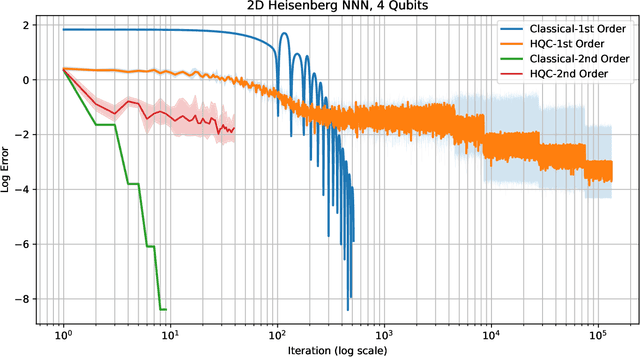
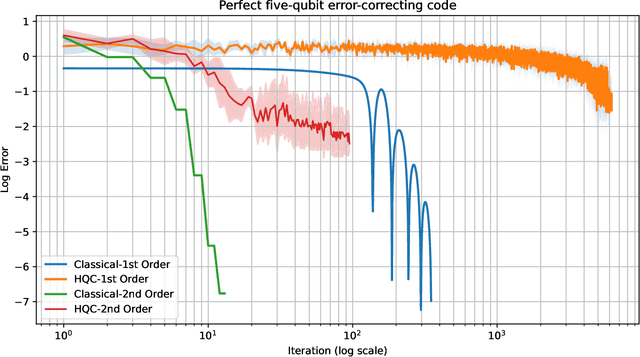
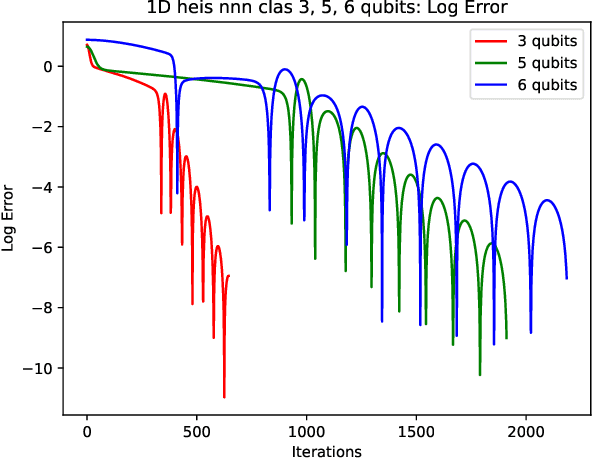
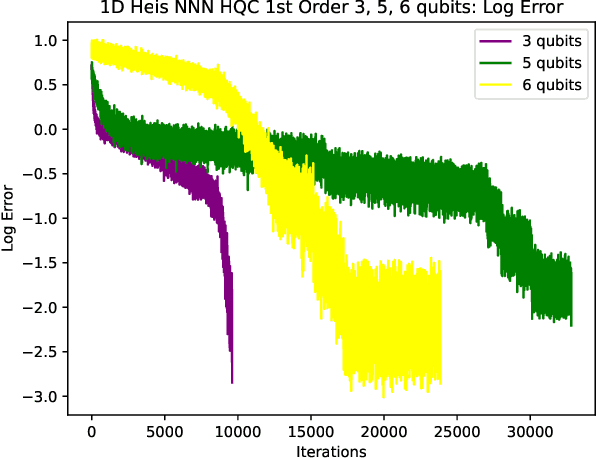
A quantum thermodynamic system is described by a Hamiltonian and a list of conserved, non-commuting charges, and a fundamental goal is to determine the minimum energy of the system subject to constraints on the charges. Recently, [Liu et al., arXiv:2505.04514] proposed first- and second-order classical and hybrid quantum-classical algorithms for solving a dual chemical potential maximization problem, and they proved that these algorithms converge to global optima by means of gradient-ascent approaches. In this paper, we benchmark these algorithms on several problems of interest in thermodynamics, including one- and two-dimensional quantum Heisenberg models with nearest and next-to-nearest neighbor interactions and with the charges set to the total $x$, $y$, and $z$ magnetizations. We also offer an alternative compelling interpretation of these algorithms as methods for designing ground and thermal states of controllable Hamiltonians, with potential applications in molecular and material design. Furthermore, we introduce stabilizer thermodynamic systems as thermodynamic systems based on stabilizer codes, with the Hamiltonian constructed from a given code's stabilizer operators and the charges constructed from the code's logical operators. We benchmark the aforementioned algorithms on several examples of stabilizer thermodynamic systems, including those constructed from the one-to-three-qubit repetition code, the perfect one-to-five-qubit code, and the two-to-four-qubit error-detecting code. Finally, we observe that the aforementioned hybrid quantum-classical algorithms, when applied to stabilizer thermodynamic systems, can serve as alternative methods for encoding qubits into stabilizer codes at a fixed temperature, and we provide an effective method for warm-starting these encoding algorithms whenever a single qubit is encoded into multiple physical qubits.
Quantum thermodynamics and semi-definite optimization
May 12, 2025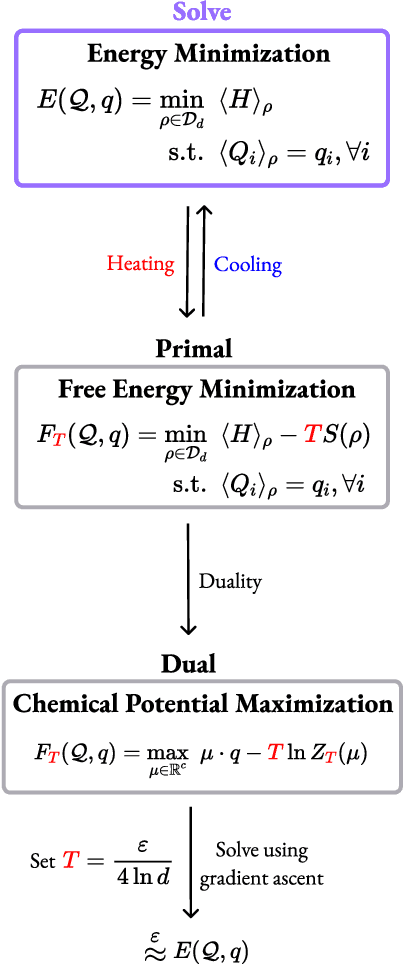
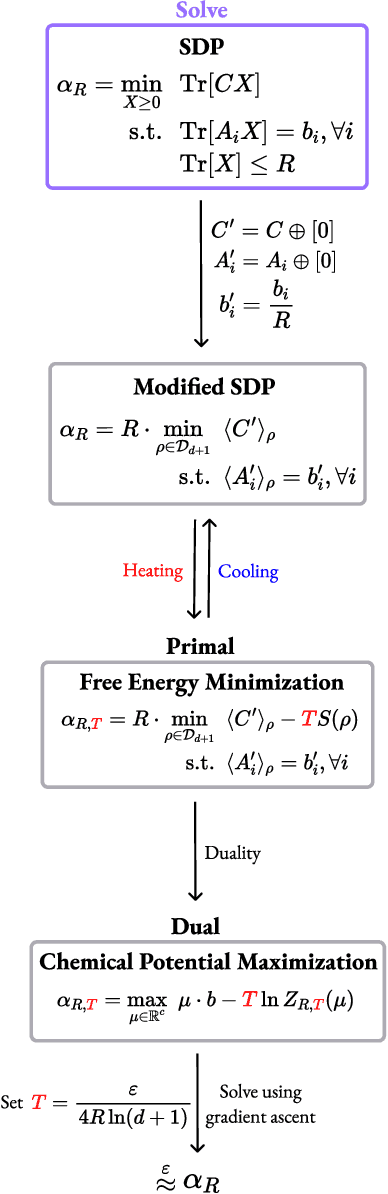
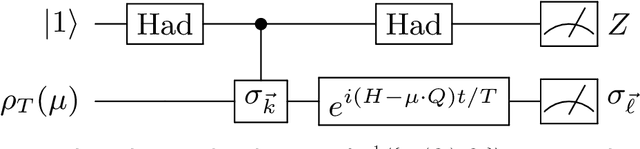
In quantum thermodynamics, a system is described by a Hamiltonian and a list of non-commuting charges representing conserved quantities like particle number or electric charge, and an important goal is to determine the system's minimum energy in the presence of these conserved charges. In optimization theory, a semi-definite program (SDP) involves a linear objective function optimized over the cone of positive semi-definite operators intersected with an affine space. These problems arise from differing motivations in the physics and optimization communities and are phrased using very different terminology, yet they are essentially identical mathematically. By adopting Jaynes' mindset motivated by quantum thermodynamics, we observe that minimizing free energy in the aforementioned thermodynamics problem, instead of energy, leads to an elegant solution in terms of a dual chemical potential maximization problem that is concave in the chemical potential parameters. As such, one can employ standard (stochastic) gradient ascent methods to find the optimal values of these parameters, and these methods are guaranteed to converge quickly. At low temperature, the minimum free energy provides an excellent approximation for the minimum energy. We then show how this Jaynes-inspired gradient-ascent approach can be used in both first- and second-order classical and hybrid quantum-classical algorithms for minimizing energy, and equivalently, how it can be used for solving SDPs, with guarantees on the runtimes of the algorithms. The approach discussed here is well grounded in quantum thermodynamics and, as such, provides physical motivation underpinning why algorithms published fifty years after Jaynes' seminal work, including the matrix multiplicative weights update method, the matrix exponentiated gradient update method, and their quantum algorithmic generalizations, perform well at solving SDPs.