 Add to Chrome
 Add to Firefox
 Add to Edge
Understanding Scam Trends and Rail Paths from Reddit Self-Disclosure Narratives
Jun 15, 2026
Online scam behavior is inherently multi-stage, and the lifecycle includes temporally ordered rails and events rather than isolated signals. Existing works analyze characteristics of scam types and rails, but they do not track scam trends across years. Moreover, the work on the relations between rails is hampered due to the lack of open-source datasets with annotations and coverage of different scam types. To address these gaps, we build a dataset to analyze the yearly trend of scam characteristics and rail paths using Reddit self-disclosure narratives from 2023 to 2025. We collect 21,304 posts from scam-related subreddits with at least one rail among identity, communication, platform, and payment for trend analysis by heuristic annotation. Then, we label 1,800 posts containing explicit or recoverable scam chains by an LLM-assisted method for scam path analysis. The method is evaluated with human annotation. Lastly, we run a topic model on the comments of the posts to analyze the community support behavior. The results reveal that scam processes are predominantly multi-rail. Across years, different scam types and rail components dominate. Different scam types vary systematically in path complexity. Reddit support behaviors have become more detailed over time. This work supports synthetic scam chain data simulation and AI-related scam risk assessment, though findings may not generalise to other platforms.

A University Framework for the Responsible use of Generative AI in Research
Apr 30, 2024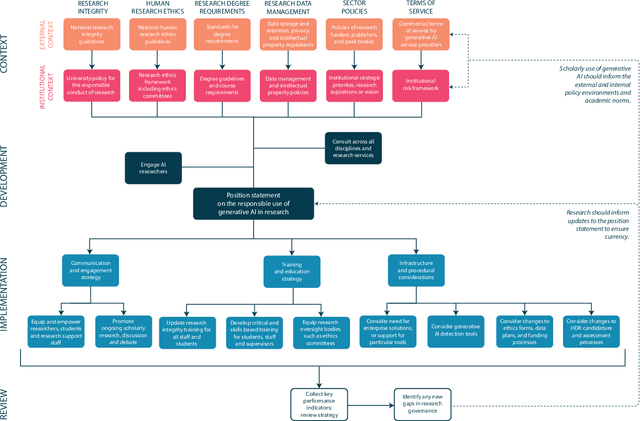
Generative Artificial Intelligence (generative AI) poses both opportunities and risks for the integrity of research. Universities must guide researchers in using generative AI responsibly, and in navigating a complex regulatory landscape subject to rapid change. By drawing on the experiences of two Australian universities, we propose a framework to help institutions promote and facilitate the responsible use of generative AI. We provide guidance to help distil the diverse regulatory environment into a principles-based position statement. Further, we explain how a position statement can then serve as a foundation for initiatives in training, communications, infrastructure, and process change. Despite the growing body of literature about AI's impact on academic integrity for undergraduate students, there has been comparatively little attention on the impacts of generative AI for research integrity, and the vital role of institutions in helping to address those challenges. This paper underscores the urgency for research institutions to take action in this area and suggests a practical and adaptable framework for so doing.