 Add to Chrome
 Add to Firefox
 Add to Edge
Scaling Interpretable Transformers with Parity Bottleneck Layers
Jul 22, 2026
Language models are thought to exhibit the phenomenon of superposition, representing many more features than dimensions in their residual streams. Sparse autoencoders (SAEs) are designed to recover such features post-hoc, but training models that are interpretable by construction has remained impractical, as a per-layer over-complete bottleneck is prohibitively expensive in both memory and compute. To overcome this issue, we introduce the ParityTransformer, a GPT-2-scale architecture whose intermediate representations are efficient and wide / sparse by design. At each layer, a Deep Parity Bottleneck (DPB) replaces a learned over-complete basis with a parameter-free algebraic dictionary, providing a deterministic incoherence guarantee and eliminating the memory requirements that have prevented per-layer interpretable bottlenecks at scale. A DPB is a hierarchically structured sparse bottleneck which efficiently enforces sparsity using a multi-level mixture-of-experts approach: a hardware-aware implementation that closes the cost gap between activation sparse and dense training to a manageable interpretability tax. Empirically, ParityTransformers perform at least as well as post-hoc SAEs on sparse probing tasks, while out-performing on measures of feature absorption, steering effectiveness, and fine-grained causal interventions. Because subsequent computation acts only on features that survive the sparse bottleneck, the ParityTransformer's features are native to the model's forwards pass by construction, addressing the question of whether SAEs probe features the model actually uses during computation. We see this as a step toward training models whose internal representations are interpretable by design rather than recovered post hoc.

Evaluating Stability of Unreflective Alignment
Aug 27, 2024Many theoretical obstacles to AI alignment are consequences of reflective stability - the problem of designing alignment mechanisms that the AI would not disable if given the option. However, problems stemming from reflective stability are not obviously present in current LLMs, leading to disagreement over whether they will need to be solved to enable safe delegation of cognitive labor. In this paper, we propose Counterfactual Priority Change (CPC) destabilization as a mechanism by which reflective stability problems may arise in future LLMs. We describe two risk factors for CPC-destabilization: 1) CPC-based stepping back and 2) preference instability. We develop preliminary evaluations for each of these risk factors, and apply them to frontier LLMs. Our findings indicate that in current LLMs, increased scale and capability are associated with increases in both CPC-based stepping back and preference instability, suggesting that CPC-destabilization may cause reflective stability problems in future LLMs.
EventScore: An Automated Real-time Early Warning Score for Clinical Events
Feb 14, 2021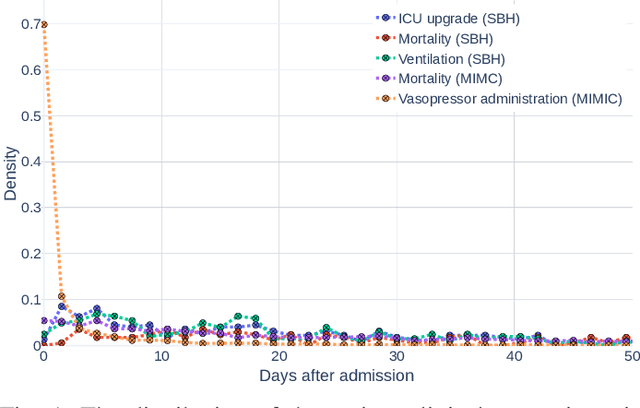
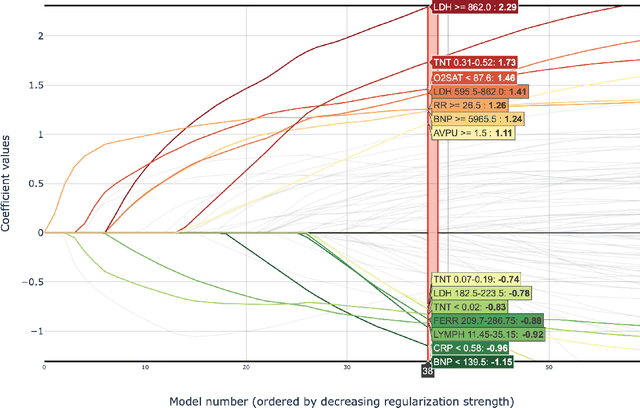
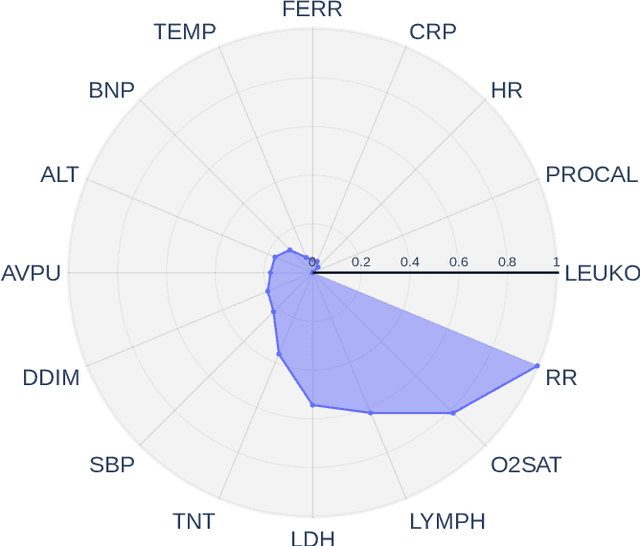
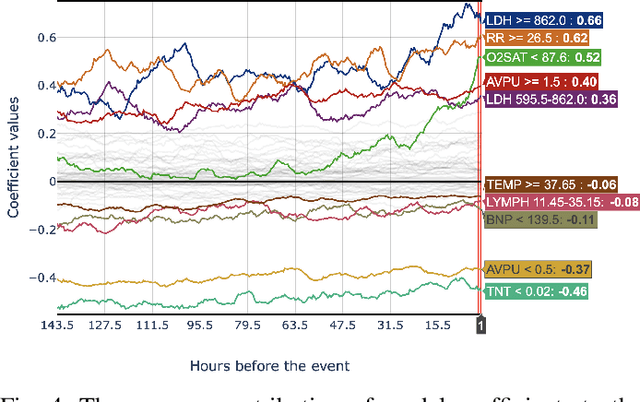
Early prediction of patients at risk of clinical deterioration can help physicians intervene and alter their clinical course towards better outcomes. In addition to the accuracy requirement, early warning systems must make the predictions early enough to give physicians enough time to intervene. Interpretability is also one of the challenges when building such systems since being able to justify the reasoning behind model decisions is desirable in clinical practice. In this work, we built an interpretable model for the early prediction of various adverse clinical events indicative of clinical deterioration. The model is evaluated on two datasets and four clinical events. The first dataset is collected in a predominantly COVID-19 positive population at Stony Brook Hospital. The second dataset is the MIMIC III dataset. The model was trained to provide early warning scores for ventilation, ICU transfer, and mortality prediction tasks on the Stony Brook Hospital dataset and to predict mortality and the need for vasopressors on the MIMIC III dataset. Our model first separates each feature into multiple ranges and then uses logistic regression with lasso penalization to select the subset of ranges for each feature. The model training is completely automated and doesn't require expert knowledge like other early warning scores. We compare our model to the Modified Early Warning Score (MEWS) and quick SOFA (qSOFA), commonly used in hospitals. We show that our model outperforms these models in the area under the receiver operating characteristic curve (AUROC) while having a similar or better median detection time on all clinical events, even when using fewer features. Unlike MEWS and qSOFA, our model can be entirely automated without requiring any manually recorded features. We also show that discretization improves model performance by comparing our model to a baseline logistic regression model.