 Add to Chrome
 Add to Firefox
 Add to Edge
Computationally Efficient Collaborative Communication Via Regularity-Based Coarsening
Aug 05, 2026
Our results show that the existence of a short high-utility protocol already suffices for efficient communication. In particular, in a game with $n$ possible observations and $m$ actions: (1) For any achievable target utility $α$, we give an algorithm with $\mathrm{poly}(n, m, 1/ε)$ runtime that designs a protocol achieving utility at least $α-ε$ using only $2^{\mathcal O(CC_α(G))}/ε^2$ bits of communication. Here, $CC_α(G)$ is the minimum number of bits used by any protocol, even a computationally inefficient one, to achieve utility $α$. (2) We prove that this exponential dependence on $CC_α(G)$ is tight up to a constant. That is, unless $\mathrm P=\mathrm{NP}$, no polynomial-time algorithm can in general find optimal protocols using fewer than $2^{CC_α(G) -2}$ bits. We note that our results strictly weaken the assumptions required by prior work in the multi-agent information aggregation literature, filling a gap that had remained elusive even for games with constant $CC_α(G)$. In particular, prior guarantees for agreement-based information aggregation rely on structural assumptions such as informational substitutes or weak learnability. We show that these assumptions already imply $CC_α(G) = O(1)$ and are therefore more restrictive conditions than required by our protocol to succeed. On a technical level, our results involve a novel strengthening of the Frieze-Kannan weak regularity lemma and yield the following powerful polynomial-time transformation tool: for every communication game $G$, it constructs a game $\hat G$ that is a coarsening of the agents' observation spaces into constant-size partitions, such that $G$ and $\hat G$ are indistinguishable with respect to every short communication protocol. This coarsening theorem is the engine behind our algorithm and may be of independent interest.

Provably Optimal Learning Algorithms for Assistance Games
Jul 09, 2026This paper studies an online variant of the assistance games framework, where an informed agent and an uninformed agent repeatedly interact over $T$ timesteps to optimize a common reward function. While the informed agent (the human) observes a latent state of the world, the uninformed agent (the assistant) observes only the human's actions. We provide the first provably efficient learning algorithms for repeated assistance games. We introduce the notion of assistance regret: the gap between the cumulative utility of interactions and that of the optimal joint policies in hindsight, which map latent states to action pairs. We present decentralized algorithms for both the human and the assistant that achieve a $(1-1/e)$-approximate assistance regret rate of $\widetilde{O}(T^{3/4})$, with runtime polynomial in the size of the action and state spaces. These algorithms are general; in particular, they accommodate any no-regret algorithm for the assistant. We prove that achieving a regret approximation factor better than $(1-1/e)$ is computationally intractable. Furthermore, we demonstrate how these generic no-regret algorithms can be tailored to a pseudo-decentralized setting -- using a shared random string -- to achieve a rate of $\widetilde{O}(T^{1/2})$, optimal up to logarithmic factors.
Learning the Preferences of a Learning Agent
May 09, 2026For AI systems to be useful to humans, they must understand and act in accordance with our values and preferences. Since specifying preferences is a hard task, inverse reinforcement learning (IRL) aims to develop methods that allow for inferring preferences from observed behavior. However, IRL assumes the human to be approximately optimal. This is a big limitation in cases where the human themselves may be learning to act optimally in an environment. In this paper, we formalize the problem of learning the preferences of a learning agent: a predictor observes a learner acting online and tries to infer the underlying reward function being (initially suboptimally) optimized by the learner. We model the learner as either being no-regret, or as converging to an optimal Boltzmann policy over time. In each of these settings, we establish theoretical guarantees for various preference learning algorithms, or otherwise show that such guarantees are impossible.
Will an AI with Private Information Allow Itself to Be Switched Off?
Nov 25, 2024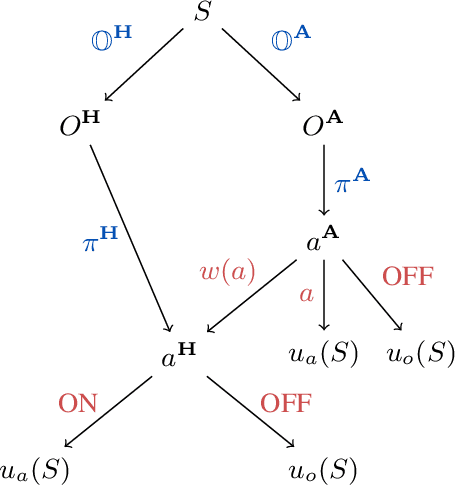
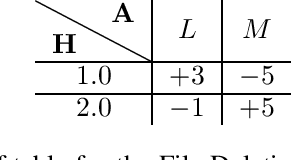
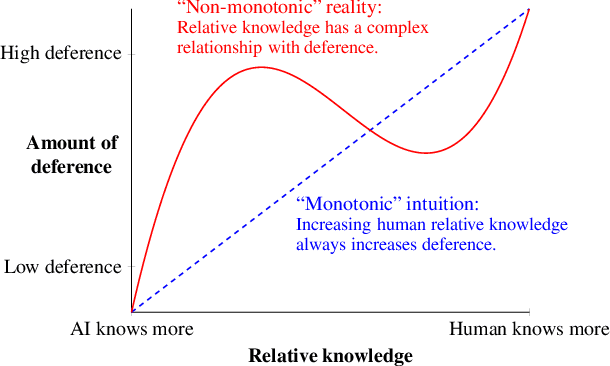
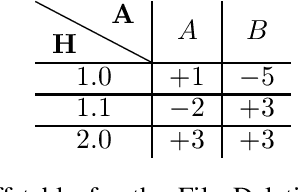
A wide variety of goals could cause an AI to disable its off switch because "you can't fetch the coffee if you're dead" (Russell 2019). Prior theoretical work on this shutdown problem assumes that humans know everything that AIs do. In practice, however, humans have only limited information. Moreover, in many of the settings where the shutdown problem is most concerning, AIs might have vast amounts of private information. To capture these differences in knowledge, we introduce the Partially Observable Off-Switch Game (POSG), a game-theoretic model of the shutdown problem with asymmetric information. Unlike when the human has full observability, we find that in optimal play, even AI agents assisting perfectly rational humans sometimes avoid shutdown. As expected, increasing the amount of communication or information available always increases (or leaves unchanged) the agents' expected common payoff. But counterintuitively, introducing bounded communication can make the AI defer to the human less in optimal play even though communication mitigates information asymmetry. In particular, communication sometimes enables new optimal behavior requiring strategic AI deference to achieve outcomes that were previously inaccessible. Thus, designing safe artificial agents in the presence of asymmetric information requires careful consideration of the tradeoffs between maximizing payoffs (potentially myopically) and maintaining AIs' incentives to defer to humans.
PID Accelerated Temporal Difference Algorithms
Jul 11, 2024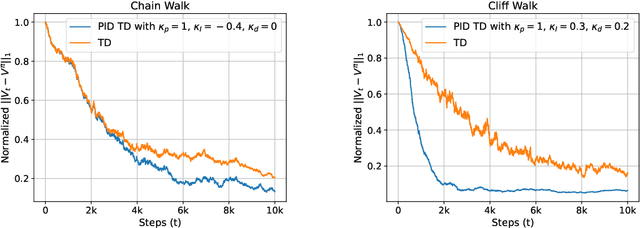
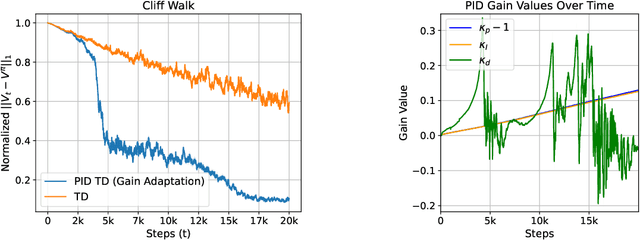
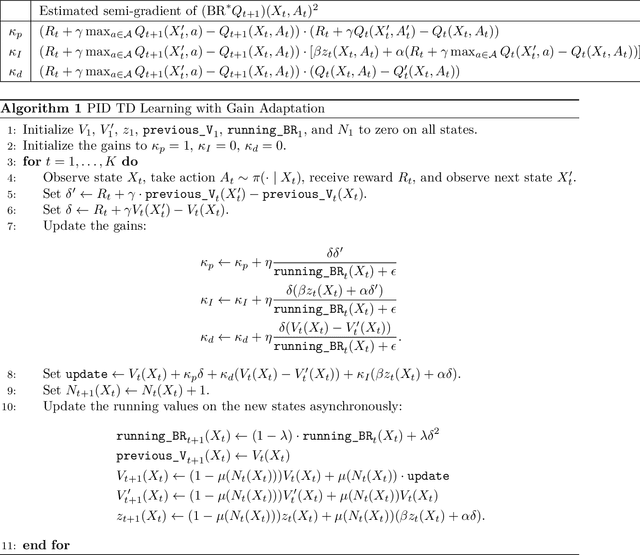
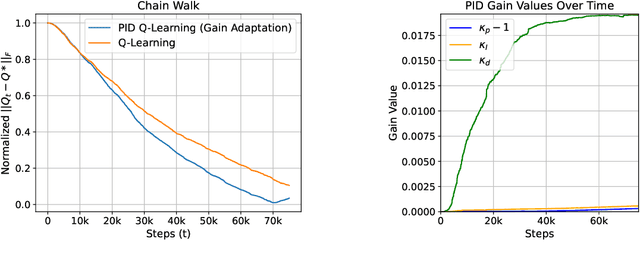
Long-horizon tasks, which have a large discount factor, pose a challenge for most conventional reinforcement learning (RL) algorithms. Algorithms such as Value Iteration and Temporal Difference (TD) learning have a slow convergence rate and become inefficient in these tasks. When the transition distributions are given, PID VI was recently introduced to accelerate the convergence of Value Iteration using ideas from control theory. Inspired by this, we introduce PID TD Learning and PID Q-Learning algorithms for the RL setting in which only samples from the environment are available. We give theoretical analysis of their convergence and acceleration compared to their traditional counterparts. We also introduce a method for adapting PID gains in the presence of noise and empirically verify its effectiveness.