 Add to Chrome
 Add to Firefox
 Add to Edge
Enhancing the Scalability and Applicability of Kohn-Sham Hamiltonians for Molecular Systems
Feb 26, 2025
Density Functional Theory (DFT) is a pivotal method within quantum chemistry and materials science, with its core involving the construction and solution of the Kohn-Sham Hamiltonian. Despite its importance, the application of DFT is frequently limited by the substantial computational resources required to construct the Kohn-Sham Hamiltonian. In response to these limitations, current research has employed deep-learning models to efficiently predict molecular and solid Hamiltonians, with roto-translational symmetries encoded in their neural networks. However, the scalability of prior models may be problematic when applied to large molecules, resulting in non-physical predictions of ground-state properties. In this study, we generate a substantially larger training set (PubChemQH) than used previously and use it to create a scalable model for DFT calculations with physical accuracy. For our model, we introduce a loss function derived from physical principles, which we call Wavefunction Alignment Loss (WALoss). WALoss involves performing a basis change on the predicted Hamiltonian to align it with the observed one; thus, the resulting differences can serve as a surrogate for orbital energy differences, allowing models to make better predictions for molecular orbitals and total energies than previously possible. WALoss also substantially accelerates self-consistent-field (SCF) DFT calculations. Here, we show it achieves a reduction in total energy prediction error by a factor of 1347 and an SCF calculation speed-up by a factor of 18%. These substantial improvements set new benchmarks for achieving accurate and applicable predictions in larger molecular systems.

Improved prediction of ligand-protein binding affinities by meta-modeling
Oct 05, 2023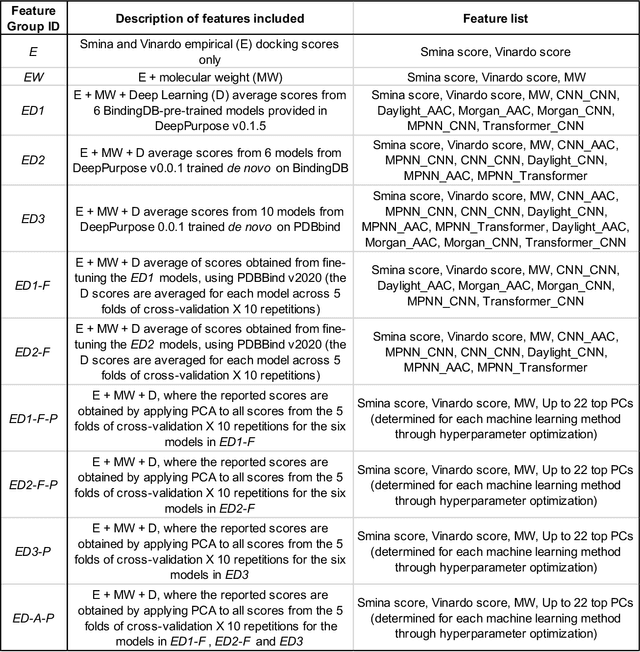
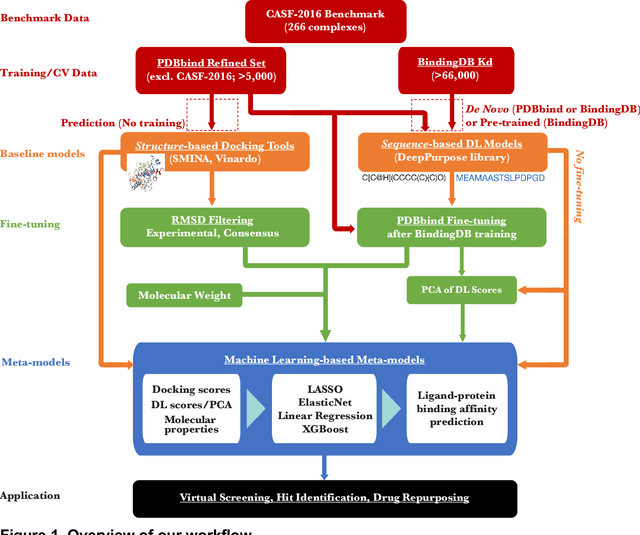
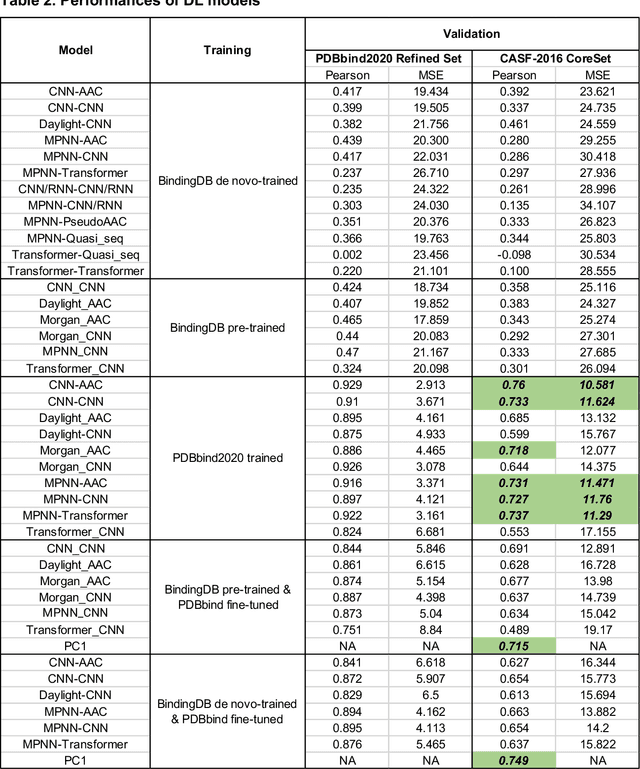
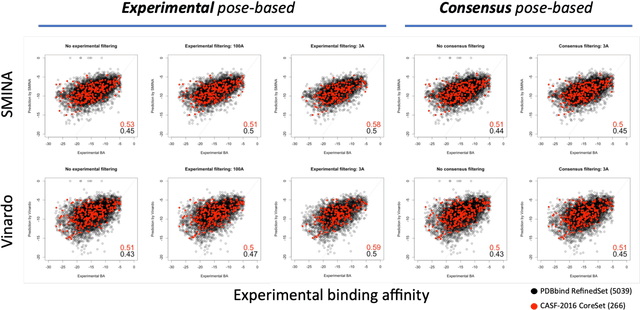
The accurate screening of candidate drug ligands against target proteins through computational approaches is of prime interest to drug development efforts, as filtering potential candidates would save time and expenses for finding drugs. Such virtual screening depends in part on methods to predict the binding affinity between ligands and proteins. Given many computational models for binding affinity prediction with varying results across targets, we herein develop a meta-modeling framework by integrating published empirical structure-based docking and sequence-based deep learning models. In building this framework, we evaluate many combinations of individual models, training databases, and linear and nonlinear meta-modeling approaches. We show that many of our meta-models significantly improve affinity predictions over individual base models. Our best meta-models achieve comparable performance to state-of-the-art exclusively structure-based deep learning tools. Overall, we demonstrate that diverse modeling approaches can be ensembled together to gain substantial improvement in binding affinity prediction while allowing control over input features such as physicochemical properties or molecular descriptors.