 Add to Chrome
 Add to Firefox
 Add to Edge
Vision-Language Model for Accurate Crater Detection
Jan 12, 2026
The European Space Agency (ESA), driven by its ambitions on planned lunar missions with the Argonaut lander, has a profound interest in reliable crater detection, since craters pose a risk to safe lunar landings. This task is usually addressed with automated crater detection algorithms (CDA) based on deep learning techniques. It is non-trivial due to the vast amount of craters of various sizes and shapes, as well as challenging conditions such as varying illumination and rugged terrain. Therefore, we propose a deep-learning CDA based on the OWLv2 model, which is built on a Vision Transformer, that has proven highly effective in various computer vision tasks. For fine-tuning, we utilize a manually labeled dataset fom the IMPACT project, that provides crater annotations on high-resolution Lunar Reconnaissance Orbiter Camera Calibrated Data Record images. We insert trainable parameters using a parameter-efficient fine-tuning strategy with Low-Rank Adaptation, and optimize a combined loss function consisting of Complete Intersection over Union (CIoU) for localization and a contrastive loss for classification. We achieve satisfactory visual results, along with a maximum recall of 94.0% and a maximum precision of 73.1% on a test dataset from IMPACT. Our method achieves reliable crater detection across challenging lunar imaging conditions, paving the way for robust crater analysis in future lunar exploration.

LROC-PANGU-GAN: Closing the Simulation Gap in Learning Crater Segmentation with Planetary Simulators
Oct 04, 2023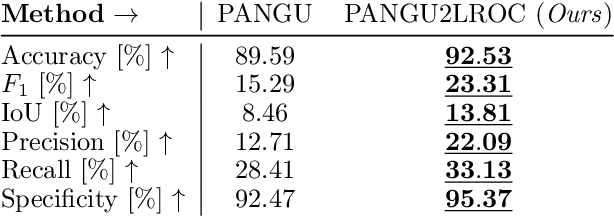
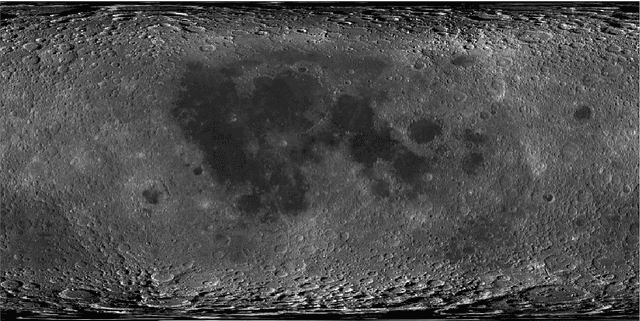
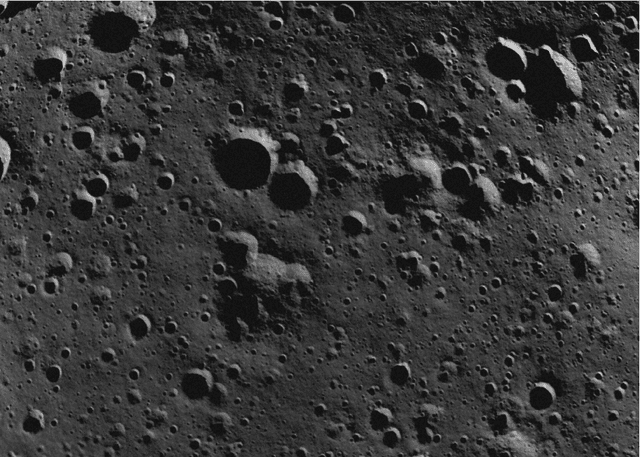
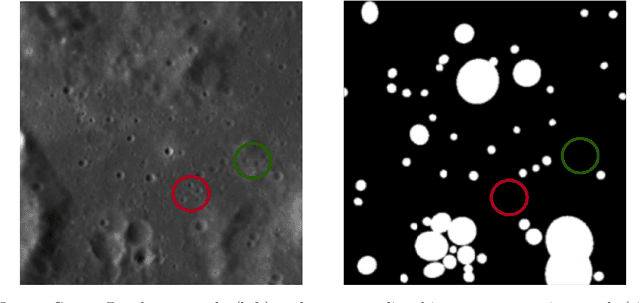
It is critical for probes landing on foreign planetary bodies to be able to robustly identify and avoid hazards - as, for example, steep cliffs or deep craters can pose significant risks to a probe's landing and operational success. Recent applications of deep learning to this problem show promising results. These models are, however, often learned with explicit supervision over annotated datasets. These human-labelled crater databases, such as from the Lunar Reconnaissance Orbiter Camera (LROC), may lack in consistency and quality, undermining model performance - as incomplete and/or inaccurate labels introduce noise into the supervisory signal, which encourages the model to learn incorrect associations and results in the model making unreliable predictions. Physics-based simulators, such as the Planet and Asteroid Natural Scene Generation Utility, have, in contrast, perfect ground truth, as the internal state that they use to render scenes is known with exactness. However, they introduce a serious simulation-to-real domain gap - because of fundamental differences between the simulated environment and the real-world arising from modelling assumptions, unaccounted for physical interactions, environmental variability, etc. Therefore, models trained on their outputs suffer when deployed in the face of realism they have not encountered in their training data distributions. In this paper, we therefore introduce a system to close this "realism" gap while retaining label fidelity. We train a CycleGAN model to synthesise LROC from Planet and Asteroid Natural Scene Generation Utility (PANGU) images. We show that these improve the training of a downstream crater segmentation network, with segmentation performance on a test set of real LROC images improved as compared to using only simulated PANGU images.