 Add to Chrome
 Add to Firefox
 Add to Edge
MRI2Qmap: multi-parametric quantitative mapping with MRI-driven denoising priors
Mar 11, 2026
Magnetic Resonance Fingerprinting (MRF) and other highly accelerated transient-state parameter mapping techniques enable simultaneous quantification of multiple tissue properties, but often suffer from aliasing artifacts due to compressed sampling. Incorporating spatial image priors can mitigate these artifacts, and deep learning has shown strong potential when large training datasets are available. However, extending this paradigm to MRF-type sequences remains challenging due to the scarcity of quantitative imaging data for training. Can this limitation be overcome by leveraging sources of training data from clinically-routine weighted MRI images? To this end, we introduce MRI2Qmap, a plug-and-play quantitative reconstruction framework that integrates the physical acquisition model with priors learned from deep denoising autoencoders pretrained on large multimodal weighted-MRI datasets. MRI2Qmap demonstrates that spatial-domain structural priors learned from independently acquired datasets of routine weighted-MRI images can be effectively used for quantitative MRI reconstruction. The proposed method is validated on highly accelerated 3D whole-brain MRF data from both in-vivo and simulated acquisitions, achieving competitive or superior performance relative to existing baselines without requiring ground-truth quantitative imaging data for training. By decoupling quantitative reconstruction from the need for ground-truth MRF training data, this framework points toward a scalable paradigm for quantitative MRI that can capitalize on the large and growing repositories of routine clinical MRI.

High-Dimensional Confidence Regions in Sparse MRI
Jul 18, 2024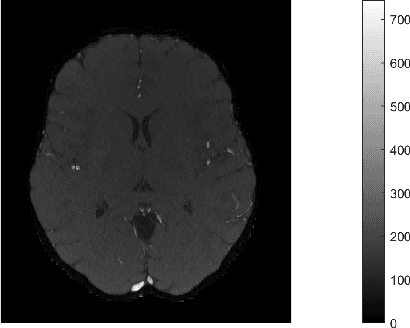
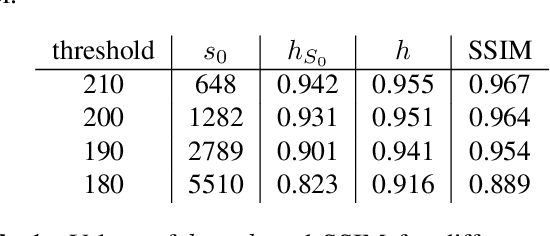
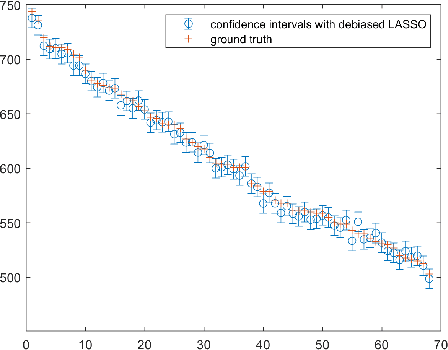
One of the most promising solutions for uncertainty quantification in high-dimensional statistics is the debiased LASSO that relies on unconstrained $\ell_1$-minimization. The initial works focused on real Gaussian designs as a toy model for this problem. However, in medical imaging applications, such as compressive sensing for MRI, the measurement system is represented by a (subsampled) complex Fourier matrix. The purpose of this work is to extend the method to the MRI case in order to construct confidence intervals for each pixel of an MR image. We show that a sufficient amount of data is $n \gtrsim \max\{ s_0\log^2 s_0\log p, s_0 \log^2 p \}$.
Compressive MRI quantification using convex spatiotemporal priors and deep auto-encoders
Jan 23, 2020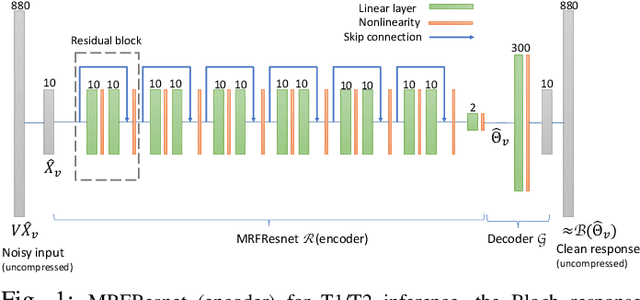
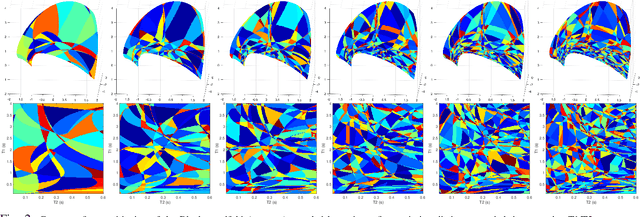
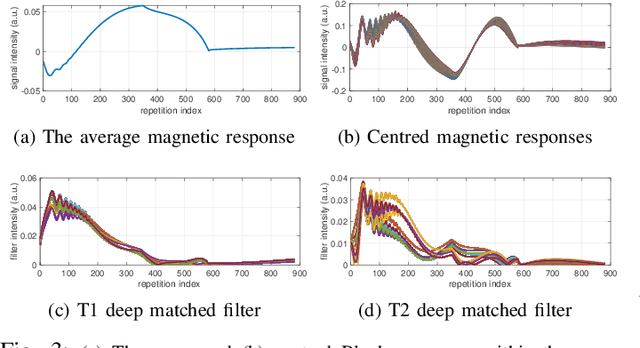
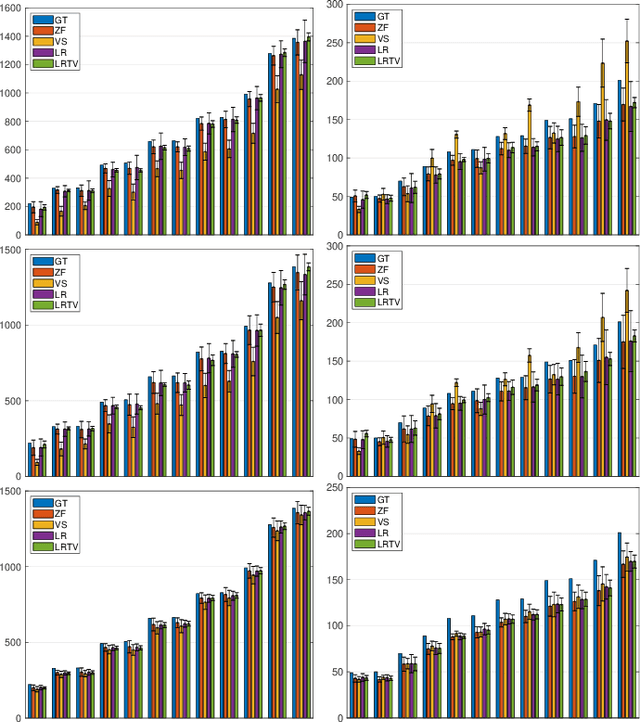
We propose a dictionary-matching-free pipeline for multi-parametric quantitative MRI image computing. Our approach has two stages based on compressed sensing reconstruction and deep learned quantitative inference. The reconstruction phase is convex and incorporates efficient spatiotemporal regularisations within an accelerated iterative shrinkage algorithm. This minimises the under-sampling (aliasing) artefacts from aggressively short scan times. The learned quantitative inference phase is purely trained on physical simulations (Bloch equations) that are flexible for producing rich training samples. We propose a deep and compact auto-encoder network with residual blocks in order to embed Bloch manifold projections through multiscale piecewise affine approximations, and to replace the nonscalable dictionary-matching baseline. Tested on a number of datasets we demonstrate effectiveness of the proposed scheme for recovering accurate and consistent quantitative information from novel and aggressively subsampled 2D/3D quantitative MRI acquisition protocols.