 Add to Chrome
 Add to Firefox
 Add to Edge
UNet-Based Keypoint Regression for 3D Cone Localization in Autonomous Racing
Feb 25, 2026
Accurate cone localization in 3D space is essential in autonomous racing for precise navigation around the track. Approaches that rely on traditional computer vision algorithms are sensitive to environmental variations, and neural networks are often trained on limited data and are infeasible to run in real time. We present a UNet-based neural network for keypoint detection on cones, leveraging the largest custom-labeled dataset we have assembled. Our approach enables accurate cone position estimation and the potential for color prediction. Our model achieves substantial improvements in keypoint accuracy over conventional methods. Furthermore, we leverage our predicted keypoints in the perception pipeline and evaluate the end-to-end autonomous system. Our results show high-quality performance across all metrics, highlighting the effectiveness of this approach and its potential for adoption in competitive autonomous racing systems.

Quantum Diffusion Model for Quark and Gluon Jet Generation
Dec 30, 2024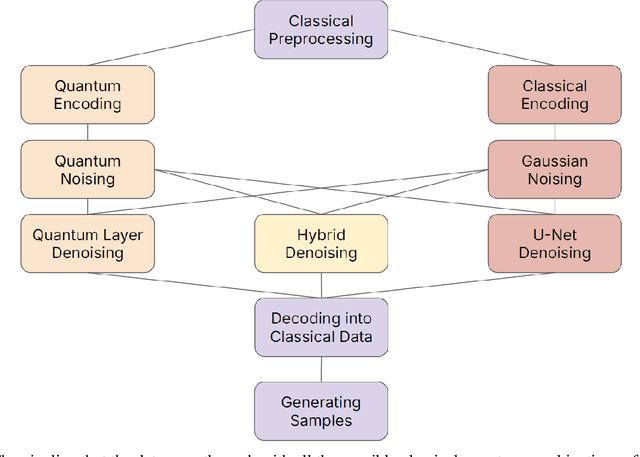

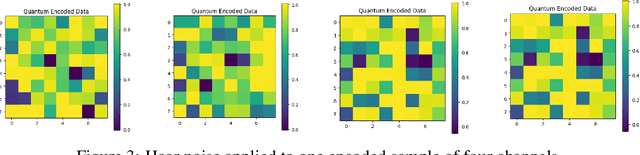
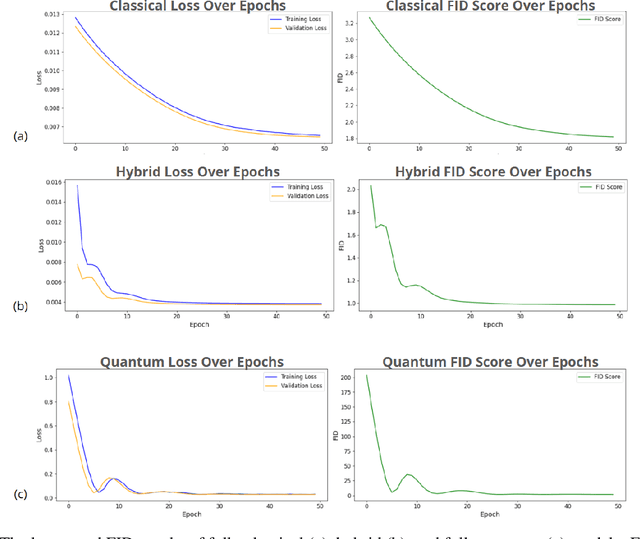
Diffusion models have demonstrated remarkable success in image generation, but they are computationally intensive and time-consuming to train. In this paper, we introduce a novel diffusion model that benefits from quantum computing techniques in order to mitigate computational challenges and enhance generative performance within high energy physics data. The fully quantum diffusion model replaces Gaussian noise with random unitary matrices in the forward process and incorporates a variational quantum circuit within the U-Net in the denoising architecture. We run evaluations on the structurally complex quark and gluon jets dataset from the Large Hadron Collider. The results demonstrate that the fully quantum and hybrid models are competitive with a similar classical model for jet generation, highlighting the potential of using quantum techniques for machine learning problems.