 Add to Chrome
 Add to Firefox
 Add to Edge
UNet-Based Keypoint Regression for 3D Cone Localization in Autonomous Racing
Feb 25, 2026
Accurate cone localization in 3D space is essential in autonomous racing for precise navigation around the track. Approaches that rely on traditional computer vision algorithms are sensitive to environmental variations, and neural networks are often trained on limited data and are infeasible to run in real time. We present a UNet-based neural network for keypoint detection on cones, leveraging the largest custom-labeled dataset we have assembled. Our approach enables accurate cone position estimation and the potential for color prediction. Our model achieves substantial improvements in keypoint accuracy over conventional methods. Furthermore, we leverage our predicted keypoints in the perception pipeline and evaluate the end-to-end autonomous system. Our results show high-quality performance across all metrics, highlighting the effectiveness of this approach and its potential for adoption in competitive autonomous racing systems.

Exploiting Unstructured Sparsity in Fully Homomorphic Encrypted DNNs
Mar 12, 2025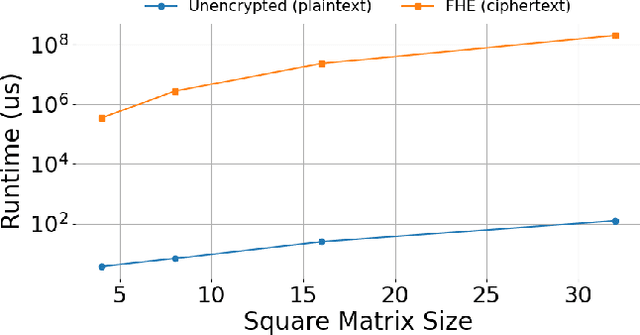
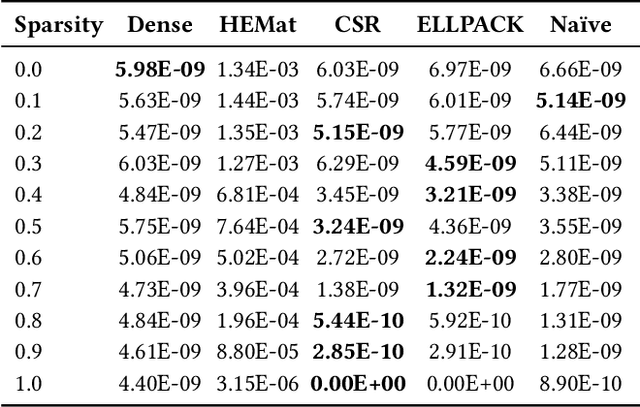
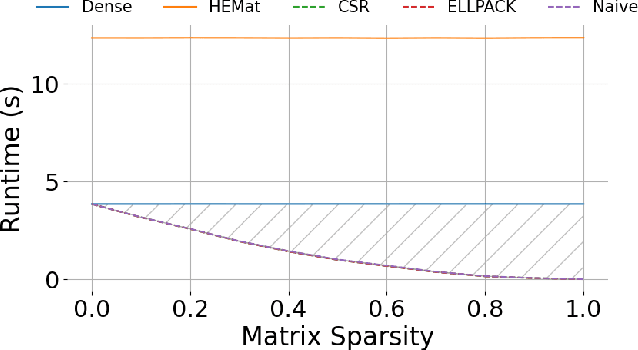
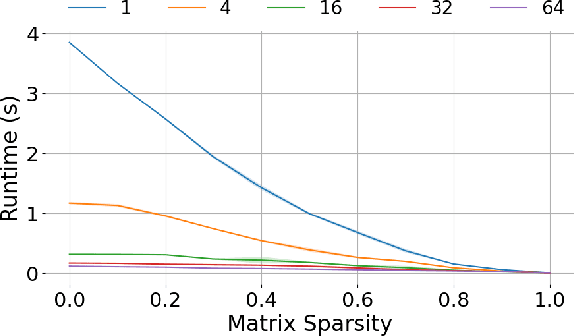
The deployment of deep neural networks (DNNs) in privacy-sensitive environments is constrained by computational overheads in fully homomorphic encryption (FHE). This paper explores unstructured sparsity in FHE matrix multiplication schemes as a means of reducing this burden while maintaining model accuracy requirements. We demonstrate that sparsity can be exploited in arbitrary matrix multiplication, providing runtime benefits compared to a baseline naive algorithm at all sparsity levels. This is a notable departure from the plaintext domain, where there is a trade-off between sparsity and the overhead of the sparse multiplication algorithm. In addition, we propose three sparse multiplication schemes in FHE based on common plaintext sparse encodings. We demonstrate the performance gain is scheme-invariant; however, some sparse schemes vastly reduce the memory storage requirements of the encrypted matrix at high sparsity values. Our proposed sparse schemes yield an average performance gain of 2.5x at 50% unstructured sparsity, with our multi-threading scheme providing a 32.5x performance increase over the equivalent single-threaded sparse computation when utilizing 64 cores.