 Add to Chrome
 Add to Firefox
 Add to Edge
LILAC: Layer-Wise Independent LoRAs and Cascaded Conditioning for Multi-Concept Customization of Diffusion Models
Jul 06, 2026
Personalizing text-to-image diffusion models to render several specific subjects in a coherent image remains challenging: the model must preserve each subject's identity while keeping the scene spatially and visually coherent. Methods that fuse independently trained concept adapters in a shared weight space (via federated averaging, gradient fusion, or orthogonality constraints) suffer from identity confusion and style bleeding and require joint retraining. In this work, we show that composing concepts as separate image layers, instead of merging their adapters in a shared weight space, avoids parameter-level interference. We introduce LILAC, a framework that composes independently trained low-rank adapters at inference time: each subject is conditioned on the frozen composite of previously placed subjects, with exactly one adapter active at a time, therefore identities never interfere at the parameter level. LILAC composes the adapters without any joint training, scales linearly with the number of concepts, and is backbone-agnostic. Under the Orthogonal Adaptation protocol, LILAC applied on Qwen-Image-Edit reaches an ArcFace detection rate of 0.861, while Orthogonal Adaptation reports 0.745 in its original setting. Adaptation reports 0.745 in its original setting. Code is available at https://github.com/marianlupascu/LILAC.

Variance Reduction on the Camera Axis: Multi-View Score Distillation for 3D
Jun 29, 2026Score distillation turns a pretrained 2D diffusion model into a 3D generator, but the per-step gradient is estimated from a single randomly chosen view: it is high-variance and blind to global shape consistency. Prior work addresses this by retraining the diffusion prior on multi-view data; this improves consistency but makes the sampling contribution inseparable from prior quality. We instead isolate the sampling axis. The per-step gradient is one noisy sample of an expectation over views; aggregating K samples per step at a fixed total UNet budget reduces variance without touching the prior. We introduce Multi-View Aggregated Score Distillation (MV-SDI), which aggregates gradients from K views per step via gradient accumulation, keeping peak memory unchanged and the 2D prior frozen, and draws views as antithetic antipodal pairs, a prior-independent geometric property, for balanced angular coverage. At a fixed 10,000-UNet-call budget, K=2 raises CLIP R-Precision from 74.8% to 83.8% and CLIP score from 0.297 to 0.312, with consistent gains on HPSv2 and ImageReward and a 0.0% divergence rate on the 43-prompt benchmark; optimization steps halve as a consequence. K=4 gives a fourfold step reduction at R-Precision 86.9% and CLIP 0.307, still well above the single-view baseline on every alignment metric. MV-SDI is compatible with gradient-based score-distillation pipelines, including Score Distillation via Inversion, and requires no retraining and no multi-view data.
FontFusion: Enhancing Generative Text in Diffusion Models with Typographic Conditioning
Jun 04, 2026Typography generation in diffusion models faces a persistent trade-off: enabling precise font control typically degrades text legibility, while maintaining readability often sacrifices typographic fidelity. We present FontFusion, a plug-and-play conditioning framework for Diffusion Transformer (DiT) architectures that resolves this dilemma through three core innovations: (1) a hierarchical token representation establishing explicit text-font relationships at multiple granularities, (2) position-aware embeddings creating spatial bindings between typography and image content, and (3) a multi-level token dropping strategy improving both computational efficiency and generalization to unseen fonts. Our systematic evaluation of font embedding spaces reveals that a dual encoder combining DeepFont and DINOv2 outperforms any single encoder for typography tasks. FontFusion demonstrates 76% relative improvement on challenging decorative fonts over single-encoder baselines and font consistency gains exceeding approximately 68-76% over unconditioned models, while integrating into existing DiT architectures without retraining.
Large Multimodal Models for Low-Resource Languages: A Survey
Feb 08, 2025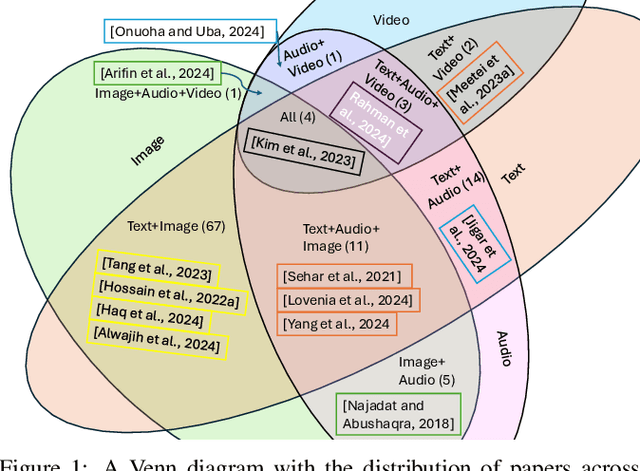
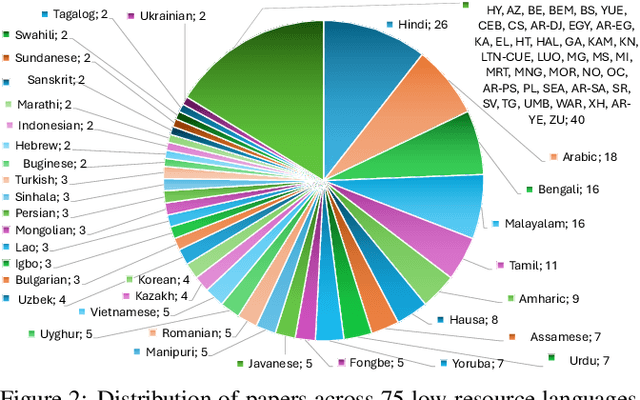
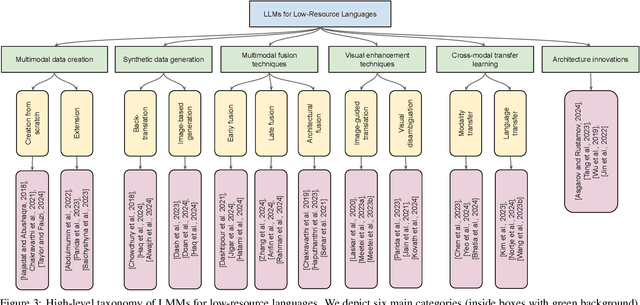
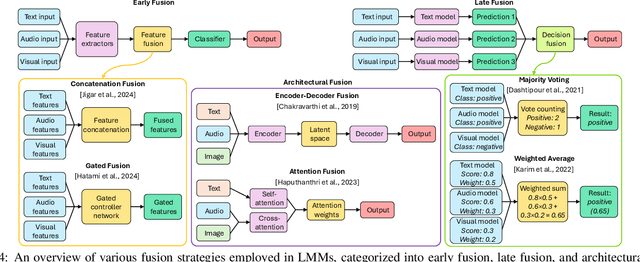
In this survey, we systematically analyze techniques used to adapt large multimodal models (LMMs) for low-resource (LR) languages, examining approaches ranging from visual enhancement and data creation to cross-modal transfer and fusion strategies. Through a comprehensive analysis of 106 studies across 75 LR languages, we identify key patterns in how researchers tackle the challenges of limited data and computational resources. We find that visual information often serves as a crucial bridge for improving model performance in LR settings, though significant challenges remain in areas such as hallucination mitigation and computational efficiency. We aim to provide researchers with a clear understanding of current approaches and remaining challenges in making LMMs more accessible to speakers of LR (understudied) languages. We complement our survey with an open-source repository available at: https://github.com/marianlupascu/LMM4LRL-Survey.