 Add to Chrome
 Add to Firefox
 Add to Edge
Wasserstein-type Gaussian Process Regressions for Input Measurement Uncertainty
Mar 18, 2026
Gaussian process (GP) regression is widely used for uncertainty quantification, yet the standard formulation assumes noise-free covariates. When inputs are measured with error, this errors-in-variables (EIV) setting can lead to optimistically narrow posterior intervals and biased decisions. We study GP regression under input measurement uncertainty by representing each noisy input as a probability measure and defining covariance through Wasserstein distances between these measures. Building on this perspective, we instantiate a deterministic projected Wasserstein ARD (PWA) kernel whose one-dimensional components admit closed-form expressions and whose product structure yields a scalable, positive-definite kernel on distributions. Unlike latent-input GP models, PWA-based GPs (\PWAGPs) handle input noise without introducing unobserved covariates or Monte Carlo projections, making uncertainty quantification more transparent and robust.

Noise-Aware Optimization in Nominally Identical Manufacturing and Measuring Systems for High-Throughput Parallel Workflows
Nov 13, 2025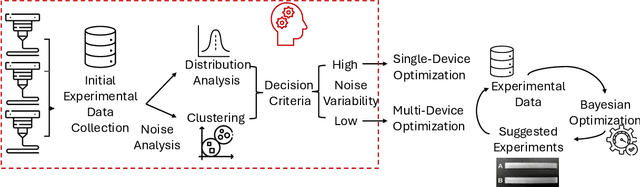

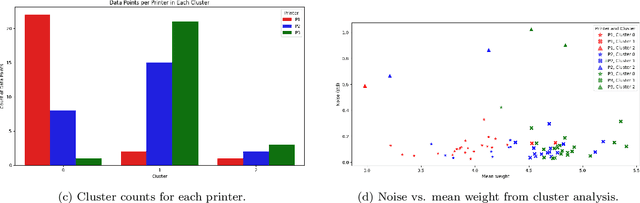
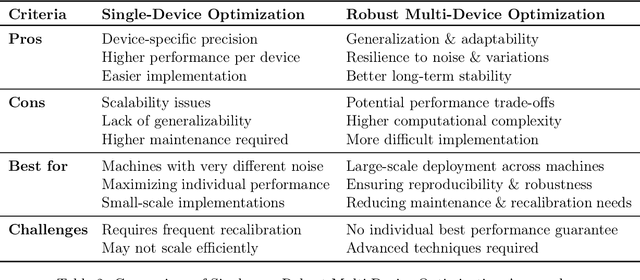
Device-to-device variability in experimental noise critically impacts reproducibility, especially in automated, high-throughput systems like additive manufacturing farms. While manageable in small labs, such variability can escalate into serious risks at larger scales, such as architectural 3D printing, where noise may cause structural or economic failures. This contribution presents a noise-aware decision-making algorithm that quantifies and models device-specific noise profiles to manage variability adaptively. It uses distributional analysis and pairwise divergence metrics with clustering to choose between single-device and robust multi-device Bayesian optimization strategies. Unlike conventional methods that assume homogeneous devices or generic robustness, this framework explicitly leverages inter-device differences to enhance performance, reproducibility, and efficiency. An experimental case study involving three nominally identical 3D printers (same brand, model, and close serial numbers) demonstrates reduced redundancy, lower resource usage, and improved reliability. Overall, this framework establishes a paradigm for precision- and resource-aware optimization in scalable, automated experimental platforms.