 Add to Chrome
 Add to Firefox
 Add to Edge
Noise-Aware Optimization in Nominally Identical Manufacturing and Measuring Systems for High-Throughput Parallel Workflows
Nov 13, 2025
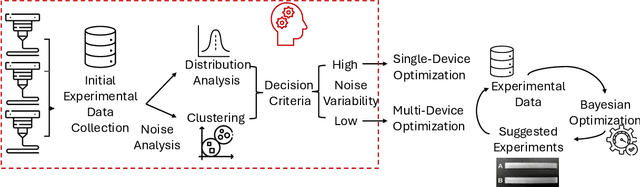

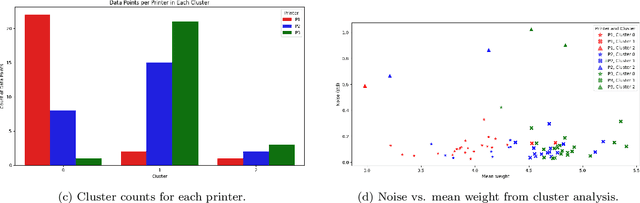
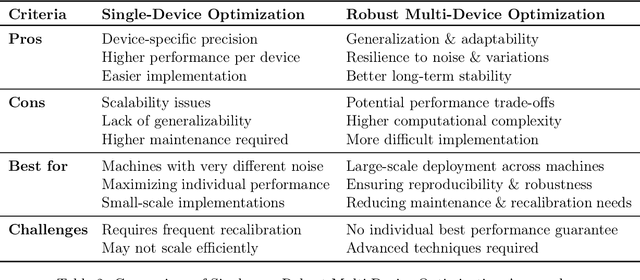
Device-to-device variability in experimental noise critically impacts reproducibility, especially in automated, high-throughput systems like additive manufacturing farms. While manageable in small labs, such variability can escalate into serious risks at larger scales, such as architectural 3D printing, where noise may cause structural or economic failures. This contribution presents a noise-aware decision-making algorithm that quantifies and models device-specific noise profiles to manage variability adaptively. It uses distributional analysis and pairwise divergence metrics with clustering to choose between single-device and robust multi-device Bayesian optimization strategies. Unlike conventional methods that assume homogeneous devices or generic robustness, this framework explicitly leverages inter-device differences to enhance performance, reproducibility, and efficiency. An experimental case study involving three nominally identical 3D printers (same brand, model, and close serial numbers) demonstrates reduced redundancy, lower resource usage, and improved reliability. Overall, this framework establishes a paradigm for precision- and resource-aware optimization in scalable, automated experimental platforms.

Model-Based Reinforcement Learning Control of Reaction-Diffusion Problems
Feb 22, 2024Mathematical and computational tools have proven to be reliable in decision-making processes. In recent times, in particular, machine learning-based methods are becoming increasingly popular as advanced support tools. When dealing with control problems, reinforcement learning has been applied to decision-making in several applications, most notably in games. The success of these methods in finding solutions to complex problems motivates the exploration of new areas where they can be employed to overcome current difficulties. In this paper, we explore the use of automatic control strategies to initial boundary value problems in thermal and disease transport. Specifically, in this work, we adapt an existing reinforcement learning algorithm using a stochastic policy gradient method and we introduce two novel reward functions to drive the flow of the transported field. The new model-based framework exploits the interactions between a reaction-diffusion model and the modified agent. The results show that certain controls can be implemented successfully in these applications, although model simplifications had to be assumed.