 Add to Chrome
 Add to Firefox
 Add to Edge
Motion-Robust Deep Reconstruction for Free-Breathing Cardiac Cine MRI
May 20, 2026
Conventional cardiac cine MRI relies on breath-hold Cartesian acquisitions, which are vulnerable to motion artifacts and can be uncomfortable or infeasible, particularly for pediatric and other noncompliant patients who cannot reliably hold their breath. Free-breathing radial acquisitions can alleviate these limitations, but robust reconstruction at high acceleration remains challenging due to prominent streak artifacts. To address these limitations, we propose Cine-DL, a clinically oriented framework that couples targeted k-space preprocessing with fast, model-based deep reconstruction. In this pipeline, raw free-breathing radial data undergo retrospective cardiac binning and respiratory gating to resolve cardiac phases and discard motion-corrupted spokes. We then introduce Streak Optimized Coil Compression (SOC), which explicitly preserves cardiac signals while suppressing peripheral interference that typically drives the streak artifacts. The resulting 2D+t cine series is reconstructed with an unrolled network that alternates a ResNet proximal operator with physics-based data consistency updates solved via conjugate gradient. We further employ a memory-efficient training strategy that reduces peak memory usage. We evaluate Cine-DL on free-breathing volunteer data against established baselines (k-t SENSE and iGRASP) and demonstrate clinical translation via hospital deployment on newly acquired patient data. Our experiments show that Cine-DL consistently improves quantitative metrics and visual fidelity, supporting a practical route toward routine, time-sensitive clinical adoption of free-breathing cine MRI.

Deep Generative Adversarial Networks for Compressed Sensing Automates MRI
May 31, 2017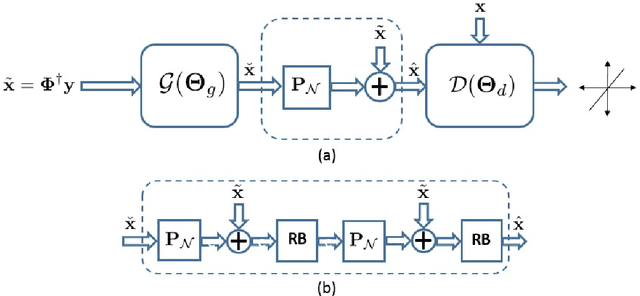
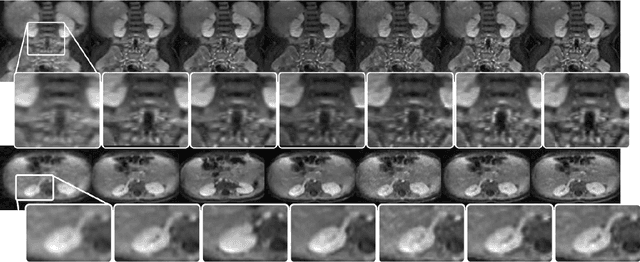
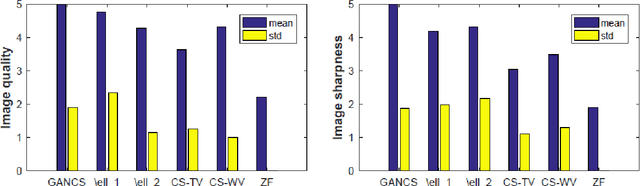
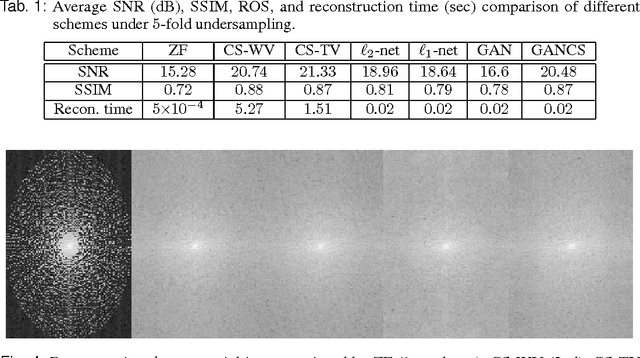
Magnetic resonance image (MRI) reconstruction is a severely ill-posed linear inverse task demanding time and resource intensive computations that can substantially trade off {\it accuracy} for {\it speed} in real-time imaging. In addition, state-of-the-art compressed sensing (CS) analytics are not cognizant of the image {\it diagnostic quality}. To cope with these challenges we put forth a novel CS framework that permeates benefits from generative adversarial networks (GAN) to train a (low-dimensional) manifold of diagnostic-quality MR images from historical patients. Leveraging a mixture of least-squares (LS) GANs and pixel-wise $\ell_1$ cost, a deep residual network with skip connections is trained as the generator that learns to remove the {\it aliasing} artifacts by projecting onto the manifold. LSGAN learns the texture details, while $\ell_1$ controls the high-frequency noise. A multilayer convolutional neural network is then jointly trained based on diagnostic quality images to discriminate the projection quality. The test phase performs feed-forward propagation over the generator network that demands a very low computational overhead. Extensive evaluations are performed on a large contrast-enhanced MR dataset of pediatric patients. In particular, images rated based on expert radiologists corroborate that GANCS retrieves high contrast images with detailed texture relative to conventional CS, and pixel-wise schemes. In addition, it offers reconstruction under a few milliseconds, two orders of magnitude faster than state-of-the-art CS-MRI schemes.