 Add to Chrome
 Add to Firefox
 Add to Edge
Automating Early Disease Prediction Via Structured and Unstructured Clinical Data
Mar 30, 2026
This study presents a fully automated methodology for early prediction studies in clinical settings, leveraging information extracted from unstructured discharge reports. The proposed pipeline uses discharge reports to support the three main steps of early prediction: cohort selection, dataset generation, and outcome labeling. By processing discharge reports with natural language processing techniques, we can efficiently identify relevant patient cohorts, enrich structured datasets with additional clinical variables, and generate high-quality labels without manual intervention. This approach addresses the frequent issue of missing or incomplete data in codified electronic health records (EHR), capturing clinically relevant information that is often underrepresented. We evaluate the methodology in the context of predicting atrial fibrillation (AF) progression, showing that predictive models trained on datasets enriched with discharge report information achieve higher accuracy and correlation with true outcomes compared to models trained solely on structured EHR data, while also surpassing traditional clinical scores. These results demonstrate that automating the integration of unstructured clinical text can streamline early prediction studies, improve data quality, and enhance the reliability of predictive models for clinical decision-making.

Early Diagnosis of Atrial Fibrillation Recurrence: A Large Tabular Model Approach with Structured and Unstructured Clinical Data
May 20, 2025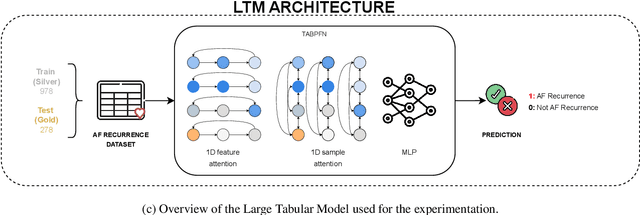
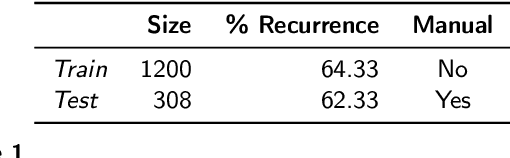
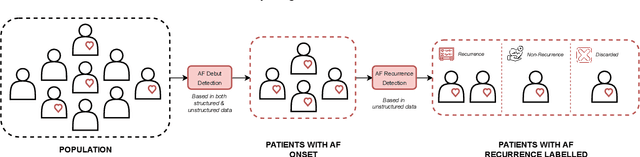
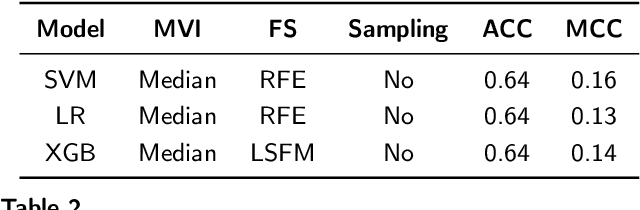
BACKGROUND: Atrial fibrillation (AF), the most common arrhythmia, is linked to high morbidity and mortality. In a fast-evolving AF rhythm control treatment era, predicting AF recurrence after its onset may be crucial to achieve the optimal therapeutic approach, yet traditional scores like CHADS2-VASc, HATCH, and APPLE show limited predictive accuracy. Moreover, early diagnosis studies often rely on codified electronic health record (EHR) data, which may contain errors and missing information. OBJECTIVE: This study aims to predict AF recurrence between one month and two years after onset by evaluating traditional clinical scores, ML models, and our LTM approach. Moreover, another objective is to develop a methodology for integrating structured and unstructured data to enhance tabular dataset quality. METHODS: A tabular dataset was generated by combining structured clinical data with free-text discharge reports processed through natural language processing techniques, reducing errors and annotation effort. A total of 1,508 patients with documented AF onset were identified, and models were evaluated on a manually annotated test set. The proposed approach includes a LTM compared against traditional clinical scores and ML models. RESULTS: The proposed LTM approach achieved the highest predictive performance, surpassing both traditional clinical scores and ML models. Additionally, the gender and age bias analyses revealed demographic disparities. CONCLUSION: The integration of structured data and free-text sources resulted in a high-quality dataset. The findings emphasize the limitations of traditional clinical scores in predicting AF recurrence and highlight the potential of ML-based approaches, particularly our LTM model.