 Add to Chrome
 Add to Firefox
 Add to Edge
HiddenObjects: Scalable Diffusion-Distilled Spatial Priors for Object Placement
Apr 12, 2026
We propose a method to learn explicit, class-conditioned spatial priors for object placement in natural scenes by distilling the implicit placement knowledge encoded in text-conditioned diffusion models. Prior work relies either on manually annotated data, which is inherently limited in scale, or on inpainting-based object-removal pipelines, whose artifacts promote shortcut learning. To address these limitations, we introduce a fully automated and scalable framework that evaluates dense object placements on high-quality real backgrounds using a diffusion-based inpainting pipeline. With this pipeline, we construct HiddenObjects, a large-scale dataset comprising 27M placement annotations, evaluated across 27k distinct scenes, with ranked bounding box insertions for different images and object categories. Experimental results show that our spatial priors outperform sparse human annotations on a downstream image editing task (3.90 vs. 2.68 VLM-Judge), and significantly surpass existing placement baselines and zero-shot Vision-Language Models for object placement. Furthermore, we distill these priors into a lightweight model for fast practical inference (230,000x faster).

POEM: Precise Object-level Editing via MLLM control
Apr 10, 2025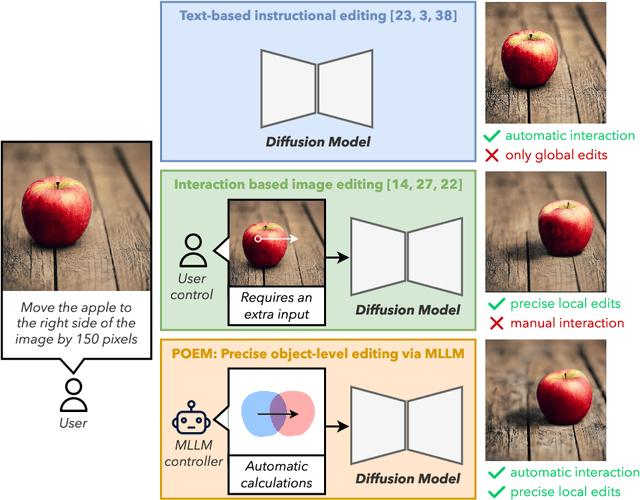
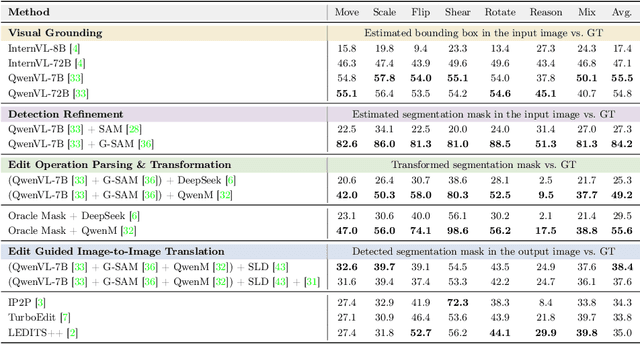
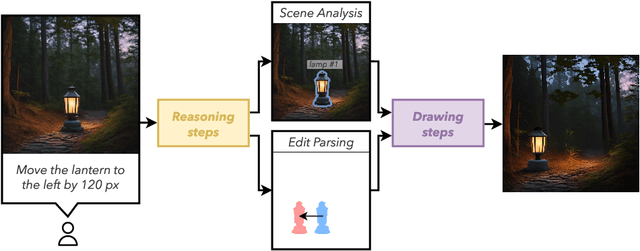
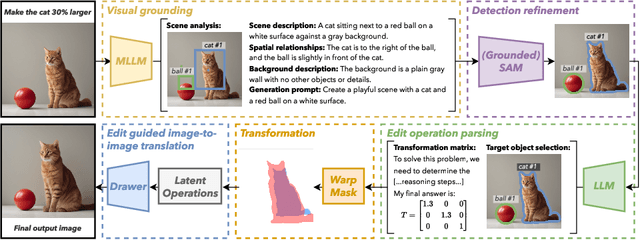
Diffusion models have significantly improved text-to-image generation, producing high-quality, realistic images from textual descriptions. Beyond generation, object-level image editing remains a challenging problem, requiring precise modifications while preserving visual coherence. Existing text-based instructional editing methods struggle with localized shape and layout transformations, often introducing unintended global changes. Image interaction-based approaches offer better accuracy but require manual human effort to provide precise guidance. To reduce this manual effort while maintaining a high image editing accuracy, in this paper, we propose POEM, a framework for Precise Object-level Editing using Multimodal Large Language Models (MLLMs). POEM leverages MLLMs to analyze instructional prompts and generate precise object masks before and after transformation, enabling fine-grained control without extensive user input. This structured reasoning stage guides the diffusion-based editing process, ensuring accurate object localization and transformation. To evaluate our approach, we introduce VOCEdits, a benchmark dataset based on PASCAL VOC 2012, augmented with instructional edit prompts, ground-truth transformations, and precise object masks. Experimental results show that POEM outperforms existing text-based image editing approaches in precision and reliability while reducing manual effort compared to interaction-based methods.