 Add to Chrome
 Add to Firefox
 Add to Edge
Reward-free Pretraining for Reinforcement Learning via Occupancy Coverage Maximization
Jun 19, 2026
Sparse rewards pose a central challenge in reinforcement learning, since agents receive no informative signal until they reach their goal. Intrinsic-reward methods address this issue by optimizing non-stationary objectives such as novelty, prediction error, or skill diversity, thereby injecting a supervision signal into the problem. While effective, these methods often require that the extrinsic (sparse) reward can be evaluated -- either online or during offline relabeling of the stored transitions. This limitation is particularly vexing for multi-task, meta-, and continual reinforcement learning, where agents' interactions with the environment are usually reward-free. In this work, we present a method to pre-train transferable exploration policies that rapidly adapt to sparse rewards at downstream task time. Our objective maximizes state-space covering for the occupancy measure, and can be framed in terms of entropy maximization. Its algorithmic implementation, ROVER, leverages recent advances on the operatorial formulation of RL to estimate occupancy with a learned resolvent world model, bypassing common hurdles associated with density and entropy estimation. ROVER further introduces a virtual "sink" state for unexplored regions, balancing coverage of known states with expansion into unseen ones and preventing cyclic expansion-collapse behavior during learning. In tabular and pixel-based sparse navigation tasks, ROVER produces more uniform aggregate coverage and stronger initializations for downstream tasks than standard reward-free baselines.

Operator World Models for Reinforcement Learning
Jun 28, 2024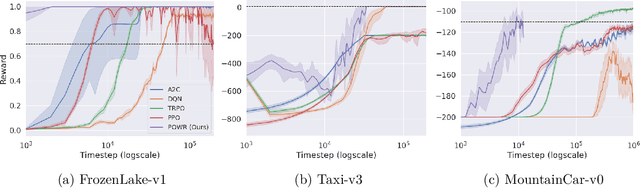
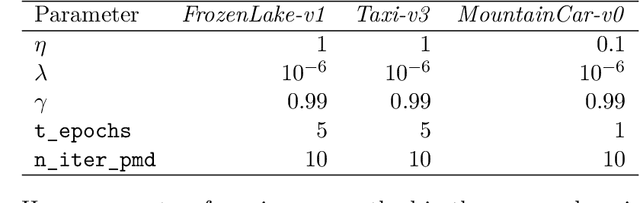
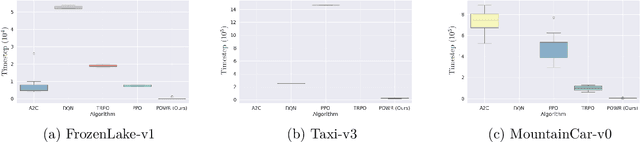
Policy Mirror Descent (PMD) is a powerful and theoretically sound methodology for sequential decision-making. However, it is not directly applicable to Reinforcement Learning (RL) due to the inaccessibility of explicit action-value functions. We address this challenge by introducing a novel approach based on learning a world model of the environment using conditional mean embeddings. We then leverage the operatorial formulation of RL to express the action-value function in terms of this quantity in closed form via matrix operations. Combining these estimators with PMD leads to POWR, a new RL algorithm for which we prove convergence rates to the global optimum. Preliminary experiments in finite and infinite state settings support the effectiveness of our method.