 Add to Chrome
 Add to Firefox
 Add to Edge
NL-COMM: Enhanced Video Streaming via Advanced Non-Linear Processing
Jan 16, 2025
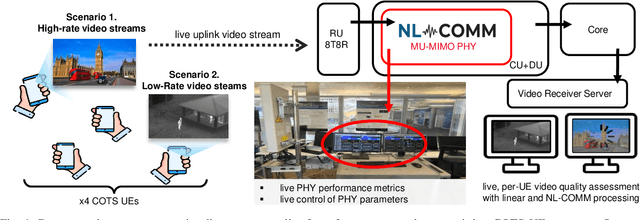
With video streaming now accounting for the majority of internet traffic, wireless networks face increasing demands, especially in densely populated areas where limited spectral resources are shared among many devices. While multi-user (MU)-MIMO technology aims to improve spectral efficiency by enabling concurrent transmissions over the same frequency and time resources, traditional linear processing methods fall short of fully utilizing available channel capacity. These methods require a substantial number of antennas and RF chains, to support a much smaller number of MIMO streams, leading to increased power consumption and operational costs, even when the supported streams are of low rate. In this demo, we present NL-COMM, an advanced non-linear MIMO processing framework, demonstrated for the first time with commercial off-the-shelf (COTS) user equipment (UEs) in a fully 3GPP-compliant environment. In addition, also for the first time, the audience will compare and assess the quality of live, over-the-air video transmission from four concurrently transmitting UE devices, alternating between current state-of-the-art MIMO detection algorithms and NL-COMM. Key gains of NL-COMM include improved stream quality, halving the number of required base station antennas without compromising stream quality compared to linear approaches, as well as achieving antenna overloading factors of 400\%.

Towards Radio Designs with Non-Linear Processing for Next Generation Mobile Systems
Jan 05, 2021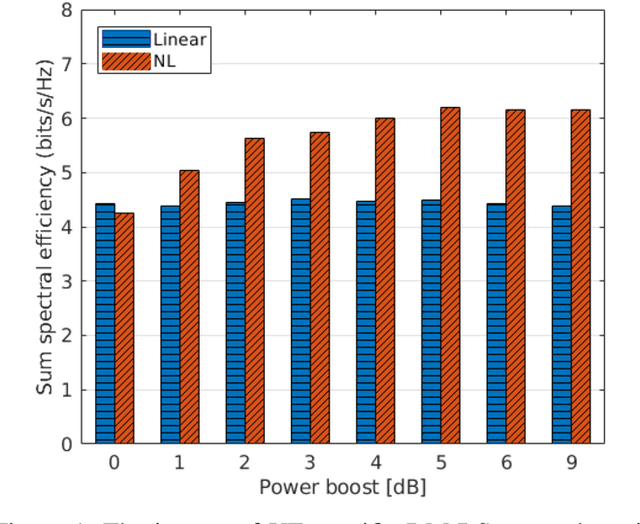
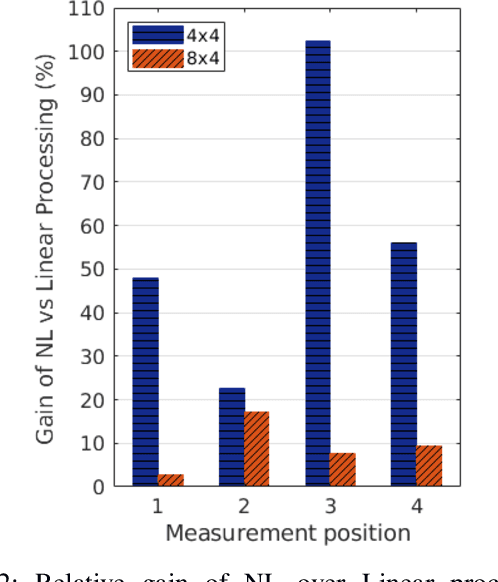
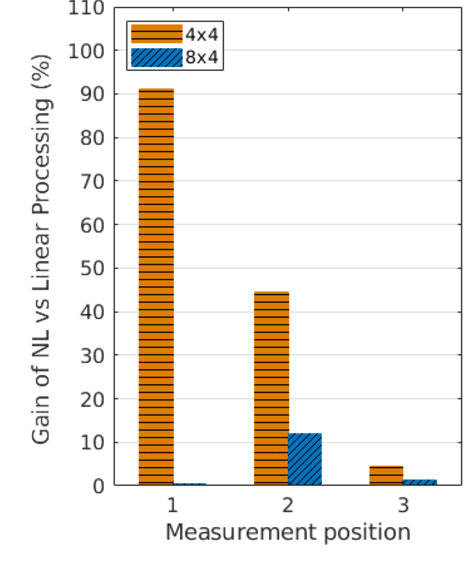
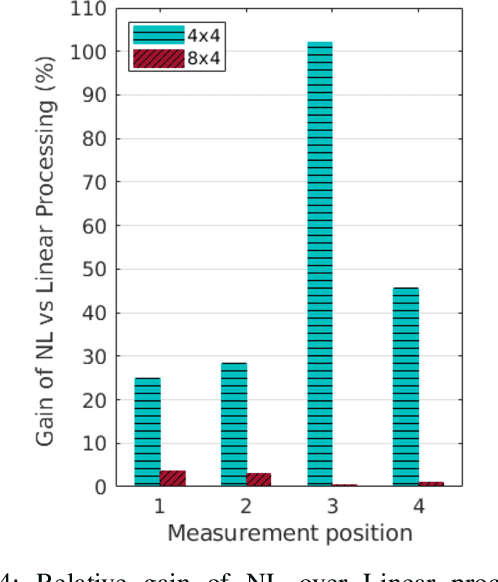
MIMO mobile systems, with a large number of antennas at the base-station side, enable the concurrent transmission of multiple, spatially separated information streams and, therefore, enable improved network throughput and connectivity both in uplink and downlink transmissions. Traditionally, to efficiently facilitate such MIMO transmissions, linear base-station processing is adopted, that translates the MIMO channel into several single-antenna channels. Still, while such approaches are relatively easy to implement, they can leave on the table a significant amount of unexploited MIMO capacity. Recently proposed non-linear base-station processing methods claim this unexplored capacity and promise a substantially increased network throughput. Still, to the best of the authors' knowledge, non-linear base-station processing methods not only have not yet been adopted by actual systems, but have not even been evaluated in a standard-compliant framework, involving of all the necessary algorithmic modules required by a practical system. This work, outlines our experience by trying to incorporate and evaluate the gains of non-linear base-station processing in a 3GPP standard environment. We discuss the several corresponding challenges and our adopted solutions, together with their corresponding limitations. We report gains that we have managed to verify, and we also discuss remaining challenges, missing algorithmic components and future research directions that would be required towards highly efficient, future mobile systems that can efficiently exploit the gains of non-linear, base-station processing.