 Add to Chrome
 Add to Firefox
 Add to Edge
ViPer NL-COMM: Making Vector Perturbation Precoding Practical
Feb 12, 2026
Large MIMO systems rely on efficient downlink precoding to enhance data rates and improve connectivity through spatial multiplexing. However, currently employed linear precoding techniques, such as MMSE, significantly limit the achievable spectral efficiency. To meet practical error-rate targets, existing linear methods require an excessively high number of access point antennas relative to the number of supported users, leading to disproportionate increases in power consumption.Efficient non-linear processing frameworks for uplink MIMO transmissions, such as NL-COMM, have been proposed. However, downlink non-linear precoding methods, such as Vector Perturbation (VP), remain impractical for real-world deployment due to their exponentially increasing computational complexity with the number of supported streams. This work presents ViPer NL-COMM, the first practical algorithmic and implementation framework for VP-based precoding. ViPer NL-COMM extends the core principles of NL-COMM to the precoding problem, enabling scalable parallelization and real-time computational performance while maintaining the substantial spectral-efficiency benefits of VP precoding. ViPer NL-COMM consists of a novel mathematical framework and an FPGA prototype capable of supporting large MIMO configurations (up to 16x16), high-order modulation (256-QAM), and wide bandwidths (100 MHz) within practical power and resource budgets. System-level evaluations demonstrate that ViPer NL-COMM achieves target error rates using only half the number of transmit antennas required by linear precoding, yielding net power savings on the order of hundreds of Watts at the RF front end. Moreover, ViPer NL-COMM enables supporting more information streams than available AP antennas when the streams are of low-rate, paving the way for enhanced massive-connectivity scenarios in next-generation wireless networks.

Toward Fully Neuromorphic Receivers for Ultra-Power Efficient Communications
May 28, 2025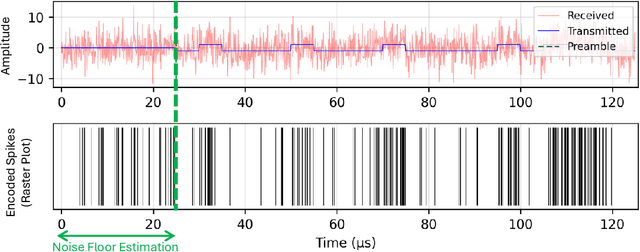
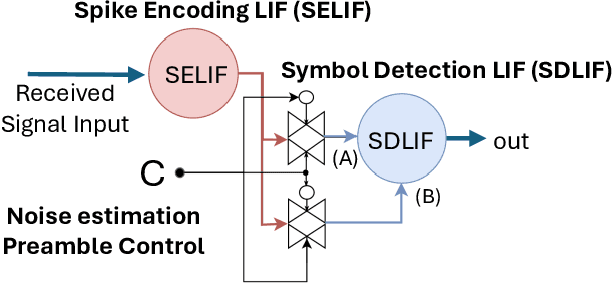
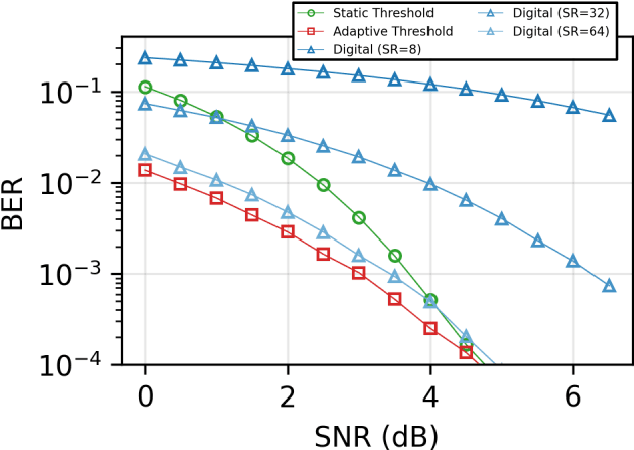
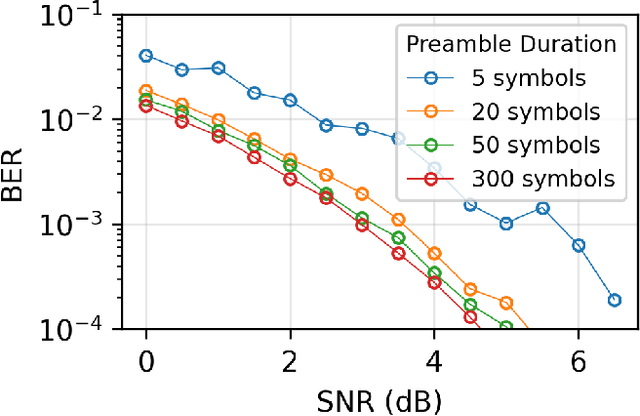
Neuromorphic computing, inspired by biological neural systems, has emerged as a promising approach for ultra-energy-efficient data processing by leveraging analog neuron structures and spike-based computation. However, its application in communication systems remains largely unexplored, with existing efforts mainly focused on mapping isolated communication algorithms onto spiking networks, often accompanied by substantial, traditional computational overhead due to transformations required to adapt problems to the spiking paradigm. In this work, we take a fundamentally different route and, for the first time, propose a fully neuromorphic communication receiver by applying neuromorphic principles directly in the analog domain from the very start of the receiver processing chain. Specifically, we examine a simple transmission scenario: a BPSK receiver with repetition coding, and show that we can achieve joint detection and decoding entirely through spiking signals. Our approach demonstrates error-rate performance gains over conventional digital realizations with power consumption on the order of microwatts, comparable with a single very low-resolution Analog-to-Digital Converter (ADC) utilized in digital receivers. To maintain performance under varying noise conditions, we also introduce a novel noise-tracking mechanism that dynamically adjusts neural parameters during transmission. Finally, we discuss the key challenges and directions toward ultra-efficient neuromorphic transceivers.
NL-COMM: Enhanced Video Streaming via Advanced Non-Linear Processing
Jan 16, 2025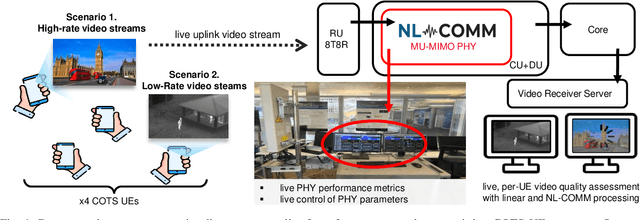
With video streaming now accounting for the majority of internet traffic, wireless networks face increasing demands, especially in densely populated areas where limited spectral resources are shared among many devices. While multi-user (MU)-MIMO technology aims to improve spectral efficiency by enabling concurrent transmissions over the same frequency and time resources, traditional linear processing methods fall short of fully utilizing available channel capacity. These methods require a substantial number of antennas and RF chains, to support a much smaller number of MIMO streams, leading to increased power consumption and operational costs, even when the supported streams are of low rate. In this demo, we present NL-COMM, an advanced non-linear MIMO processing framework, demonstrated for the first time with commercial off-the-shelf (COTS) user equipment (UEs) in a fully 3GPP-compliant environment. In addition, also for the first time, the audience will compare and assess the quality of live, over-the-air video transmission from four concurrently transmitting UE devices, alternating between current state-of-the-art MIMO detection algorithms and NL-COMM. Key gains of NL-COMM include improved stream quality, halving the number of required base station antennas without compromising stream quality compared to linear approaches, as well as achieving antenna overloading factors of 400\%.
Enabling Ultra-Dense, Open-RAN, Vehicular Networks with Non-Linear MIMO Processing
Sep 22, 2024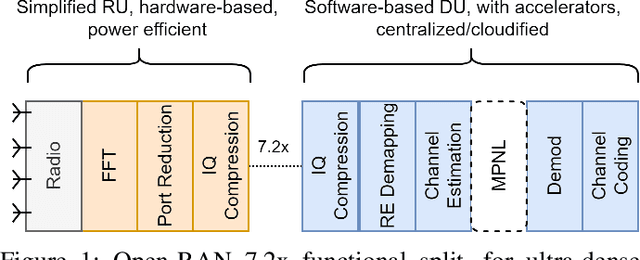
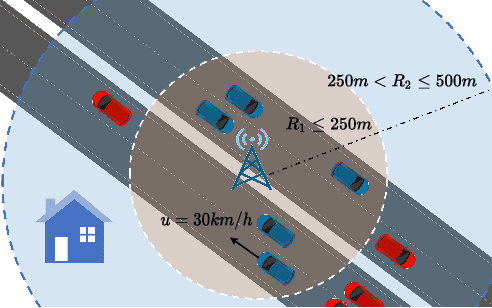
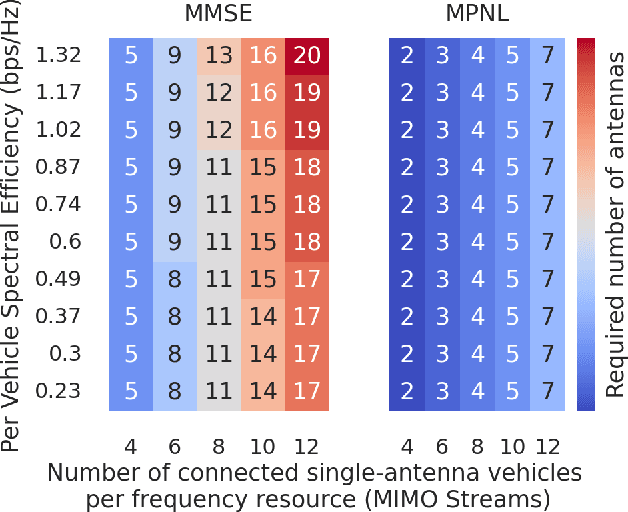
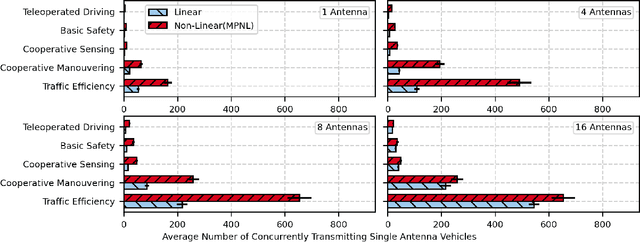
Future autonomous transportation systems necessitate network infrastructure capable of accommodating massive vehicular connectivity, despite the scarce availability of frequency resources. Current approaches for achieving such required high spectral efficiency, rely on the utilization of Multiple-Input, Multiple-Output (MIMO) technology. However, conventional MIMO processing approaches, based on linear processing principles, leave much of the system's capacity heavily unexploited. They typically require a large number of power-consuming antennas and RF-chains to support a substantially smaller number of concurrently connected devices, even when the devices are transmitting at low rates. This translates to inflated operational costs that become substantial, particularly in ultra-dense, metropolitan-scale deployments. Therefore, the question is how to efficiently harness this unexploited MIMO capacity and fully leverage the available RF infrastructure to maximize device connectivity. Addressing this challenge, this work proposes an Open Radio Access Network (Open-RAN) deployment, with Massively Parallelizable Non-linear (MPNL) MIMO processing for densely deployed, and power-efficient vehicular networks. For the first time, we quantify the substantial gains of MPNL in achieving massive vehicular connectivity with significantly reduced utilized antennas, compared to conventional linear approaches, and without any throughput loss. We find that an Open-RAN-based realization exploiting the MPNL advancements can yield an increase of over 300% in terms of concurrently transmitting single-antenna vehicles in urban mobility settings and for various Vehicle-to-Infrastructure (V2I) and Network (V2N) use cases. In this context, we discuss how implementing MPNL allows for simpler and more densely deployed radio units, paving the way for fully autonomous and sustainable transportation systems.
Ultra-Low-Complexity, Non-Linear Processing for MU-MIMO Systems
Aug 27, 2024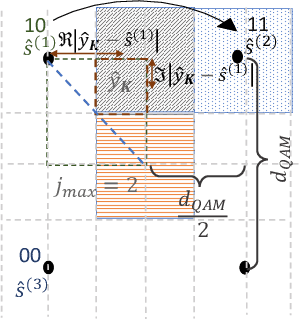
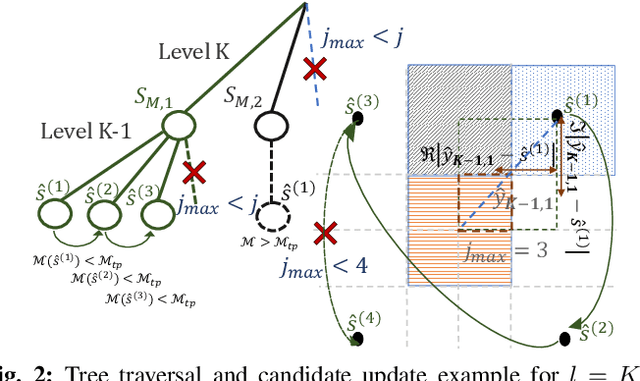
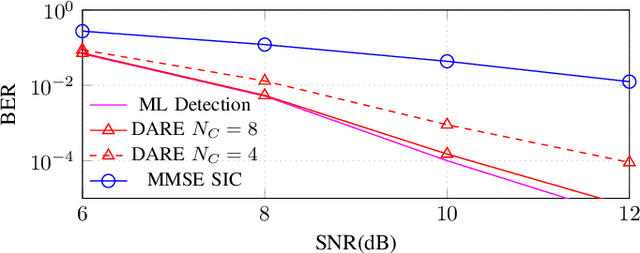
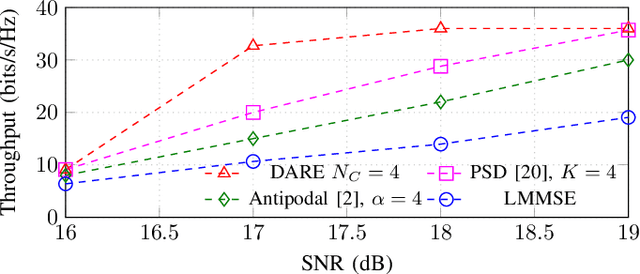
Non-linear detection schemes can substantially improve the achievable throughput and connectivity capabilities of uplink MU-MIMO systems that employ linear detection. However, the complexity requirements of existing non-linear soft detectors that provide substantial gains compared to linear ones are at least an order of magnitude more complex, making their adoption challenging. In particular, joint soft information computation involves solving multiple vector minimization problems, each with a complexity that scales exponentially with the number of users. This work introduces a novel ultra-low-complexity, non-linear detection scheme that performs joint Detection and Approximate Reliability Estimation (DARE). For the first time, DARE can substantially improve the achievable throughput (e.g., 40%) with less than 2x the complexity of linear MMSE, making non-linear processing extremely practical. To enable this, DARE includes a novel procedure to approximate the reliability of the received bits based on the region of the received observable that can efficiently approach the accurately calculated soft detection performance. In addition, we show that DARE can achieve a better throughput than linear detection when using just half the base station antennas, resulting in substantial power savings (e.g., 500 W). Consequently, DARE is a very strong candidate for future power-efficient MU-MIMO developments, even in the case of software-based implementations, as in the case of emerging Open-RAN systems. Furthermore, DARE can achieve the throughput of the state-of-the-art non-linear detectors with complexity requirements that are orders of magnitude lower.
Towards Neuromorphic Processing for Next-Generation MU-MIMO Detection
Aug 23, 2024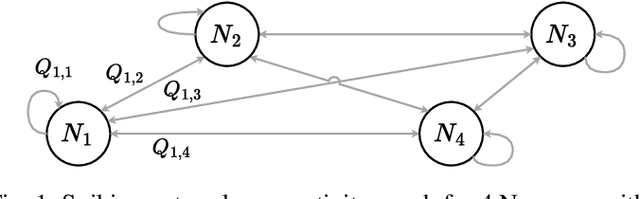
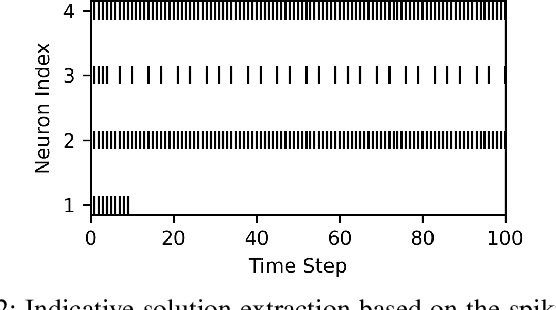
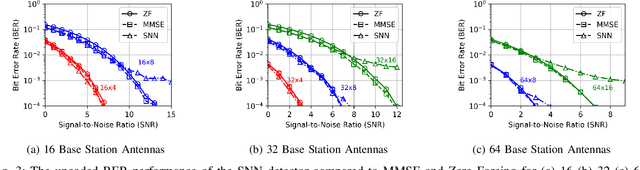
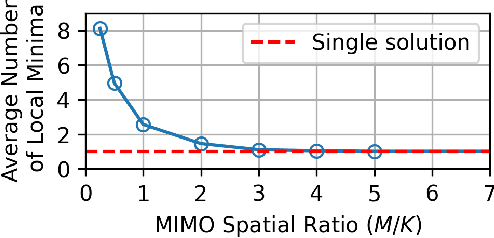
Upcoming physical layer (PHY) processing solutions, leveraging multiple-input multiple-output (MIMO) advances, are expected to support broad transmission bandwidths and the concurrent transmission of multiple information streams. However, the inherent computational complexities of conventional MIMO PHY algorithms pose significant practical challenges, not only in meeting the strict real-time processing latency requirements but also in maintaining practical computational power consumption budgets. Novel computing paradigms, such as neuromorphic computing, promise substantial gains in computational power efficiency. However, it is unknown whether it is feasible or efficient to realize practical PHY algorithms on such platforms. In this work, we evaluate for the first time the potential of neuromorphic computing principles for multi-user (MU)-MIMO detection. In particular, we developed the first spiking-based MU-MIMO simulator that meets practical error-rate targets, suggesting power gains of at least one order of magnitude when realized on actual neuromorphic hardware, compared to conventional processing platforms. Finally, we discuss the challenges and future research directions that could unlock practical neuromorphic-based MU-MIMO systems and revolutionize PHY power efficiency.
Towards Radio Designs with Non-Linear Processing for Next Generation Mobile Systems
Jan 05, 2021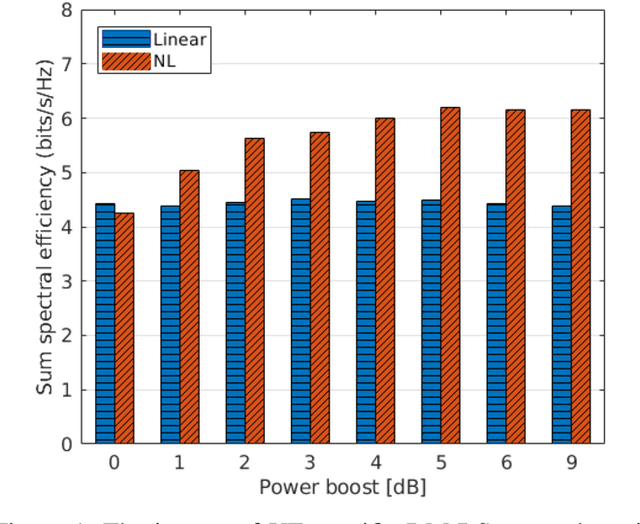
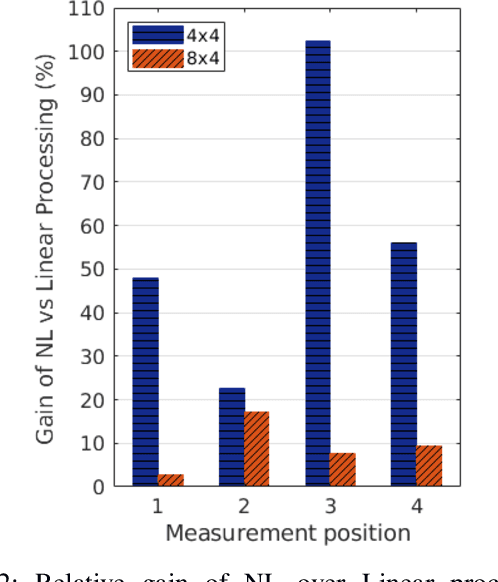
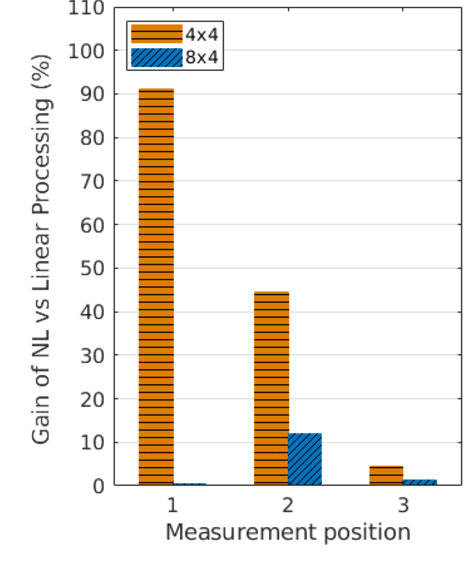
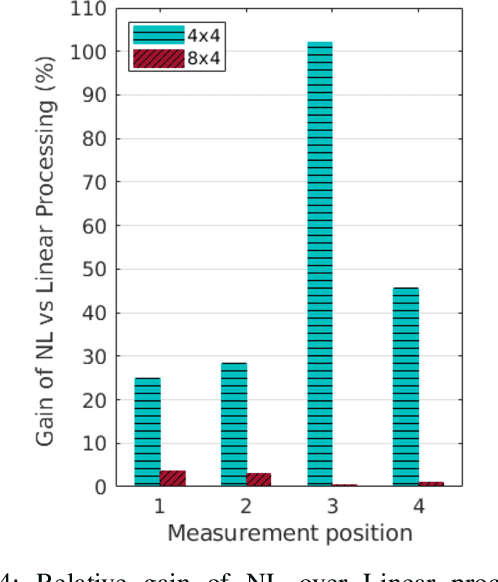
MIMO mobile systems, with a large number of antennas at the base-station side, enable the concurrent transmission of multiple, spatially separated information streams and, therefore, enable improved network throughput and connectivity both in uplink and downlink transmissions. Traditionally, to efficiently facilitate such MIMO transmissions, linear base-station processing is adopted, that translates the MIMO channel into several single-antenna channels. Still, while such approaches are relatively easy to implement, they can leave on the table a significant amount of unexploited MIMO capacity. Recently proposed non-linear base-station processing methods claim this unexplored capacity and promise a substantially increased network throughput. Still, to the best of the authors' knowledge, non-linear base-station processing methods not only have not yet been adopted by actual systems, but have not even been evaluated in a standard-compliant framework, involving of all the necessary algorithmic modules required by a practical system. This work, outlines our experience by trying to incorporate and evaluate the gains of non-linear base-station processing in a 3GPP standard environment. We discuss the several corresponding challenges and our adopted solutions, together with their corresponding limitations. We report gains that we have managed to verify, and we also discuss remaining challenges, missing algorithmic components and future research directions that would be required towards highly efficient, future mobile systems that can efficiently exploit the gains of non-linear, base-station processing.