 Add to Chrome
 Add to Firefox
 Add to Edge
Efficient and Robust Online Learning to Rank in Decentralized Systems
Jun 10, 2026
In Online Learning to Rank (OLTR), ranking models are trained directly from live user interactions, but existing systems rely on a trusted central server to collect and process these interactions. This leaves operators free to introduce biases that conflict with user interests. Decentralized learning offers an attractive alternative, allowing users to collaboratively train a shared ranking model by exchanging model updates directly with one another, without any central authority. In such settings, however, malicious nodes can send poisoned model updates that degrade the ranking quality of honest nodes. We introduce RankGuard, a decentralized OLTR framework in which users collaboratively train ranking models and exchange model updates directly with other nodes. RankGuard defends against poisoning attacks by carefully evaluating incoming models against the user's own private click history, corrected for position bias. An incoming model is only aggregated if it better explains the user's past interactions than the current local model, making it fundamentally hard for malicious nodes to craft updates that pass this test without also genuinely helping the user. We derive a theoretical convergence guarantee of RankGuard. To the best of our knowledge, this is the first formal convergence analysis of a decentralized OLTR algorithm. We evaluate RankGuard against four poisoning attacks, including a powerful adaptive attack, using four standard benchmarks and three click models. RankGuard outperforms all baselines in most settings while being up to 62x more efficient than its closest competitors.

A Large-Scale Web Search Dataset for Federated Online Learning to Rank
Aug 17, 2025The centralized collection of search interaction logs for training ranking models raises significant privacy concerns. Federated Online Learning to Rank (FOLTR) offers a privacy-preserving alternative by enabling collaborative model training without sharing raw user data. However, benchmarks in FOLTR are largely based on random partitioning of classical learning-to-rank datasets, simulated user clicks, and the assumption of synchronous client participation. This oversimplifies real-world dynamics and undermines the realism of experimental results. We present AOL4FOLTR, a large-scale web search dataset with 2.6 million queries from 10,000 users. Our dataset addresses key limitations of existing benchmarks by including user identifiers, real click data, and query timestamps, enabling realistic user partitioning, behavior modeling, and asynchronous federated learning scenarios.
De-DSI: Decentralised Differentiable Search Index
Apr 19, 2024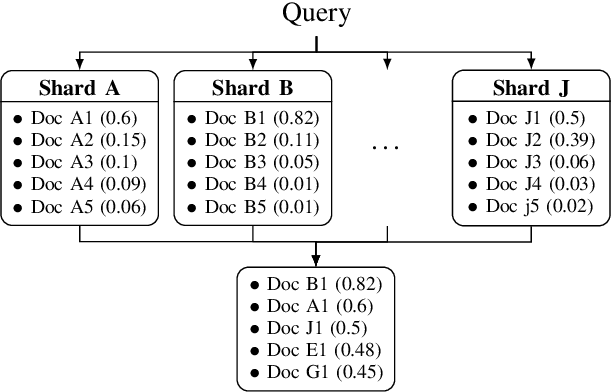
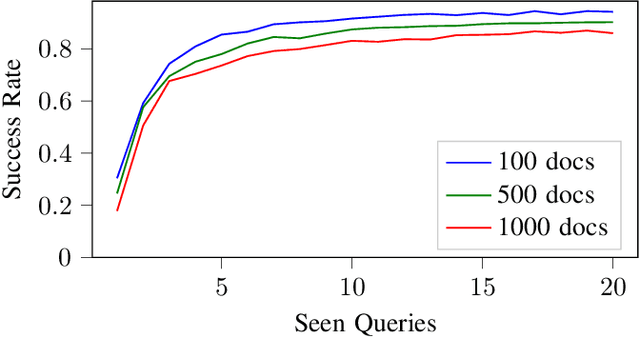
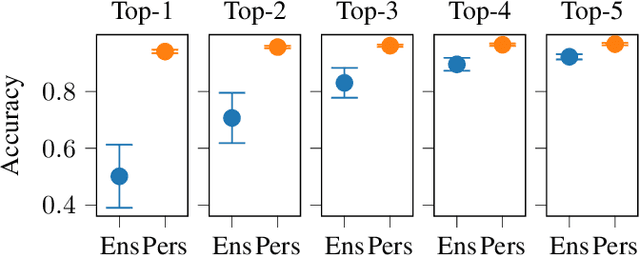
This study introduces De-DSI, a novel framework that fuses large language models (LLMs) with genuine decentralization for information retrieval, particularly employing the differentiable search index (DSI) concept in a decentralized setting. Focused on efficiently connecting novel user queries with document identifiers without direct document access, De-DSI operates solely on query-docid pairs. To enhance scalability, an ensemble of DSI models is introduced, where the dataset is partitioned into smaller shards for individual model training. This approach not only maintains accuracy by reducing the number of data each model needs to handle but also facilitates scalability by aggregating outcomes from multiple models. This aggregation uses a beam search to identify top docids and applies a softmax function for score normalization, selecting documents with the highest scores for retrieval. The decentralized implementation demonstrates that retrieval success is comparable to centralized methods, with the added benefit of the possibility of distributing computational complexity across the network. This setup also allows for the retrieval of multimedia items through magnet links, eliminating the need for platforms or intermediaries.