 Add to Chrome
 Add to Firefox
 Add to Edge
A Real-Time Generalized Nash Equilibrium Framework for Interaction-Aware Autonomous Driving in Mixed Traffic
Jul 23, 2026
Safe and efficient navigation in mixed-traffic environments remains a critical challenge for Autonomous Vehicles (AVs), primarily due to the complex interdependence between the AV's decisions and the unpredictable reactions of human drivers. This paper introduces a comprehensive decision-making framework that formulates the driving interaction as a Generalized Nash Equilibrium Problem (GNEP). Unlike decoupled optimization approaches, this framework explicitly models shared safety and geometric constraints, ensuring that the feasibility of the AV's strategy is dynamically linked to the opponent's actions. To solve this non-convex problem in real-time, we propose a dedicated solver based on Particle Swarm Optimization (PSO). The complete architecture was validated on a test track using a real autonomous Renault Zoé interacting with a human driver. Experimental results demonstrate the system's ability to handle critical scenarios by generating comfortable, human-like trajectories. Benchmarks confirm the solver's operational feasibility, achieving convergence in under 50 ms.

GTP-UDrive: Unified Game-Theoretic Trajectory Planner and Decision-Maker for Autonomous Driving in Mixed Traffic Environments
Jun 20, 2024Understanding the interdependence between autonomous and human-operated vehicles remains an ongoing challenge, with significant implications for the safety and feasibility of autonomous driving.This interdependence arises from inherent interactions among road users.Thus, it is crucial for Autonomous Vehicles (AVs) to understand and analyze the intentions of human-driven vehicles, and to display behavior comprehensible to other traffic participants.To this end, this paper presents GTP-UDRIVE, a unified game-theoretic trajectory planner and decision-maker considering a mixed-traffic environment. Our model considers the intentions of other vehicles in the decision-making process and provides the AV with a human-like trajectory, based on the clothoid interpolation technique.% This study investigates a solver based on Particle Swarm Optimization (PSO) that quickly converges to an optimal decision.Among highly interactive traffic scenarios, the intersection crossing is particularly challenging. Hence, we choose to demonstrate the feasibility and effectiveness of our method in real traffic conditions, using an experimental autonomous vehicle at an unsignalized intersection. Testing results reveal that our approach is suitable for 1) Making decisions and generating trajectories simultaneously. 2) Describing the vehicle's trajectory as a piecewise clothoid and enforcing geometric constraints. 3) Reducing search space dimensionality for the trajectory optimization problem.
Automatic generation of ground truth for the evaluation of obstacle detection and tracking techniques
Jul 16, 2018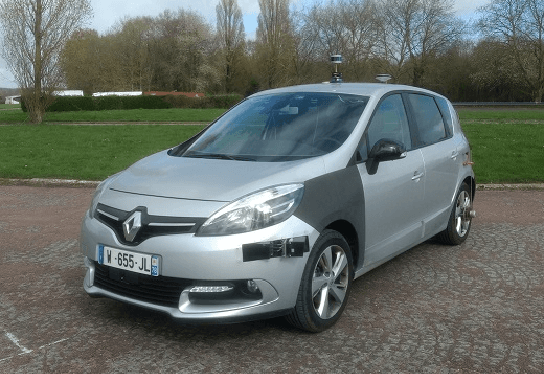
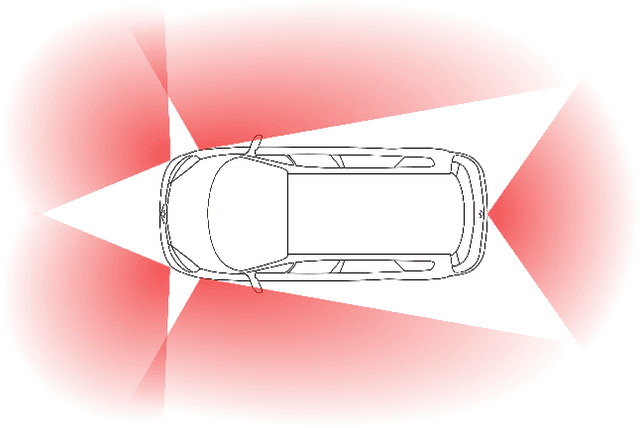
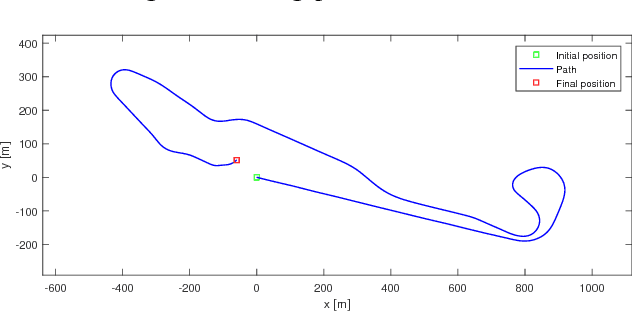
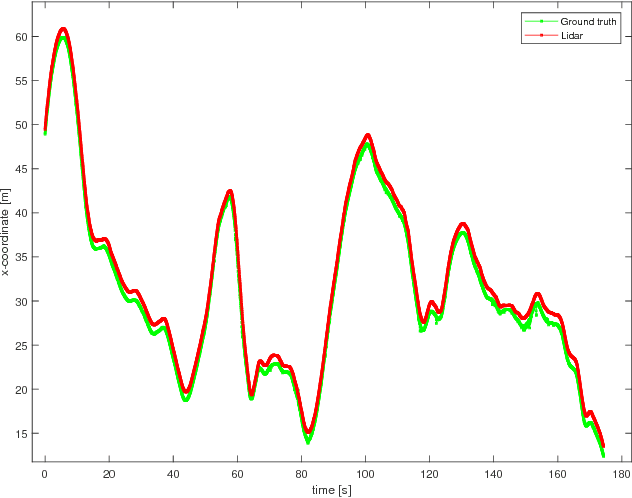
As automated vehicles are getting closer to becoming a reality, it will become mandatory to be able to characterise the performance of their obstacle detection systems. This validation process requires large amounts of ground-truth data, which is currently generated by manually annotation. In this paper, we propose a novel methodology to generate ground-truth kinematics datasets for specific objects in real-world scenes. Our procedure requires no annotation whatsoever, human intervention being limited to sensors calibration. We present the recording platform which was exploited to acquire the reference data and a detailed and thorough analytical study of the propagation of errors in our procedure. This allows us to provide detailed precision metrics for each and every data item in our datasets. Finally some visualisations of the acquired data are given.