 Add to Chrome
 Add to Firefox
 Add to Edge
In-Context VLA: Endowing Vision-Language-Action Models with Language via In-Context Post-Training and Agentic Tool Use
Aug 06, 2026
Vision-Language-Action (VLA) models have become the dominant recipe for generalist manipulation, yet they are almost universally trained by behavior cloning: a policy imitates expert action chunks conditioned on a static image and a fixed instruction. A natural remedy is to inject explicit reasoning through textual chain-of-thought (CoT). We show, both empirically and analytically, that free-form textual CoT degrades low-level control: the reasoning it produces is ungrounded, its latency breaks closed-loop timing, and, crucially, the reasoning and action tokens are optimized against conflicting objectives so that the policy learns to narrate rather than to act. We argue that what a VLA needs is not the ability to generate language, but the ability to consume grounded language. To this end we introduce \textbf{\ourmethod{}}, a framework that endows a VLA with language competence through (i) in-context post-training, in which perceptual evidence is injected as structured context and the model is supervised only on actions, and (ii) an agentic tool-use interface, in which the policy queries open-vocabulary detectors, monocular depth, and a vision--language model to actively acquire task-relevant information. Rather than emitting a single templated caption, our data engine produces diverse, paraphrased, and evidence-conditioned spatial descriptions, so that the policy learns to interpret language it has never seen verbatim. Across the RoboCasa-GR1, SimplerEnv, and LIBERO simulation benchmarks, together with 8 real-world robot manipulation tasks, our method consistently achieves SOTA results in both performance and efficiency when compared with CoT-based approaches under matched configurations.

WeClick: Weakly-Supervised Video Semantic Segmentation with Click Annotations
Aug 04, 2021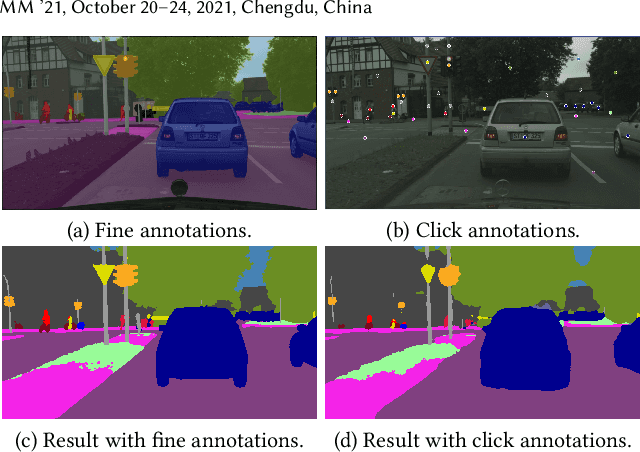
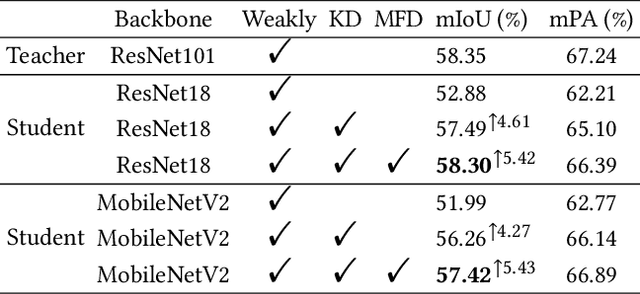
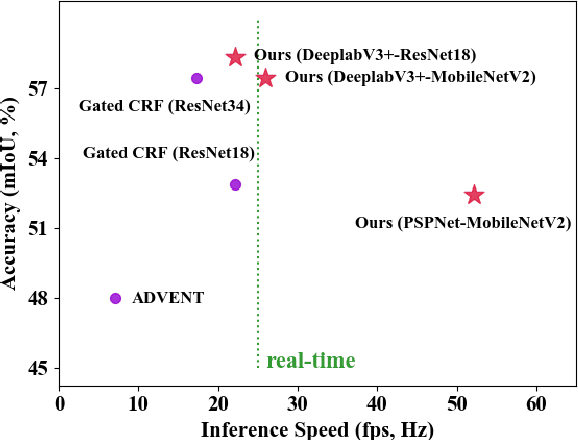
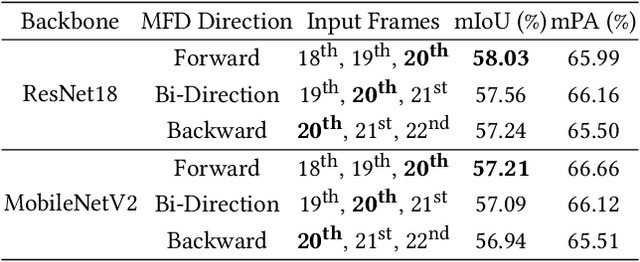
Compared with tedious per-pixel mask annotating, it is much easier to annotate data by clicks, which costs only several seconds for an image. However, applying clicks to learn video semantic segmentation model has not been explored before. In this work, we propose an effective weakly-supervised video semantic segmentation pipeline with click annotations, called WeClick, for saving laborious annotating effort by segmenting an instance of the semantic class with only a single click. Since detailed semantic information is not captured by clicks, directly training with click labels leads to poor segmentation predictions. To mitigate this problem, we design a novel memory flow knowledge distillation strategy to exploit temporal information (named memory flow) in abundant unlabeled video frames, by distilling the neighboring predictions to the target frame via estimated motion. Moreover, we adopt vanilla knowledge distillation for model compression. In this case, WeClick learns compact video semantic segmentation models with the low-cost click annotations during the training phase yet achieves real-time and accurate models during the inference period. Experimental results on Cityscapes and Camvid show that WeClick outperforms the state-of-the-art methods, increases performance by 10.24% mIoU than baseline, and achieves real-time execution.