 Add to Chrome
 Add to Firefox
 Add to Edge
Steerable Visual Representations
Apr 02, 2026
Pretrained Vision Transformers (ViTs) such as DINOv2 and MAE provide generic image features that can be applied to a variety of downstream tasks such as retrieval, classification, and segmentation. However, such representations tend to focus on the most salient visual cues in the image, with no way to direct them toward less prominent concepts of interest. In contrast, Multimodal LLMs can be guided with textual prompts, but the resulting representations tend to be language-centric and lose their effectiveness for generic visual tasks. To address this, we introduce Steerable Visual Representations, a new class of visual representations, whose global and local features can be steered with natural language. While most vision-language models (e.g., CLIP) fuse text with visual features after encoding (late fusion), we inject text directly into the layers of the visual encoder (early fusion) via lightweight cross-attention. We introduce benchmarks for measuring representational steerability, and demonstrate that our steerable visual features can focus on any desired objects in an image while preserving the underlying representation quality. Our method also matches or outperforms dedicated approaches on anomaly detection and personalized object discrimination, exhibiting zero-shot generalization to out-of-distribution tasks.

No Detail Left Behind: Revisiting Self-Retrieval for Fine-Grained Image Captioning
Sep 04, 2024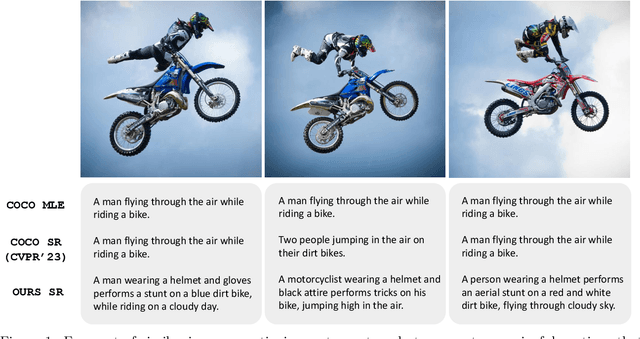
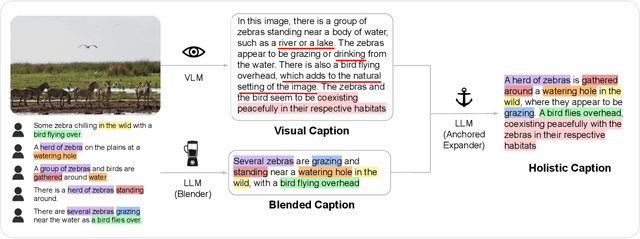
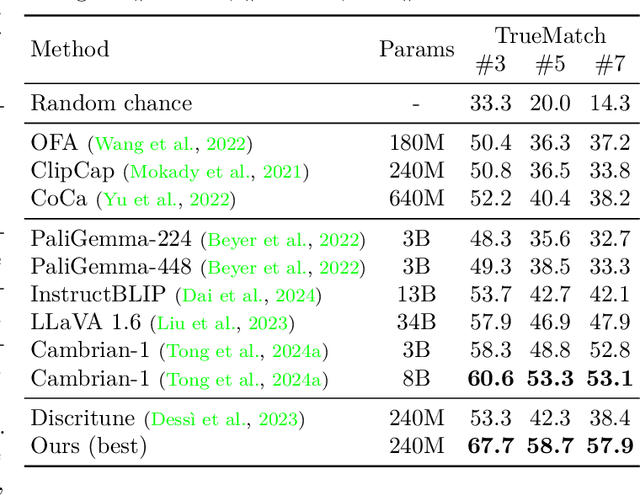
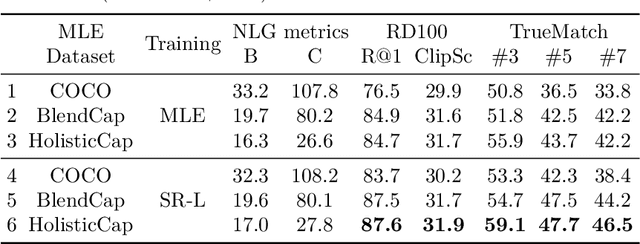
Image captioning systems are unable to generate fine-grained captions as they are trained on data that is either noisy (alt-text) or generic (human annotations). This is further exacerbated by maximum likelihood training that encourages generation of frequently occurring phrases. Previous works have tried to address this limitation by fine-tuning captioners with a self-retrieval (SR) reward. However, we find that SR fine-tuning has a tendency to reduce caption faithfulness and even hallucinate. In this work, we circumvent this bottleneck by improving the MLE initialization of the captioning system and designing a curriculum for the SR fine-tuning process. To this extent, we present (1) Visual Caption Boosting, a novel framework to instill fine-grainedness in generic image captioning datasets while remaining anchored in human annotations; and (2) BagCurri, a carefully designed training curriculum that more optimally leverages the contrastive nature of the self-retrieval reward. Jointly, they enable the captioner to describe fine-grained aspects in the image while preserving faithfulness to ground-truth captions. Our approach outperforms previous work by +8.9% on SR against 99 random distractors (RD100) (Dessi et al., 2023); and +7.6% on ImageCoDe. Additionally, existing metrics to evaluate captioning systems fail to reward diversity or evaluate a model's fine-grained understanding ability. Our third contribution addresses this by proposing self-retrieval from the lens of evaluation. We introduce TrueMatch, a benchmark comprising bags of highly similar images that uses SR to assess the captioner's ability to capture subtle visual distinctions. We evaluate and compare several state-of-the-art open-source MLLMs on TrueMatch, and find that our SR approach outperforms them all by a significant margin (e.g. +4.8% - 7.1% over Cambrian) while having 1-2 orders of magnitude fewer parameters.