 Add to Chrome
 Add to Firefox
 Add to Edge
Synthesizing Procedural Memory: Challenges and Architectures in Automated Workflow Generation
Dec 23, 2025
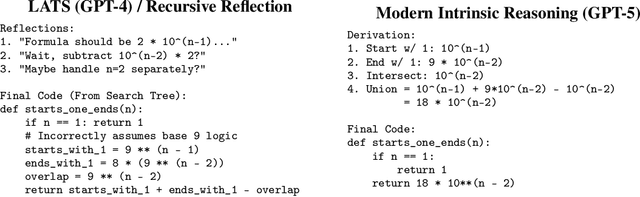
While CodeMem establishes executable code as the optimal representation for agentic procedural memory, the mechanism for autonomously synthesizing this memory from a blank slate remains underexplored. This paper operationalizes the transition of Large Language Models from passive tool-users to active workflow architects. Through a high-fidelity case study of a cross-service orchestration task involving Outlook and OneDrive, we identify and address four structural bottlenecks in automated skill generation: the Discovery Gap involving navigation of large tool registries, the Verification Gap regarding grounding tool response structures, the Decomposition Gap which replaces inefficient search with Linear State Anchoring, and the Scaling Gap focused on concurrency and persistence. We demonstrate that by enforcing a scientific methodology of hypothesize, probe, and code, agents can autonomously write robust, production-grade code skills.

CodeMem: Architecting Reproducible Agents via Dynamic MCP and Procedural Memory
Dec 17, 2025

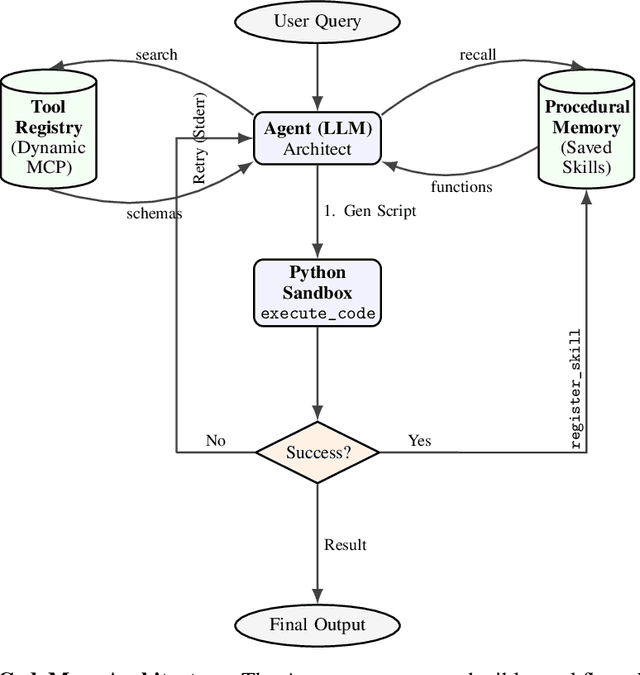

Current tool-using AI agents suffer from limited action space, context inefficiency, and probabilistic instability that makes them unsuitable for handling repetitive tasks which are otherwise reliably and efficiently tackled by agentic workflows built on platforms like n8n and Zapier. Earlier works like CodeAct, DynaSaur, Code Mode have tried to tackle the first two issues by using the whole Python language as its action space: The number of tools that the agent can call becomes infinite. Python code blocks can execute complex actions into a single step and print only relevant results which helps in keeping the context lean. However, the probabilistic instability issue still remains, as for the same task in the same environment, the agent can follow different trajectories due to the probabilistic nature of LLMs. Therefore, we need procedural memory for consistency and reliability. This paper proposes CodeMem, an architecture to implement procedural memory via code which can be used to build and run reusable agentic workflows with deterministic reliability.