 Add to Chrome
 Add to Firefox
 Add to Edge
Beyond Motion Pattern: An Empirical Study of Physical Forces for Human Motion Understanding
Dec 23, 2025
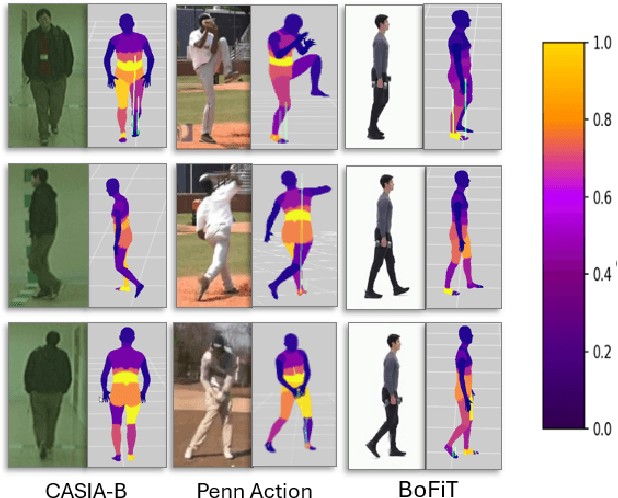
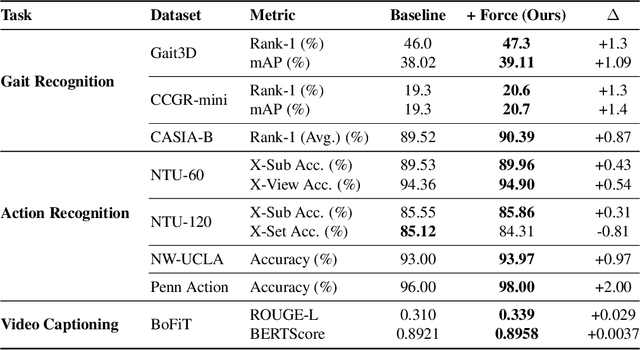
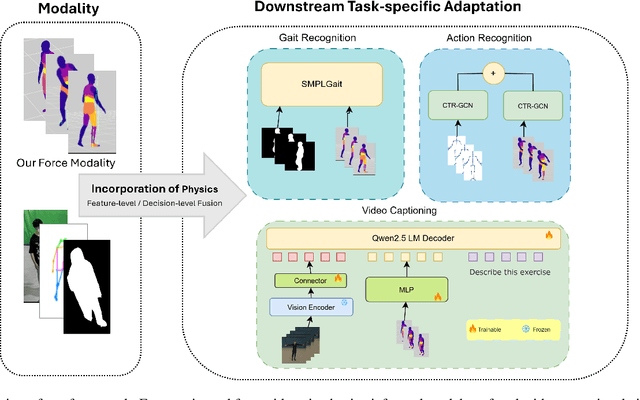
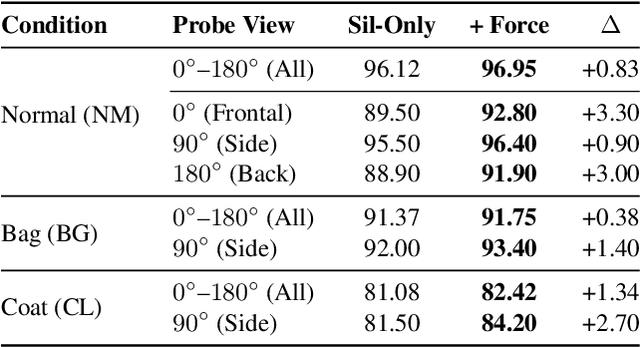
Human motion understanding has advanced rapidly through vision-based progress in recognition, tracking, and captioning. However, most existing methods overlook physical cues such as joint actuation forces that are fundamental in biomechanics. This gap motivates our study: if and when do physically inferred forces enhance motion understanding? By incorporating forces into established motion understanding pipelines, we systematically evaluate their impact across baseline models on 3 major tasks: gait recognition, action recognition, and fine-grained video captioning. Across 8 benchmarks, incorporating forces yields consistent performance gains; for example, on CASIA-B, Rank-1 gait recognition accuracy improved from 89.52% to 90.39% (+0.87), with larger gain observed under challenging conditions: +2.7% when wearing a coat and +3.0% at the side view. On Gait3D, performance also increases from 46.0% to 47.3% (+1.3). In action recognition, CTR-GCN achieved +2.00% on Penn Action, while high-exertion classes like punching/slapping improved by +6.96%. Even in video captioning, Qwen2.5-VL's ROUGE-L score rose from 0.310 to 0.339 (+0.029), indicating that physics-inferred forces enhance temporal grounding and semantic richness. These results demonstrate that force cues can substantially complement visual and kinematic features under dynamic, occluded, or appearance-varying conditions.

Dense-Face: Personalized Face Generation Model via Dense Annotation Prediction
Dec 24, 2024The text-to-image (T2I) personalization diffusion model can generate images of the novel concept based on the user input text caption. However, existing T2I personalized methods either require test-time fine-tuning or fail to generate images that align well with the given text caption. In this work, we propose a new T2I personalization diffusion model, Dense-Face, which can generate face images with a consistent identity as the given reference subject and align well with the text caption. Specifically, we introduce a pose-controllable adapter for the high-fidelity image generation while maintaining the text-based editing ability of the pre-trained stable diffusion (SD). Additionally, we use internal features of the SD UNet to predict dense face annotations, enabling the proposed method to gain domain knowledge in face generation. Empirically, our method achieves state-of-the-art or competitive generation performance in image-text alignment, identity preservation, and pose control.