 Add to Chrome
 Add to Firefox
 Add to Edge
Ensemble of Unsupervised Deep Learning for Clustering Imbalanced Tabular Data
Jul 31, 2026
Data imbalance poses a major challenge in supervised classification, where the majority-class bias contributes to false negatives and overestimates classification accuracy. Unsupervised deep clustering can be immune to class imbalance because representation learning for clustering is performed without class labels. Deep clustering has been proposed for images, languages, and graphs, while its application to tabular data has only emerged recently. This paper is among the first to examine the performance of state-of-the-art deep clustering methods under varying levels of data imbalance. We introduce two novel cluster ensemble approaches: one aggregates deep clustering assignments across different embedding dimensions, and the other applies majority voting to the best-performing clustering algorithms. Experiments on 16 binary tabular datasets with varying and artificially induced levels of imbalance reveal distinct strengths of different deep clustering methods. On average, our ensemble methods outperform individual clustering methods in ACC, NMI, and ARI scores, offering greater resilience to data imbalance when identifying ground-truth classes without supervision. Therefore, in an imbalanced data scenario, deep clustering can serve as a strong alternative to supervised classification.

A Fair Benchmarking of Deep Relational Database Learning Models
Jul 04, 2026Relational databases (RDBs) are the primary data infrastructure in many enterprises, yet recent deep learning methods designed for RDBs have been evaluated under inconsistent experimental protocols, making fair comparison difficult. We present one of the first systematic benchmarking studies of recently released deep learning methods for RDBs, evaluating them across five relational databases, with one classification and one regression task for each. We refactor all deep RDB models to allow the full range of experimental procedures to be applied consistently across all methods. Our findings indicate that the relational transformer (RT) approach delivers the strongest overall performance on both classification and regression tasks compared to the state-of-the-art graph-based modeling and learning of RDBs. Even for single-table learning tasks, deep learning methods designed for RDBs outperform the leading tabular foundation model, TabPFN 2.5. Extending learning from a single table (hop = 0) to multiple tables (hop = 1, 2) by connecting neighboring tables in relational databases enhances performance, but the additional benefit from higher hops diminishes as computational overhead grows. Deep RDB learning methods have the potential to challenge state-of-the-art tabular foundation models, especially on large-scale enterprise data. The source code for this benchmarking study is publicly available.
Mining Electronic Health Records to Investigate Effectiveness of Ensemble Deep Clustering
Apr 08, 2026In electronic health records (EHRs), clustering patients and distinguishing disease subtypes are key tasks to elucidate pathophysiology and aid clinical decision-making. However, clustering in healthcare informatics is still based on traditional methods, especially K-means, and has achieved limited success when applied to embedding representations learned by autoencoders as hybrid methods. This paper investigates the effectiveness of traditional, hybrid, and deep learning methods in heart failure patient cohorts using real EHR data from the All of Us Research Program. Traditional clustering methods perform robustly because deep learning approaches are specifically designed for image clustering, a task that differs substantially from the tabular EHR data setting. To address the shortcomings of deep clustering, we introduce an ensemble-based deep clustering approach that aggregates cluster assignments obtained from multiple embedding dimensions, rather than relying on a single fixed embedding space. When combined with traditional clustering in a novel ensemble framework, the proposed ensemble embedding for deep clustering delivers the best overall performance ranking across 14 diverse clustering methods and multiple patient cohorts. This paper underscores the importance of biological sex-specific clustering of EHR data and the advantages of combining traditional and deep clustering approaches over a single method.
Predicting Early and Complete Drug Release from Long-Acting Injectables Using Explainable Machine Learning
Jan 05, 2026Polymer-based long-acting injectables (LAIs) have transformed the treatment of chronic diseases by enabling controlled drug delivery, thus reducing dosing frequency and extending therapeutic duration. Achieving controlled drug release from LAIs requires extensive optimization of the complex underlying physicochemical properties. Machine learning (ML) can accelerate LAI development by modeling the complex relationships between LAI properties and drug release. However, recent ML studies have provided limited information on key properties that modulate drug release, due to the lack of custom modeling and analysis tailored to LAI data. This paper presents a novel data transformation and explainable ML approach to synthesize actionable information from 321 LAI formulations by predicting early drug release at 24, 48, and 72 hours, classification of release profile types, and prediction of complete release profiles. These three experiments investigate the contribution and control of LAI material characteristics in early and complete drug release profiles. A strong correlation (>0.65) is observed between the true and predicted drug release in 72 hours, while a 0.87 F1-score is obtained in classifying release profile types. A time-independent ML framework predicts delayed biphasic and triphasic curves with better performance than current time-dependent approaches. Shapley additive explanations reveal the relative influence of material characteristics during early and for complete release which fill several gaps in previous in-vitro and ML-based studies. The novel approach and findings can provide a quantitative strategy and recommendations for scientists to optimize the drug-release dynamics of LAI. The source code for the model implementation is publicly available.
LLM Attention Transplant for Transfer Learning of Tabular Data Across Disparate Domains
Nov 08, 2025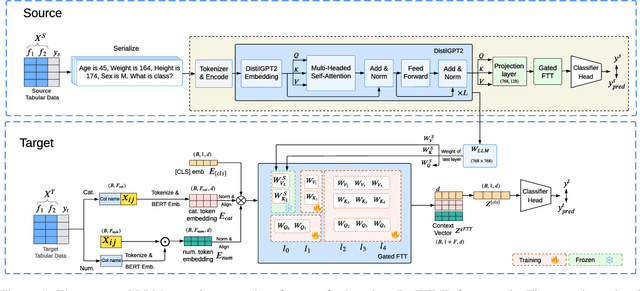
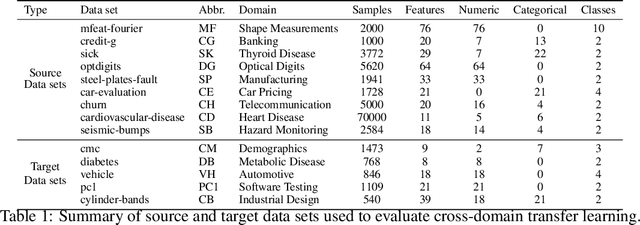
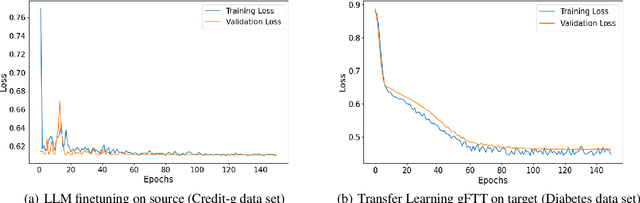

Transfer learning of tabular data is non-trivial due to heterogeneity in the feature space across disparate domains. The limited success of traditional deep learning in tabular knowledge transfer can be advanced by leveraging large language models (LLMs). However, the efficacy of LLMs often stagnates for mixed data types structured in tables due to the limitations of text prompts and in-context learning. We propose a lightweight transfer learning framework that fine-tunes an LLM using source tabular data and transplants the LLM's selective $key$ and $value$ projection weights into a gated feature tokenized transformer (gFTT) built for tabular data. The gFTT model with cross-domain attention is fine-tuned using target tabular data for transfer learning, eliminating the need for shared features, LLM prompt engineering, and large-scale pretrained models. Our experiments using ten pairs of source-target data sets and 12 baselines demonstrate the superiority of the proposed LLM-attention transplant for transfer learning (LATTLE) method over traditional ML models, state-of-the-art deep tabular architectures, and transfer learning models trained on thousands to billions of tabular samples. The proposed attention transfer demonstrates an effective solution to learning relationships between data tables using an LLM in a low-resource learning environment. The source code for the proposed method is publicly available.
No Imputation of Missing Values In Tabular Data Classification Using Incremental Learning
Apr 20, 2025Tabular data sets with varying missing values are prepared for machine learning using an arbitrary imputation strategy. Synthetic values generated by imputation models often concern data stakeholders about computational complexity, data quality, and data-driven outcomes. This paper eliminates these concerns by proposing no imputation incremental learning (NIIL) of tabular data with varying missing value rates and types. The proposed method incrementally learns partitions of overlapping feature sets while using attention masks to exclude missing values from attention scoring. The average classification performance rank order across 15 diverse tabular data sets highlights the superiority of NIIL over 11 state-of-the-art learning methods with or without missing value imputations. Further experiments substantiate the robustness of NIIL against varying missing value types and rates compared to methods that involve the imputation of missing values. Our empirical analysis reveals that a feature partition size of half of the original feature space is, computation-wise and accuracy-wise, the best choice for the proposed incremental learning. The proposed method is one of the first deep learning solutions that can effectively learn tabular data without requiring the imputation of missing values.
DeepIFSA: Deep Imputation of Missing Values Using Feature and Sample Attention
Jan 19, 2025Missing values of varying patterns and rates in real-world tabular data pose a significant challenge in developing reliable data-driven models. Existing missing value imputation methods use statistical and traditional machine learning, which are ineffective when the missing rate is high and not at random. This paper explores row and column attention in tabular data to address the shortcomings of existing methods by introducing a new method for imputing missing values. The method combines between-feature and between-sample attention learning in a deep data reconstruction framework. The proposed data reconstruction uses CutMix data augmentation within a contrastive learning framework to improve the uncertainty of missing value estimation. The performance and generalizability of trained imputation models are evaluated on set-aside test data folds with missing values. The proposed joint attention learning outperforms nine state-of-the-art imputation methods across several missing value types and rates (10%-50%) on twelve data sets. Real electronic health records data with missing values yield the best classification accuracy when imputed using the proposed attention learning compared to other statistical, machine learning, and deep imputation methods. This paper highlights the heterogeneity of tabular data sets to recommend imputation methods based on missing value types and data characteristics.
Transfer Learning of Tabular Data by Finetuning Large Language Models
Jan 12, 2025Despite the artificial intelligence (AI) revolution, deep learning has yet to achieve much success with tabular data due to heterogeneous feature space and limited sample sizes without viable transfer learning. The new era of generative AI, powered by large language models (LLM), brings unprecedented learning opportunities to diverse data and domains. This paper investigates the effectiveness of an LLM application programming interface (API) and transfer learning of LLM in tabular data classification. LLM APIs respond to input text prompts with tokenized data and instructions, whereas transfer learning finetunes an LLM for a target classification task. This paper proposes an end-to-end finetuning of LLM to demonstrate cross-data transfer learning on ten benchmark data sets when large pre-trained tabular data models do not exist to facilitate transfer learning. The proposed LLM finetuning method outperforms state-of-the-art machine and deep learning methods on tabular data with less than ten features - a standard feature size for tabular data sets. The transfer learning approach uses a fraction of the computational cost of other deep learning or API-based solutions while ensuring competitive or superior classification performance.
Attention versus Contrastive Learning of Tabular Data -- A Data-centric Benchmarking
Jan 08, 2024Despite groundbreaking success in image and text learning, deep learning has not achieved significant improvements against traditional machine learning (ML) when it comes to tabular data. This performance gap underscores the need for data-centric treatment and benchmarking of learning algorithms. Recently, attention and contrastive learning breakthroughs have shifted computer vision and natural language processing paradigms. However, the effectiveness of these advanced deep models on tabular data is sparsely studied using a few data sets with very large sample sizes, reporting mixed findings after benchmarking against a limited number of baselines. We argue that the heterogeneity of tabular data sets and selective baselines in the literature can bias the benchmarking outcomes. This article extensively evaluates state-of-the-art attention and contrastive learning methods on a wide selection of 28 tabular data sets (14 easy and 14 hard-to-classify) against traditional deep and machine learning. Our data-centric benchmarking demonstrates when traditional ML is preferred over deep learning and vice versa because no best learning method exists for all tabular data sets. Combining between-sample and between-feature attentions conquers the invincible traditional ML on tabular data sets by a significant margin but fails on high dimensional data, where contrastive learning takes a robust lead. While a hybrid attention-contrastive learning strategy mostly wins on hard-to-classify data sets, traditional methods are frequently superior on easy-to-classify data sets with presumably simpler decision boundaries. To the best of our knowledge, this is the first benchmarking paper with statistical analyses of attention and contrastive learning performances on a diverse selection of tabular data sets against traditional deep and machine learning baselines to facilitate further advances in this field.
Between-Sample Relationship in Learning Tabular Data Using Graph and Attention Networks
Jun 11, 2023Traditional machine learning assumes samples in tabular data to be independent and identically distributed (i.i.d). This assumption may miss useful information within and between sample relationships in representation learning. This paper relaxes the i.i.d assumption to learn tabular data representations by incorporating between-sample relationships for the first time using graph neural networks (GNN). We investigate our hypothesis using several GNNs and state-of-the-art (SOTA) deep attention models to learn the between-sample relationship on ten tabular data sets by comparing them to traditional machine learning methods. GNN methods show the best performance on tabular data with large feature-to-sample ratios. Our results reveal that attention-based GNN methods outperform traditional machine learning on five data sets and SOTA deep tabular learning methods on three data sets. Between-sample learning via GNN and deep attention methods yield the best classification accuracy on seven of the ten data sets. This suggests that the i.i.d assumption may not always hold for most tabular data sets.