 Add to Chrome
 Add to Firefox
 Add to Edge
MLingualFC: Evaluating Jailbreak Vulnerabilities in Multilingual Vision-Language Models
Jun 05, 2026
Vision-Language Models (VLMs) have demonstrated strong performance across multimodal tasks, yet their safety robustness remains an open challenge. While prior work has shown that structured visual prompts such as flowcharts can effectively jailbreak VLMs, existing studies are largely limited to English-centric settings. In this paper, we introduce MLingualFC, a multilingual multimodal benchmark designed to evaluate jailbreak vulnerabilities of VLMs across diverse languages using structured flowchart representations. MLingualFC encodes harmful instructions into flowchart images across five languages (Hindi, Punjabi, Spanish, Romanian, and German). We evaluate state-of-the-art multilingual VLMs, including Qwen2.5-VL, Gemma-4, and Pangea, under a black-box threat model. Our results reveal significant multilingual safety gaps. Flowchart-based attacks achieve high attack success rates (ASR) in case of Latin script languages, demonstrating that visual encoding of harmful content effectively bypasses safety alignment across languages. In contrast, non-Latin script languages such as Punjabi exhibit substantially lower ASR, suggesting potential limitations in visual text recognition rather than stronger safety alignment. These findings highlight that current VLM safety mechanisms fail to generalize across languages and modalities. Resources are available at https://github.com/Rishabhpm23/MLingualFC

Elevating Code-mixed Text Handling through Auditory Information of Words
Oct 27, 2023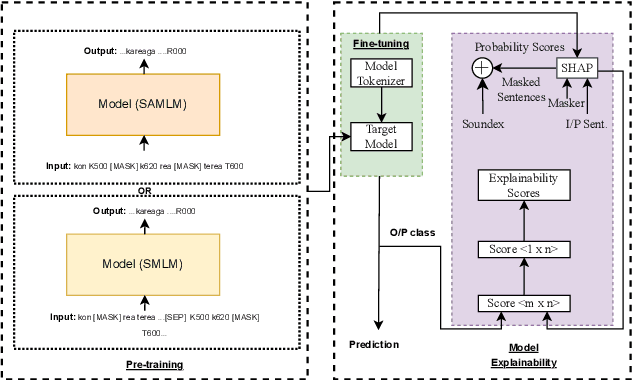
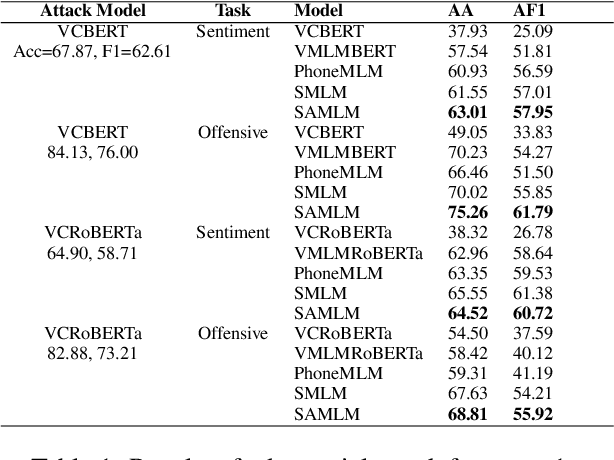
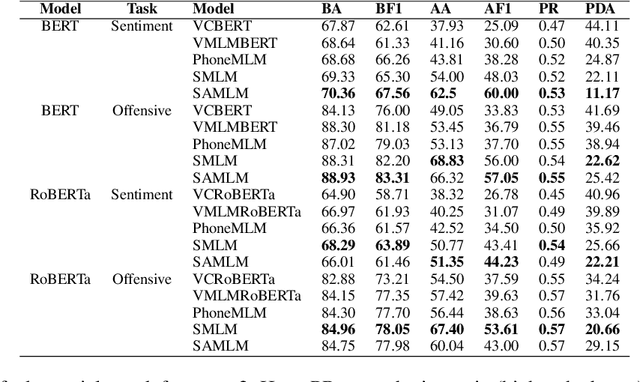
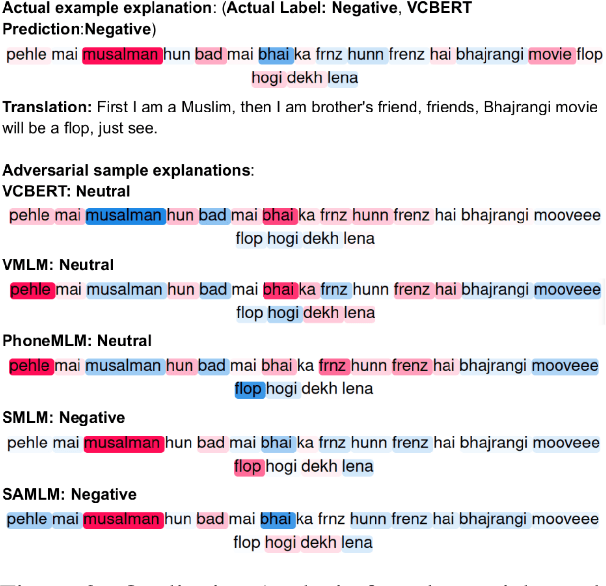
With the growing popularity of code-mixed data, there is an increasing need for better handling of this type of data, which poses a number of challenges, such as dealing with spelling variations, multiple languages, different scripts, and a lack of resources. Current language models face difficulty in effectively handling code-mixed data as they primarily focus on the semantic representation of words and ignore the auditory phonetic features. This leads to difficulties in handling spelling variations in code-mixed text. In this paper, we propose an effective approach for creating language models for handling code-mixed textual data using auditory information of words from SOUNDEX. Our approach includes a pre-training step based on masked-language-modelling, which includes SOUNDEX representations (SAMLM) and a new method of providing input data to the pre-trained model. Through experimentation on various code-mixed datasets (of different languages) for sentiment, offensive and aggression classification tasks, we establish that our novel language modeling approach (SAMLM) results in improved robustness towards adversarial attacks on code-mixed classification tasks. Additionally, our SAMLM based approach also results in better classification results over the popular baselines for code-mixed tasks. We use the explainability technique, SHAP (SHapley Additive exPlanations) to explain how the auditory features incorporated through SAMLM assist the model to handle the code-mixed text effectively and increase robustness against adversarial attacks \footnote{Source code has been made available on \url{https://github.com/20118/DefenseWithPhonetics}, \url{https://www.iitp.ac.in/~ai-nlp-ml/resources.html\#Phonetics}}.