 Add to Chrome
 Add to Firefox
 Add to Edge
Gamayun's Path to Multilingual Mastery: Cost-Efficient Training of a 1.5B-Parameter LLM
Dec 25, 2025
We present Gamayun, a 1.5B-parameter multilingual language model trained entirely from scratch on 2.5T tokens. Designed for efficiency and deployment in resource-constrained environments, Gamayun addresses the lack of research on small non-English-centric LLMs by adopting a novel two-stage pre-training strategy: balanced multilingual training for cross-lingual alignment, followed by high-quality English enrichment to transfer performance gains across languages. Our model supports 12 languages, with special focus on Russian. Despite a significantly smaller training budget than comparable models, Gamayun outperforms LLaMA3.2-1B (9T tokens) on all considered benchmarks, and surpasses Qwen2.5-1.5B (18T tokens) on a wide range of English and multilingual tasks. It matches or exceeds Qwen3 (36T tokens) on most tasks outside advanced STEM, achieving state-of-the-art results in Russian, including the MERA benchmark, among the models of comparable size (1-2B parameters).

A Semi-Supervised Deep Learning Approach to Dataset Collection for Query-By-Humming Task
Dec 02, 2023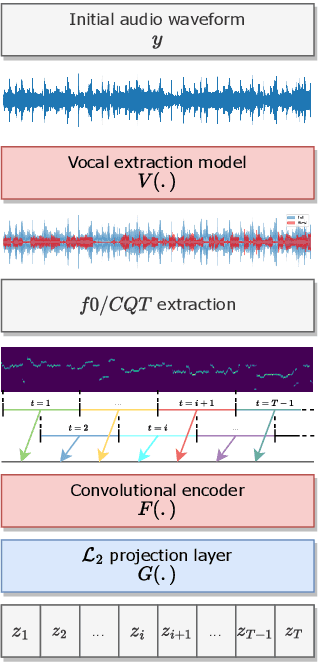
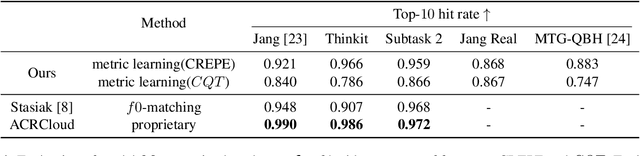
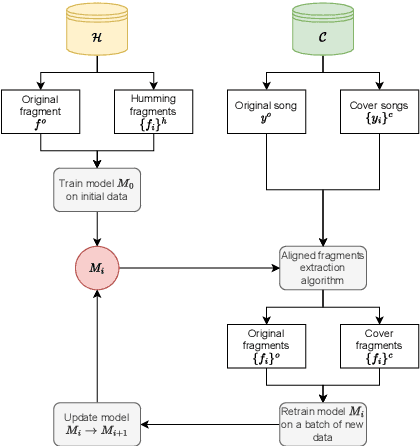
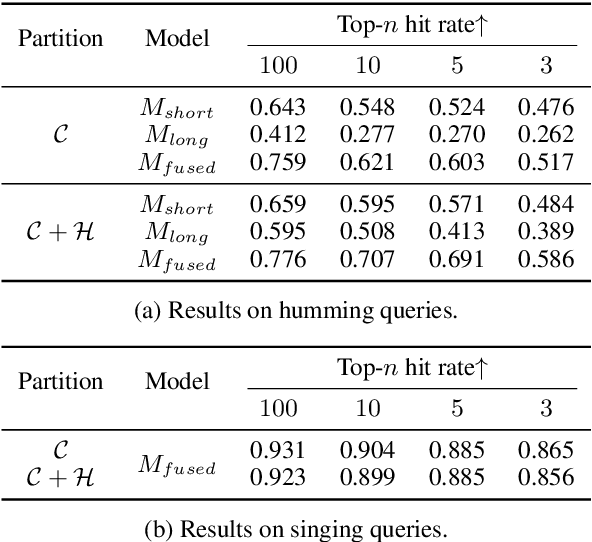
Query-by-Humming (QbH) is a task that involves finding the most relevant song based on a hummed or sung fragment. Despite recent successful commercial solutions, implementing QbH systems remains challenging due to the lack of high-quality datasets for training machine learning models. In this paper, we propose a deep learning data collection technique and introduce Covers and Hummings Aligned Dataset (CHAD), a novel dataset that contains 18 hours of short music fragments, paired with time-aligned hummed versions. To expand our dataset, we employ a semi-supervised model training pipeline that leverages the QbH task as a specialized case of cover song identification (CSI) task. Starting with a model trained on the initial dataset, we iteratively collect groups of fragments of cover versions of the same song and retrain the model on the extended data. Using this pipeline, we collect over 308 hours of additional music fragments, paired with time-aligned cover versions. The final model is successfully applied to the QbH task and achieves competitive results on benchmark datasets. Our study shows that the proposed dataset and training pipeline can effectively facilitate the implementation of QbH systems.