 Add to Chrome
 Add to Firefox
 Add to Edge
AudioSAE: Towards Understanding of Audio-Processing Models with Sparse AutoEncoders
Feb 04, 2026
Sparse Autoencoders (SAEs) are powerful tools for interpreting neural representations, yet their use in audio remains underexplored. We train SAEs across all encoder layers of Whisper and HuBERT, provide an extensive evaluation of their stability, interpretability, and show their practical utility. Over 50% of the features remain consistent across random seeds, and reconstruction quality is preserved. SAE features capture general acoustic and semantic information as well as specific events, including environmental noises and paralinguistic sounds (e.g. laughter, whispering) and disentangle them effectively, requiring removal of only 19-27% of features to erase a concept. Feature steering reduces Whisper's false speech detections by 70% with negligible WER increase, demonstrating real-world applicability. Finally, we find SAE features correlated with human EEG activity during speech perception, indicating alignment with human neural processing. The code and checkpoints are available at https://github.com/audiosae/audiosae_demo.

Gamayun's Path to Multilingual Mastery: Cost-Efficient Training of a 1.5B-Parameter LLM
Dec 25, 2025We present Gamayun, a 1.5B-parameter multilingual language model trained entirely from scratch on 2.5T tokens. Designed for efficiency and deployment in resource-constrained environments, Gamayun addresses the lack of research on small non-English-centric LLMs by adopting a novel two-stage pre-training strategy: balanced multilingual training for cross-lingual alignment, followed by high-quality English enrichment to transfer performance gains across languages. Our model supports 12 languages, with special focus on Russian. Despite a significantly smaller training budget than comparable models, Gamayun outperforms LLaMA3.2-1B (9T tokens) on all considered benchmarks, and surpasses Qwen2.5-1.5B (18T tokens) on a wide range of English and multilingual tasks. It matches or exceeds Qwen3 (36T tokens) on most tasks outside advanced STEM, achieving state-of-the-art results in Russian, including the MERA benchmark, among the models of comparable size (1-2B parameters).
Commute Your Domains: Trajectory Optimality Criterion for Multi-Domain Learning
Jan 26, 2025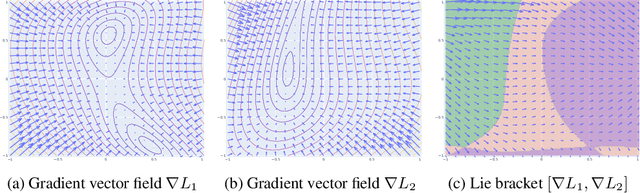
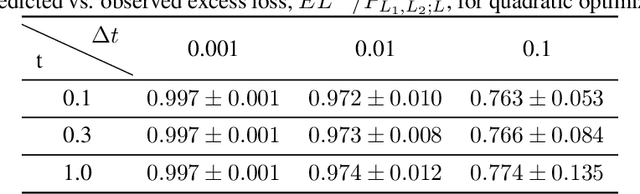
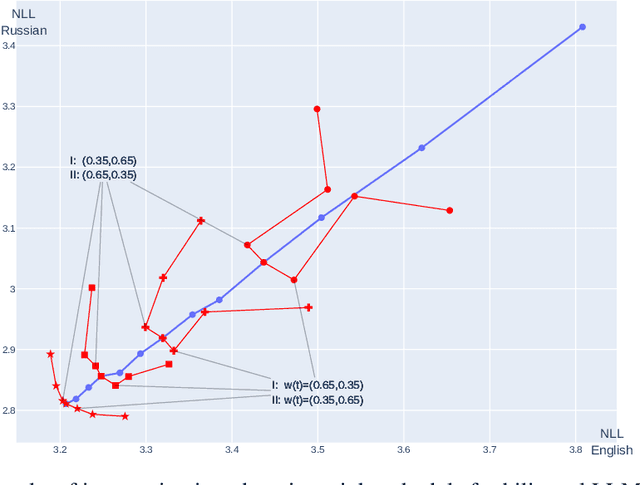
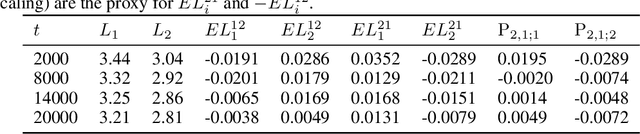
In multi-domain learning, a single model is trained on diverse data domains to leverage shared knowledge and improve generalization. The order in which the data from these domains is used for training can significantly affect the model's performance on each domain. However, this dependence is under-studied. In this paper, we investigate the influence of training order (or data mixing) in multi-domain learning using the concept of Lie bracket of gradient vector fields. By analyzing the infinitesimal effects of changing the training order, we identify regions in the parameter space where altering the order between two training domains can benefit the target loss. We validate the predictions of our theoretical framework on the influence of training order (or data mixing) both on a toy example and bilingual LLM pre-training.