 Add to Chrome
 Add to Firefox
 Add to Edge
Keyphrase Generative Representation of Youth Crisis Conversations Beyond Static Taxonomies
May 26, 2026
Crisis Responders (CRs) rapidly assess thousands of youth SMS conversations each year to identify mental health concerns and guide support. Yet youth distress is increasingly expressed through evolving and context-specific language that often does not fit fixed-label taxonomies. This work analyzed 703,975 de-identified Kids Help Phone conversations (2018-2023) and expanded KHP's 19-label issue taxonomy into a 39-label hierarchical schema. We then introduce Keyphrase Generative Representation (KGR), a constrained LLM generating concise, conversation-specific keyphrases, evaluated across 129 conversations and 387 expert annotations. The expanded taxonomy achieved expert consensus reliability, with an accuracy of 0.96, and expert review found that 81% of keyphrases accurately reflected content and 74% improved clarity. KGR surfaced identity-linked themes absent from the fixed taxonomy, including immigration problems and caregiver burden, and supported a topic-retrieval workflow that increased accuracy from 0.25 to 0.70 (+0.45) over the manual analyst process. KGR marks a shift toward hybrid, interpretable generative representations that extend crisis response beyond static taxonomies to surface emerging and culturally grounded patterns of youth distress.

Interpretable Fine-Gray Deep Survival Model for Competing Risks: Predicting Post-Discharge Foot Complications for Diabetic Patients in Ontario
Nov 16, 2025Model interpretability is crucial for establishing AI safety and clinician trust in medical applications for example, in survival modelling with competing risks. Recent deep learning models have attained very good predictive performance but their limited transparency, being black-box models, hinders their integration into clinical practice. To address this gap, we propose an intrinsically interpretable survival model called CRISPNAM-FG. Leveraging the structure of Neural Additive Models (NAMs) with separate projection vectors for each risk, our approach predicts the Cumulative Incidence Function using the Fine-Gray formulation, achieving high predictive power with intrinsically transparent and auditable predictions. We validated the model on several benchmark datasets and applied our model to predict future foot complications in diabetic patients across 29 Ontario hospitals (2016-2023). Our method achieves competitive performance compared to other deep survival models while providing transparency through shape functions and feature importance plots.
FAIIR: Building Toward A Conversational AI Agent Assistant for Youth Mental Health Service Provision
Jun 10, 2024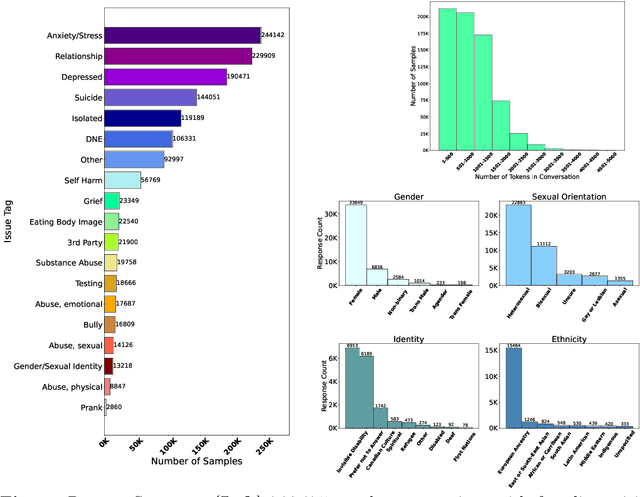
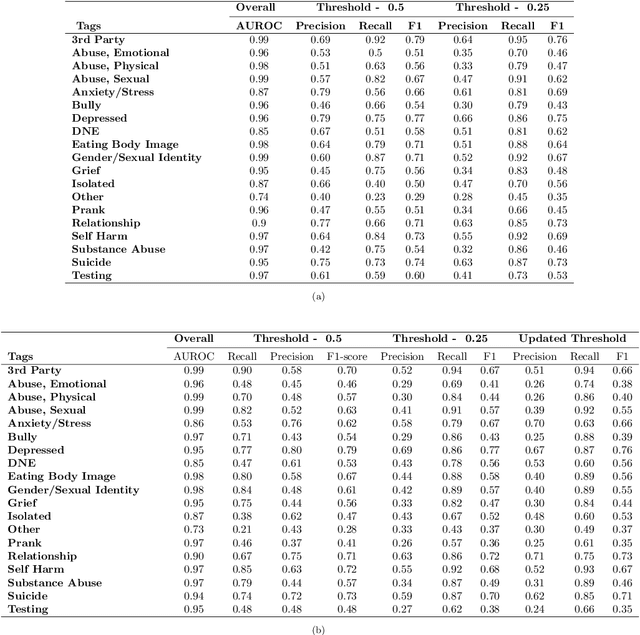
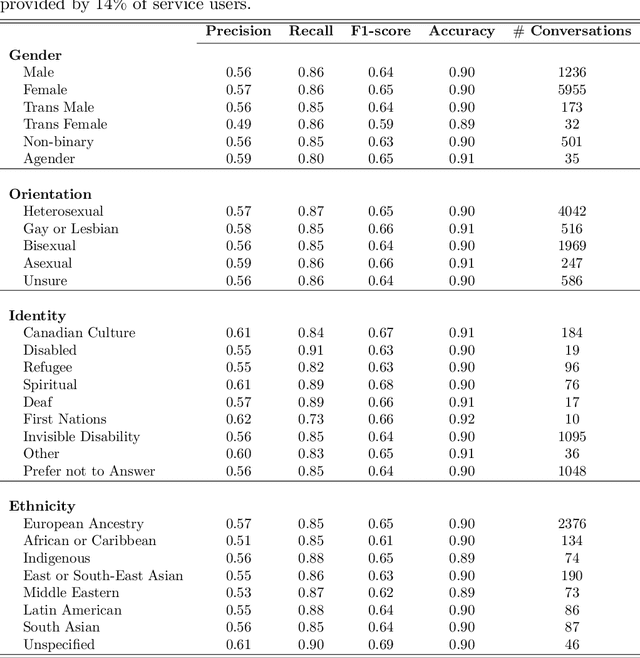
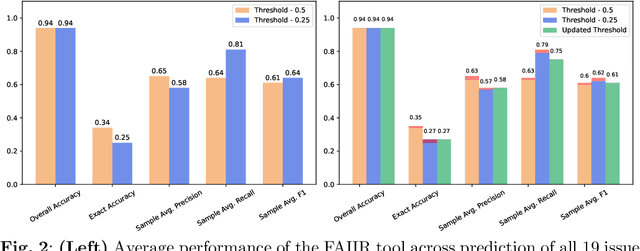
World's healthcare systems and mental health agencies face both a growing demand for youth mental health services, alongside a simultaneous challenge of limited resources. Given these constraints, this work presents our experience in the creation and evaluation of the FAIIR (Frontline Assistant: Issue Identification and Recommendation) tool, an ensemble of domain-adapted and fine-tuned transformer models, leveraging natural language processing to identify issues that youth may be experiencing. We explore the technical development, performance, and validation processes leveraged for the FAIIR tool in application to situations of frontline crisis response via Kids Help Phone. Frontline Crisis Responders assign an issue tag from a defined list following each conversation. Assisting with the identification of issues of relevance helps reduce the burden on CRs, ensuring that appropriate resources can be provided and that active rescues and mandatory reporting can take place in critical situations requiring immediate de-escalation.
The FAIIR Tool: A Conversational AI Agent Assistant for Youth Mental Health Service Provision
May 28, 2024World's healthcare systems and mental health agencies face both a growing demand for youth mental health services, alongside a simultaneous challenge of limited resources. Given these constraints, this work presents our experience in the creation and evaluation of the FAIIR (Frontline Assistant: Issue Identification and Recommendation) tool, an ensemble of domain-adapted and fine-tuned transformer models, leveraging natural language processing to identify issues that youth may be experiencing. We explore the technical development, performance, and validation processes leveraged for the FAIIR tool in application to situations of frontline crisis response via Kids Help Phone. Frontline Crisis Responders assign an issue tag from a defined list following each conversation. Assisting with the identification of issues of relevance helps reduce the burden on CRs, ensuring that appropriate resources can be provided and that active rescues and mandatory reporting can take place in critical situations requiring immediate de-escalation.