 Add to Chrome
 Add to Firefox
 Add to Edge
Human-in-the-Loop User Feedback Affects Perceived Accuracy and Trust, but Task Subjectivity Matters
Jul 20, 2026
While ML can produce complex models beyond those that a human could produce manually, incorporating human input can often improve performance beyond purely data-driven models. While this feedback could come from system designers or domain experts, in many cases, the end users who regularly use the system will naturally develop an understanding of its flaws and desire the ability to change the system's behavior based on their knowledge. While soliciting feedback from end users can result in significant model improvement over time, introducing these feedback techniques can also affect several human factors-such as trust or perception of system accuracy-that are not yet fully understood and have different effects reported in the existing literature. Therefore, we sought to build on the existing research to further explore how the act of providing feedback can affect user understanding of an intelligent system and its accuracy in different contexts. We present three controlled experiments that study the effects of interactive feedback collections on user impressions in domains with objective and subjective feedback. The results show that in a context where there is an objectively correct answer, providing HITL feedback lowered both participants' trust in the system and their perception of system accuracy, regardless of whether the system accuracy improved in response to their feedback. However, when the feedback being provided involved subjective opinion, no such negative bias was observed. Furthermore, in the objective context, participants distrusted the system over time, whereas participants in the subjective context mistrusted the system over time. These results highlight the importance of considering the effects of allowing different types of end-user feedback on user trust when designing intelligent systems.

"Trust Junk" Leads to Unjustified Support for Highly Discriminatory Predictive Models
Jul 14, 2026The persuasive power of data visualizations can go awry: for instance, in an explainable AI (XAI) context, visualizations can produce over-trust of predictive models. In this paper, we use a crowdsourced study to show that providing accurate (but superfluous or irrelevant) data in a model explanation can, in fact, result in unjustified trust and other positive beliefs about a model, even when the model is patently discriminatory and unfair. Our results suggest that XAI designers and developers need to consider the implicit or explicit rhetorics of their work, and beware of the potential of visualizations to imbue models with unearned trust.
Soliciting Human-in-the-Loop User Feedback for Interactive Machine Learning Reduces User Trust and Impressions of Model Accuracy
Aug 28, 2020
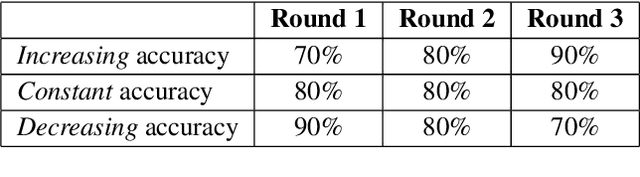
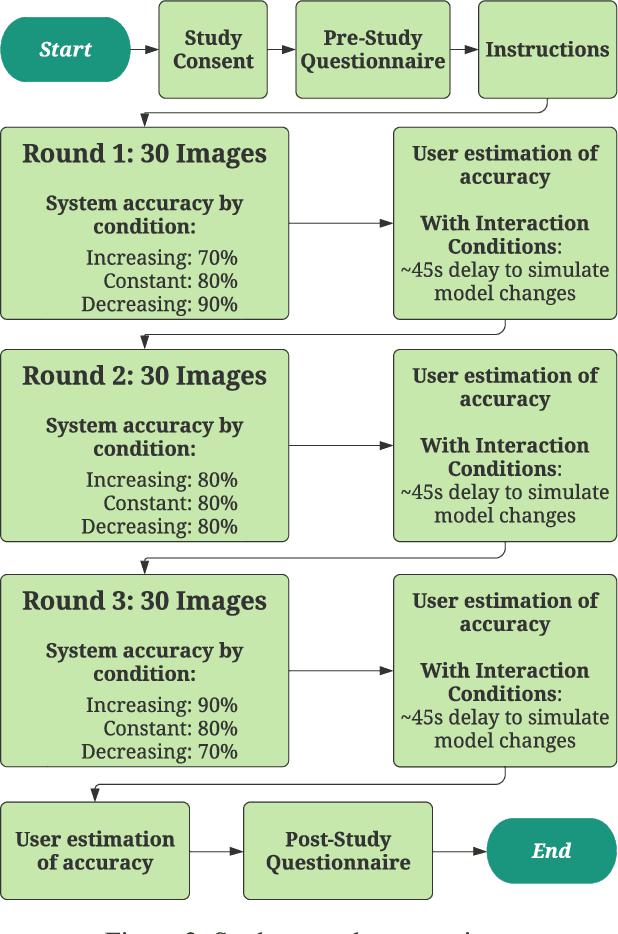
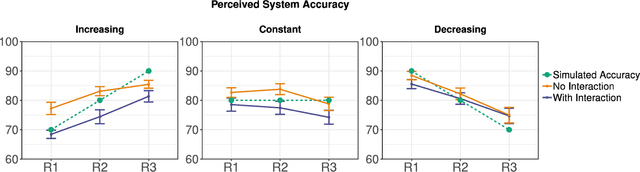
Mixed-initiative systems allow users to interactively provide feedback to potentially improve system performance. Human feedback can correct model errors and update model parameters to dynamically adapt to changing data. Additionally, many users desire the ability to have a greater level of control and fix perceived flaws in systems they rely on. However, how the ability to provide feedback to autonomous systems influences user trust is a largely unexplored area of research. Our research investigates how the act of providing feedback can affect user understanding of an intelligent system and its accuracy. We present a controlled experiment using a simulated object detection system with image data to study the effects of interactive feedback collection on user impressions. The results show that providing human-in-the-loop feedback lowered both participants' trust in the system and their perception of system accuracy, regardless of whether the system accuracy improved in response to their feedback. These results highlight the importance of considering the effects of allowing end-user feedback on user trust when designing intelligent systems.
The Role of Domain Expertise in User Trust and the Impact of First Impressions with Intelligent Systems
Aug 20, 2020


Domain-specific intelligent systems are meant to help system users in their decision-making process. Many systems aim to simultaneously support different users with varying levels of domain expertise, but prior domain knowledge can affect user trust and confidence in detecting system errors. While it is also known that user trust can be influenced by first impressions with intelligent systems, our research explores the relationship between ordering bias and domain expertise when encountering errors in intelligent systems. In this paper, we present a controlled user study to explore the role of domain knowledge in establishing trust and susceptibility to the influence of first impressions on user trust. Participants reviewed an explainable image classifier with a constant accuracy and two different orders of observing system errors (observing errors in the beginning of usage vs. in the end). Our findings indicate that encountering errors early-on can cause negative first impressions for domain experts, negatively impacting their trust over the course of interactions. However, encountering correct outputs early helps more knowledgable users to dynamically adjust their trust based on their observations of system performance. In contrast, novice users suffer from over-reliance due to their lack of proper knowledge to detect errors.
Don't Explain without Verifying Veracity: An Evaluation of Explainable AI with Video Activity Recognition
May 05, 2020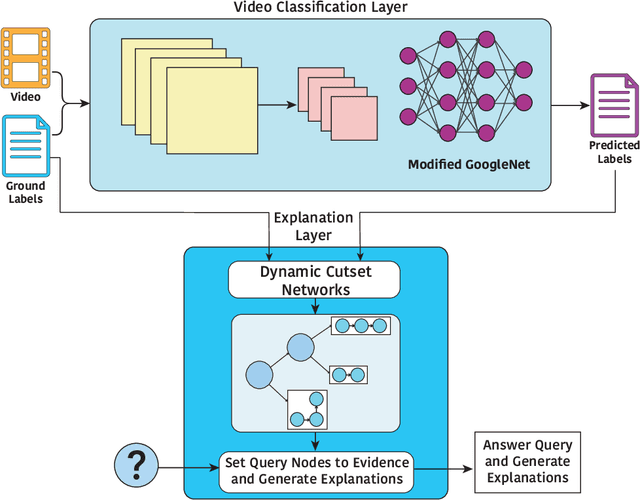
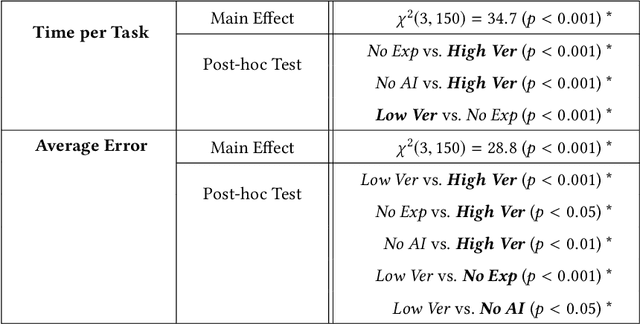
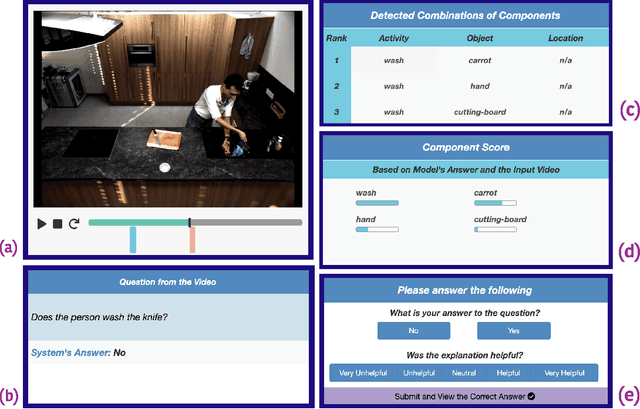
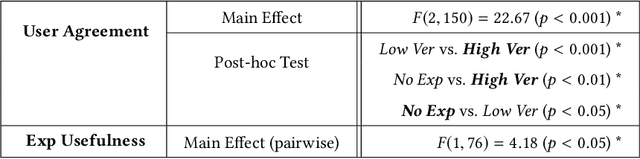
Explainable machine learning and artificial intelligence models have been used to justify a model's decision-making process. This added transparency aims to help improve user performance and understanding of the underlying model. However, in practice, explainable systems face many open questions and challenges. Specifically, designers might reduce the complexity of deep learning models in order to provide interpretability. The explanations generated by these simplified models, however, might not accurately justify and be truthful to the model. This can further add confusion to the users as they might not find the explanations meaningful with respect to the model predictions. Understanding how these explanations affect user behavior is an ongoing challenge. In this paper, we explore how explanation veracity affects user performance and agreement in intelligent systems. Through a controlled user study with an explainable activity recognition system, we compare variations in explanation veracity for a video review and querying task. The results suggest that low veracity explanations significantly decrease user performance and agreement compared to both accurate explanations and a system without explanations. These findings demonstrate the importance of accurate and understandable explanations and caution that poor explanations can sometimes be worse than no explanations with respect to their effect on user performance and reliance on an AI system.