 Add to Chrome
 Add to Firefox
 Add to Edge
Demographically-Conditioned Synthetic Medical Images for Bias Mitigation and Bias Detection in Disease Classifiers
Jul 16, 2026
Per-subgroup fairness audits of medical image classifiers face a sample-size problem: minority subgroups in held-out test sets have so few samples that the resulting confidence intervals on per-subgroup performance are wider than the bias the audit is meant to detect. We argue that a demographically-conditioned synthetic generator can do both: mitigate bias on the training side and detect bias on the evaluation side. Working on COVID-19 chest CT classification with an end-to-end fine-tuned Stable Diffusion 2.1 generator, we make two findings. For bias mitigation (training), a demographically-balanced synthetic cohort is most useful as a pretraining prior, not as joint augmentation: with the same fixed data, sequential pretraining followed by fine-tuning substantially outperforms joint augmentation, and the resulting classifier surpasses the full-real baseline at $\sim$$100\times$ real-data efficiency. For bias detection (evaluation), across five synthetic minority cohorts and five classifier seeds, the synthetic estimator reproduces the subgroup ranking of a well-powered real oracle (Spearman $ρ= 1.00$ on MCC and Recall) and gives the more reliable per-cell estimate where the small real test set runs out of samples. The synthetic cohort is therefore most useful in exactly the cells that fairness audits care about, as both a fix for and a measure of subgroup bias.

CompDiff: Hierarchical Compositional Diffusion for Fair and Zero-Shot Intersectional Medical Image Generation
Mar 17, 2026Generative models are increasingly used to augment medical imaging datasets for fairer AI. Yet a key assumption often goes unexamined: that generators themselves produce equally high-quality images across demographic groups. Models trained on imbalanced data can inherit these imbalances, yielding degraded synthesis quality for rare subgroups and struggling with demographic intersections absent from training. We refer to this as the imbalanced generator problem. Existing remedies such as loss reweighting operate at the optimization level and provide limited benefit when training signal is scarce or absent for certain combinations. We propose CompDiff, a hierarchical compositional diffusion framework that addresses this problem at the representation level. A dedicated Hierarchical Conditioner Network (HCN) decomposes demographic conditioning, producing a demographic token concatenated with CLIP embeddings as cross-attention context. This structured factorization encourages parameter sharing across subgroups and supports compositional generalization to rare or unseen demographic intersections. Experiments on chest X-rays (MIMIC-CXR) and fundus images (FairGenMed) show that CompDiff compares favorably against both standard fine-tuning and FairDiffusion across image quality (FID: 64.3 vs. 75.1), subgroup equity (ES-FID), and zero-shot intersectional generalization (up to 21% FID improvement on held-out intersections). Downstream classifiers trained on CompDiff-generated data also show improved AUROC and reduced demographic bias, suggesting that architectural design of demographic conditioning is an important and underexplored factor in fair medical image generation. Code is available at https://anonymous.4open.science/r/CompDiff-6FE6.
Generative AI for Synthetic Data Across Multiple Medical Modalities: A Systematic Review of Recent Developments and Challenges
Jul 02, 2024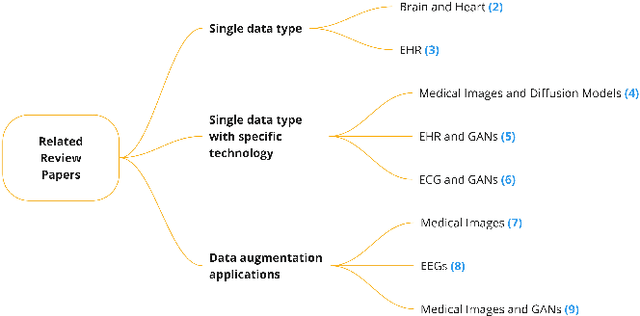
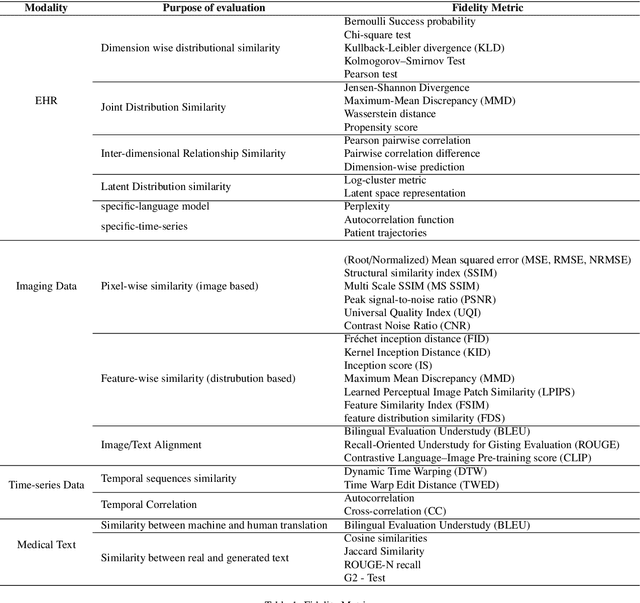
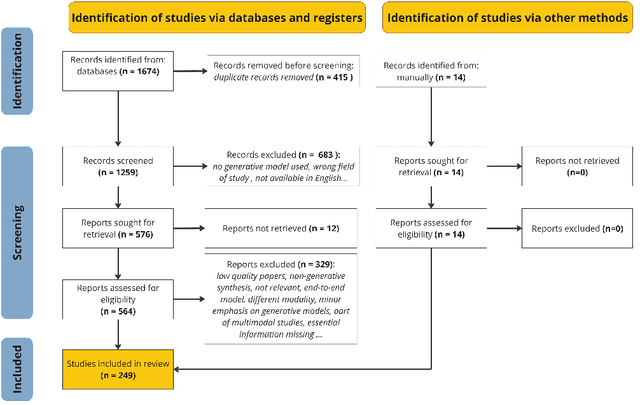

This paper presents a comprehensive systematic review of generative models (GANs, VAEs, DMs, and LLMs) used to synthesize various medical data types, including imaging (dermoscopic, mammographic, ultrasound, CT, MRI, and X-ray), text, time-series, and tabular data (EHR). Unlike previous narrowly focused reviews, our study encompasses a broad array of medical data modalities and explores various generative models. Our search strategy queries databases such as Scopus, PubMed, and ArXiv, focusing on recent works from January 2021 to November 2023, excluding reviews and perspectives. This period emphasizes recent advancements beyond GANs, which have been extensively covered previously. The survey reveals insights from three key aspects: (1) Synthesis applications and purpose of synthesis, (2) generation techniques, and (3) evaluation methods. It highlights clinically valid synthesis applications, demonstrating the potential of synthetic data to tackle diverse clinical requirements. While conditional models incorporating class labels, segmentation masks and image translations are prevalent, there is a gap in utilizing prior clinical knowledge and patient-specific context, suggesting a need for more personalized synthesis approaches and emphasizing the importance of tailoring generative approaches to the unique characteristics of medical data. Additionally, there is a significant gap in using synthetic data beyond augmentation, such as for validation and evaluation of downstream medical AI models. The survey uncovers that the lack of standardized evaluation methodologies tailored to medical images is a barrier to clinical application, underscoring the need for in-depth evaluation approaches, benchmarking, and comparative studies to promote openness and collaboration.