 Add to Chrome
 Add to Firefox
 Add to Edge
Can Generalist Agents Automate Data Curation?
Jun 02, 2026
Curating training data is among the most consequential yet labor-intensive parts of modern AI development: practitioners iteratively propose, implement, evaluate, and revise data policies against noisy benchmark feedback. We ask whether generalist coding agents can automate this data-curation loop. We introduce *Curation-Bench*, an agent-centric benchmark that fixes the model, training recipe, and evaluation suite while giving agents command-line access to inspect data, implement policies, submit them to a fixed training/evaluation pipeline, and revise. In a vision-language instruction-tuning instantiation, out-of-the-box agents reach strong published data-selection baselines within ten iterations. However, trajectory analysis reveals a persistent *execution-research gap*: agents mainly tune local policy variants rather than explore new policy families, even when given strategy guides and paper references. Scaffolds requiring each iteration to cite, instantiate, and adapt a prior method shift agents toward method-guided exploration. The scaffolded agent autonomously composes -- without human design input -- a data-selection policy that outperforms strong published baselines at one-tenth their data budget. Overall, current agents can run the curation loop, but reliable data research requires scaffolded method adaptation, not open-ended prompting alone. Code and benchmark are open-sourced.

Memory-Induced Tool-Drift in LLM Agents
May 24, 2026Modern LLM agents combine long-term memory for personalization with tool-calling interfaces for taking actions in the world -- a combination underpinning contemporary production systems. We study a previously unexamined failure of this combination: when personality-driven biases stored in memory (cost-consciousness, impatience, risk tolerance, etc.) silently affect tool calls in contexts where they are not applicable. We call this memory-induced tool-drift and operationalize it through MEMDRIFT, a benchmark of 105 scenarios spanning five bias dimensions and seven professional domains, generated through an automated adversarial pipeline. Across seven frontier models -- including those with extended reasoning -- biased memories raise deflection scores (a judge-scored measure of parameter deviation from unbiased baselines) by up to $+3.6$ points on a 1--5 scale. Tool-drift persists when memory management is handled by three production memory architectures. The phenomenon affects real-world tools: scanning 6{,}062 tools across 288 verified MCP servers, we flag 608 with susceptible parameters and confirm tool-drift on a validated subset. Mechanistically, biased memories act as implicit steering vectors, pushing activations along the same latent directions as explicit behavioral instructions. They also redistribute attention from task-relevant context toward memory entries with surface-level keyword overlap to the target parameter. Standard defenses -- prompt-based relevance instructions and memory filters -- reduce drift but do not eliminate it. As agents take increasingly consequential actions on a user's behalf, memory-induced tool-drift represents a systematic vulnerability that current safeguards do not address, motivating dedicated defenses at the intersection of memory management and tool-call generation.
Characterizing Model-Native Skills
Apr 19, 2026Skills are a natural unit for describing what a language model can do and how its behavior can be changed. However, existing characterizations rely on human-written taxonomies, textual descriptions, or manual profiling pipelines--all external hypotheses about what matters that need not align with the model's internal representations. We argue that when the goal is to intervene on model behavior, skill characterization should be *model-native*: grounded in the model's own representations rather than imposed through external ontologies. We instantiate this view by recovering a compact orthogonal basis from sequence-level activations. The resulting basis is semantically interpretable but need not correspond to any predefined human ontology; instead, it captures axes of behavioral variation that the model itself organizes around. We validate this characterization on reasoning post-training, using the recovered basis for both SFT data selection and inference-time steering. We develop lightweight proxy interventions to identify which directions are most useful for a given model. Across Llama3-8B and Qwen2.5-3B, selecting data along those directions improves Pass@1 by up to 20% on MATH and 41% on AMC, outperforming data selection based on human-characterized skills. Because the basis lives in activation space, the same directions also serve as steering vectors at inference time, improving Pass@8 by up to 4.8% on MATH--an intervention that human-characterized skills cannot support. We further validate the characterization on safety alignment, where selecting adversarial training data for model-native skill coverage rather than textual diversity yields more sample-efficient learning. These results suggest that recovering skills from the model's own representations, rather than imposing them externally, provides a more effective foundation for intervening on model behavior. Codes are open-sourced.
DiPT: Enhancing LLM reasoning through diversified perspective-taking
Sep 10, 2024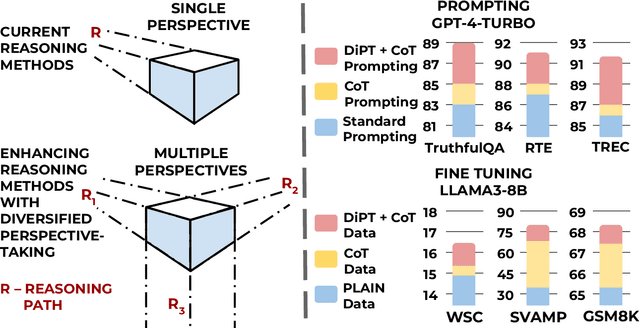
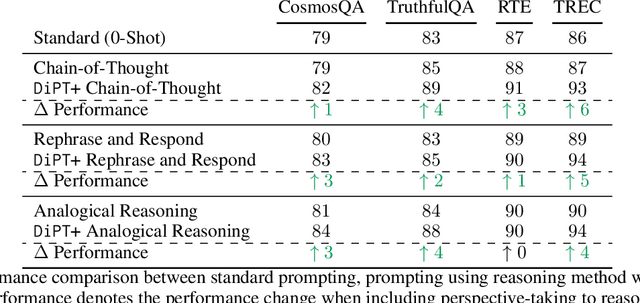
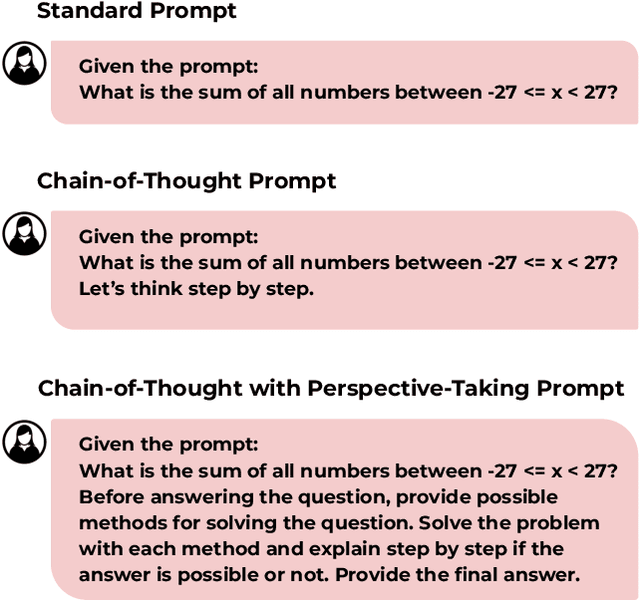
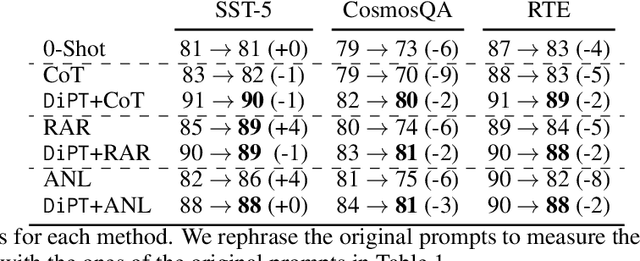
Existing work on improving language model reasoning typically explores a single solution path, which can be prone to errors. Inspired by perspective-taking in social studies, this paper introduces DiPT, a novel approach that complements current reasoning methods by explicitly incorporating diversified viewpoints. This approach allows the model to gain a deeper understanding of the problem's context and identify the most effective solution path during the inference stage. Additionally, it provides a general data-centric AI recipe for augmenting existing data to improve their quality for fine-tuning. Our empirical results demonstrate that DiPT can be flexibly integrated into existing methods that focus on a single reasoning approach, enhancing their reasoning performance and stability when presented with paraphrased problems. Furthermore, we illustrate improved context understanding by maintaining the model's safe outputs against "jailbreaking" prompts intentionally designed to bypass safeguards built into deployed models. Lastly, we show that fine-tuning with data enriched with diverse perspectives can boost the reasoning capabilities of the model compared to fine-tuning with raw data alone.