 Add to Chrome
 Add to Firefox
 Add to Edge
TabPFN-3: Technical Report
May 13, 2026
Tabular data underpins most high-value prediction problems in science and industry, and TabPFN has driven the foundation model revolution for this modality. Designed with feedback from our users, TabPFN-3 builds on this foundation to scale state-of-the-art performance to datasets with 1M training rows and substantially reduce training and inference time. Pretrained exclusively on synthetic data from our prior, TabPFN-3 dramatically pushes the frontier of tabular prediction and brings substantial gains on time series, relational, and tabular-text data. On the standard tabular benchmark TabArena, a forward pass of TabPFN-3 outperforms all other models, including tuned and ensembled baselines, by a significant margin, and pareto-dominates the speed/performance frontier. On more diverse datasets, TabPFN-3 ranks first on datasets with many classes, and beats 8-hour-tuned gradient-boosted-tree baselines on datasets up to 1M training rows and 200 features. TabPFN-3 introduces test-time compute scaling to tabular foundation models. Our API offering TabPFN-3-Plus (Thinking) exploits this to beat all non-TabPFN models by over 200 Elo on TabArena, rising to 420 Elo on the largest data subset, and outperforms AutoGluon 1.5 extreme while being 10x faster, without using LLMs, real data, internet search or any other model besides TabPFN. TabPFN-3 extends the capabilities of our models, enabling SOTA prediction on relational data (new SOTA foundation model on RelBenchV1) and tabular-text data (SOTA on TabSTAR via TabPFN-3-Plus); and improves existing integrations: a specialized checkpoint, TabPFN-TS-3, ranks 2nd on the time-series benchmark fev-bench, and SHAP-value computation is up to 120x faster. TabPFN-3 achieves this performance while being up to 20x faster than TabPFN-2.5. In addition, a reduced KV cache and row-chunking scale to 1M rows on one H100 with fast inference speed.

Causal Data Augmentation for Robust Fine-Tuning of Tabular Foundation Models
Jan 07, 2026Fine-tuning tabular foundation models (TFMs) under data scarcity is challenging, as early stopping on even scarcer validation data often fails to capture true generalization performance. We propose CausalMixFT, a method that enhances fine-tuning robustness and downstream performance by generating structurally consistent synthetic samples using Structural Causal Models (SCMs) fitted on the target dataset. This approach augments limited real data with causally informed synthetic examples, preserving feature dependencies while expanding training diversity. Evaluated across 33 classification datasets from TabArena and over 2300 fine-tuning runs, our CausalMixFT method consistently improves median normalized ROC-AUC from 0.10 (standard fine-tuning) to 0.12, outperforming purely statistical generators such as CTGAN (-0.01), TabEBM (-0.04), and TableAugment (-0.09). Moreover, it narrows the median validation-test performance correlation gap from 0.67 to 0.30, enabling more reliable validation-based early stopping, a key step toward improving fine-tuning stability under data scarcity. These results demonstrate that incorporating causal structure into data augmentation provides an effective and principled route to fine-tuning tabular foundation models in low-data regimes.
TabPFN-2.5: Advancing the State of the Art in Tabular Foundation Models
Nov 11, 2025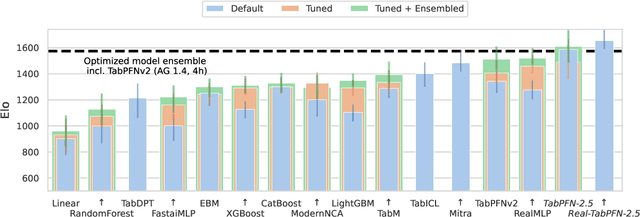
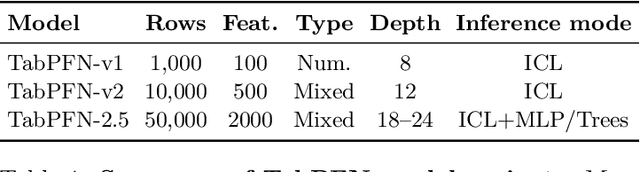
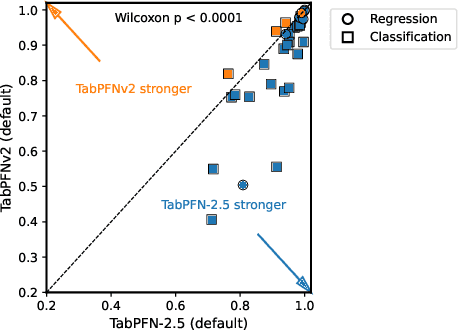
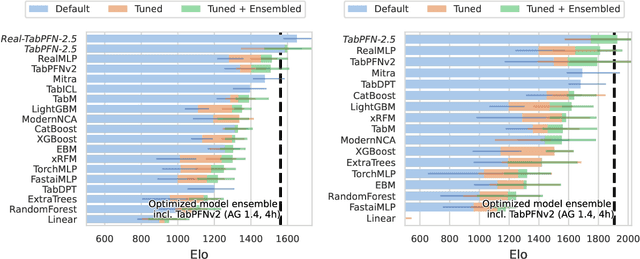
The first tabular foundation model, TabPFN, and its successor TabPFNv2 have impacted tabular AI substantially, with dozens of methods building on it and hundreds of applications across different use cases. This report introduces TabPFN-2.5, the next generation of our tabular foundation model, built for datasets with up to 50,000 data points and 2,000 features, a 20x increase in data cells compared to TabPFNv2. TabPFN-2.5 is now the leading method for the industry standard benchmark TabArena (which contains datasets with up to 100,000 training data points), substantially outperforming tuned tree-based models and matching the accuracy of AutoGluon 1.4, a complex four-hour tuned ensemble that even includes the previous TabPFNv2. Remarkably, default TabPFN-2.5 has a 100% win rate against default XGBoost on small to medium-sized classification datasets (<=10,000 data points, 500 features) and a 87% win rate on larger datasets up to 100K samples and 2K features (85% for regression). For production use cases, we introduce a new distillation engine that converts TabPFN-2.5 into a compact MLP or tree ensemble, preserving most of its accuracy while delivering orders-of-magnitude lower latency and plug-and-play deployment. This new release will immediately strengthen the performance of the many applications and methods already built on the TabPFN ecosystem.