 Add to Chrome
 Add to Firefox
 Add to Edge
How Far Can Disaggregation Go? A Design-Space Exploration of Attention-FFN Disaggregation for Efficient MoE LLM Serving
May 27, 2026
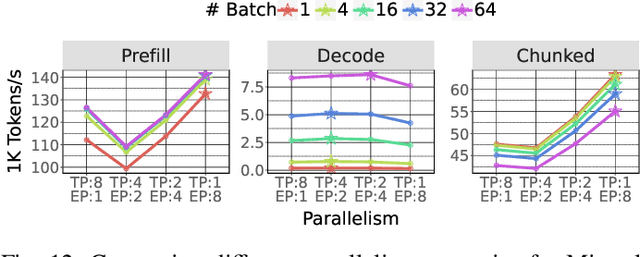
Modern large language model (LLM) inference has progressively disaggregated to keep pace with growing model sizes and tight TTFT and TPOT service-level objectives: from chunked-prefill aggregation, to prefill-decode (P/D) disaggregation, and most recently to operator-level Attention-FFN Disaggregation (AFD). This trend is especially important for mixture-of-experts (MoE) models, where memory-bound attention, compute-intensive expert FFNs, and MoE dispatch/combine communication create distinct resource demands. AFD further exposes this heterogeneity by placing attention and MoE-FFN execution on separate GPU groups. Each level of disaggregation deepens the scheduling design space across workload characteristics, resource allocation, and interconnect topology, raising the central question: when does each level actually pay off? We systematically characterize this trade-off for MoE inference across realistic workloads spanning input/output sequence lengths, prefix-KV reuse, and per-user latency constraints. Using chunked-prefill and P/D disaggregation as baselines, we study the benefits and limits of AFD at scale through a framework that fuses on-device kernel measurements with high-fidelity network simulation. Under strict TTFT/TPOT SLOs, AFD sustains around 4k tokens/s of system throughput on DeepSeek-V3.2 across chat, coding, and agentic-coding workloads, where non-AFD deployments are infeasible. We distill concrete takeaways for jointly optimizing throughput and interactivity, including how to partition attention and FFN across GPUs as a function of workload and model architecture, providing design principles for current rack- and cluster-scale deployments as well as future disaggregated AI infrastructure.

Understanding and Optimizing Multi-Stage AI Inference Pipelines
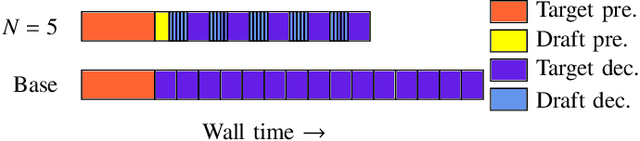
Apr 16, 2025The rapid evolution of Large Language Models (LLMs) has driven the need for increasingly sophisticated inference pipelines and hardware platforms. Modern LLM serving extends beyond traditional prefill-decode workflows, incorporating multi-stage processes such as Retrieval Augmented Generation (RAG), key-value (KV) cache retrieval, dynamic model routing, and multi step reasoning. These stages exhibit diverse computational demands, requiring distributed systems that integrate GPUs, ASICs, CPUs, and memory-centric architectures. However, existing simulators lack the fidelity to model these heterogeneous, multi-engine workflows, limiting their ability to inform architectural decisions. To address this gap, we introduce HERMES, a Heterogeneous Multi-stage LLM inference Execution Simulator. HERMES models diverse request stages; including RAG, KV retrieval, reasoning, prefill, and decode across complex hardware hierarchies. HERMES supports heterogeneous clients executing multiple models concurrently unlike prior frameworks while incorporating advanced batching strategies and multi-level memory hierarchies. By integrating real hardware traces with analytical modeling, HERMES captures critical trade-offs such as memory bandwidth contention, inter-cluster communication latency, and batching efficiency in hybrid CPU-accelerator deployments. Through case studies, we explore the impact of reasoning stages on end-to-end latency, optimal batching strategies for hybrid pipelines, and the architectural implications of remote KV cache retrieval. HERMES empowers system designers to navigate the evolving landscape of LLM inference, providing actionable insights into optimizing hardware-software co-design for next-generation AI workloads.
Demystifying Platform Requirements for Diverse LLM Inference Use Cases
Jun 03, 2024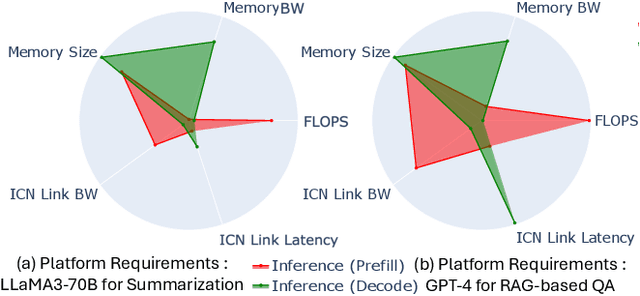
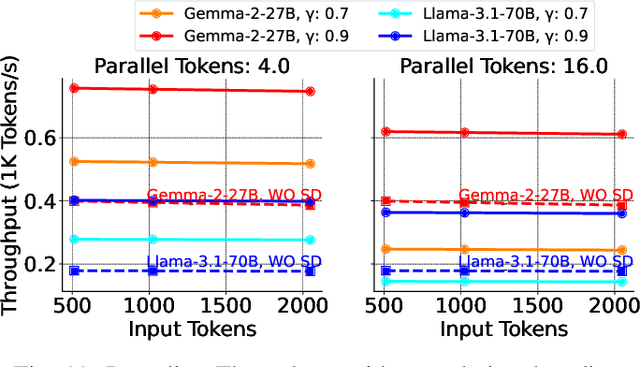
Large language models (LLMs) have shown remarkable performance across a wide range of applications, often outperforming human experts. However, deploying these parameter-heavy models efficiently for diverse inference use cases requires carefully designed hardware platforms with ample computing, memory, and network resources. With LLM deployment scenarios and models evolving at breakneck speed, the hardware requirements to meet SLOs remains an open research question. In this work, we present an analytical tool, GenZ, to study the relationship between LLM inference performance and various platform design parameters. Our analysis provides insights into configuring platforms for different LLM workloads and use cases. We quantify the platform requirements to support SOTA LLMs models like LLaMA and GPT-4 under diverse serving settings. Furthermore, we project the hardware capabilities needed to enable future LLMs potentially exceeding hundreds of trillions of parameters. The trends and insights derived from GenZ can guide AI engineers deploying LLMs as well as computer architects designing next-generation hardware accelerators and platforms. Ultimately, this work sheds light on the platform design considerations for unlocking the full potential of large language models across a spectrum of applications. The source code is available at https://github.com/abhibambhaniya/GenZ-LLM-Analyzer .