 Add to Chrome
 Add to Firefox
 Add to Edge
A Systematic Comparison and Evaluation of Building Ontologies for Deploying Data-Driven Analytics in Smart Buildings
Mar 15, 2026
Ontologies play a critical role in data exchange, information integration, and knowledge sharing across diverse smart building applications. Yet, semantic differences between the prevailing building ontologies hamper their purpose of bringing data interoperability and restrict the ability to reuse building ontologies in real-world applications. In this paper, we propose and adopt a framework to conduct a systematic comparison and evaluation of four popular building ontologies (Brick Schema, RealEstateCore, Project Haystack and Google's Digital Buildings) from both axiomatic design and assertions in a use case, namely the Terminological Box (TBox) evaluation and the Assertion Box (ABox) evaluation. In the TBox evaluation, we use the SQuaRE-based Ontology Quality Evaluation (OQuaRE) Framework and concede that Project Haystack and Brick Schema are more compact with respect to the ontology axiomatic design. In the ABox evaluation, we apply an empirical study with sample building data that suggests that Brick Schema and RealEstateCore have greater completeness and expressiveness in capturing the main concepts and relations within the building domain. The results implicitly indicate that there is no universal building ontology for integrating Linked Building Data (LBD). We also discuss ontology compatibility and investigate building ontology design patterns (ODPs) to support ontology matching, alignment, and harmonisation.

ANUBIS: Skeleton Action Recognition Dataset, Review, and Benchmark
May 08, 2022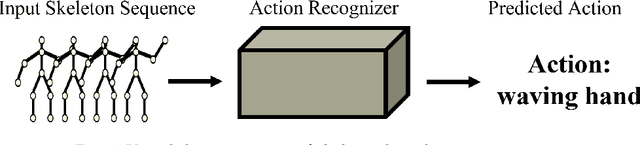
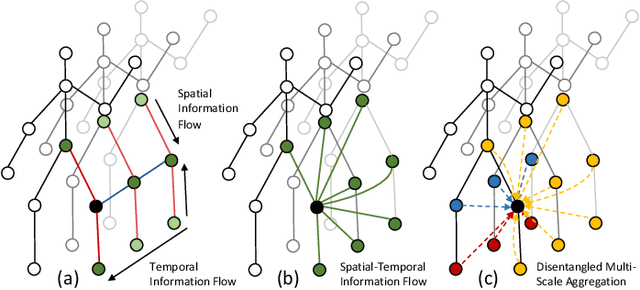
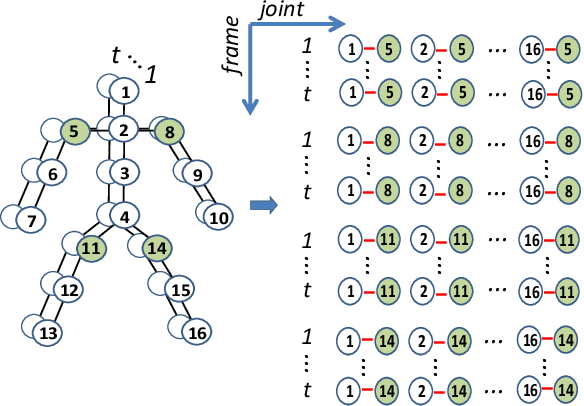
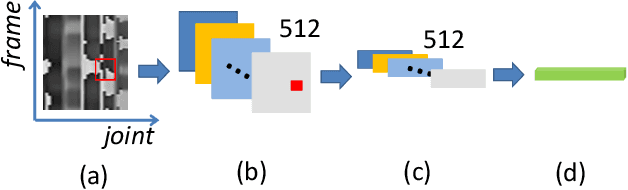
Skeleton-based action recognition, as a subarea of action recognition, is swiftly accumulating attention and popularity. The task is to recognize actions performed by human articulation points. Compared with other data modalities, 3D human skeleton representations have extensive unique desirable characteristics, including succinctness, robustness, racial-impartiality, and many more. We aim to provide a roadmap for new and existing researchers a on the landscapes of skeleton-based action recognition for new and existing researchers. To this end, we present a review in the form of a taxonomy on existing works of skeleton-based action recognition. We partition them into four major categories: (1) datasets; (2) extracting spatial features; (3) capturing temporal patterns; (4) improving signal quality. For each method, we provide concise yet informatively-sufficient descriptions. To promote more fair and comprehensive evaluation on existing approaches of skeleton-based action recognition, we collect ANUBIS, a large-scale human skeleton dataset. Compared with previously collected dataset, ANUBIS are advantageous in the following four aspects: (1) employing more recently released sensors; (2) containing novel back view; (3) encouraging high enthusiasm of subjects; (4) including actions of the COVID pandemic era. Using ANUBIS, we comparably benchmark performance of current skeleton-based action recognizers. At the end of this paper, we outlook future development of skeleton-based action recognition by listing several new technical problems. We believe they are valuable to solve in order to commercialize skeleton-based action recognition in the near future. The dataset of ANUBIS is available at: http://hcc-workshop.anu.edu.au/webs/anu101/home.