 Add to Chrome
 Add to Firefox
 Add to Edge
Euclid Quick Data Release (Q1). AgileLens: A scalable CNN-based pipeline for strong gravitational lens identification
Apr 08, 2026
We present an end-to-end, iterative pipeline for efficient identification of strong galaxy--galaxy lensing systems, applied to the Euclid Q1 imaging data. Starting from VIS catalogues, we reject point sources, apply a magnitude cut (I$_E$ $\leq$ 24) on deflectors, and run a pixel-level artefact/noise filter to build 96 $\times$ 96 pix cutouts; VIS+NISP colour composites are constructed with a VIS-anchored luminance scheme that preserves VIS morphology and NISP colour contrast. A VIS-only seed classifier supplies clear positives and typical impostors, from which we curate a morphology-balanced negative set and augment scarce positives. Among the six CNNs studied initially, a modified VGG16 (GlobalAveragePooling + 256/128 dense layers with the last nine layers trainable) performs best; the training set grows from 27 seed lenses (augmented to 1809) plus 2000 negatives to a colour dataset of 30,686 images. After three rounds of iterative fine-tuning, human grading of the top 4000 candidates ranked by the final model yields 441 Grade A/B candidate lensing systems, including 311 overlapping with the existing Q1 strong-lens catalogue, and 130 additional A/B candidates (9 As and 121 Bs) not previously reported. Independently, the model recovers 740 out of 905 (81.8%) candidate Q1 lenses within its top 20,000 predictions, considering off-centred samples. Candidates span I$_E$ $\simeq$ 17--24 AB mag (median 21.3 AB mag) and are redder in Y$_E$--H$_E$ than the parent population, consistent with massive early-type deflectors. Each training iteration required a week for a small team, and the approach easily scales to future Euclid releases; future work will calibrate the selection function via lens injection, extend recall through uncertainty-aware active learning, explore multi-scale or attention-based neural networks with fast post-hoc vetters that incorporate lens models into the classification.

Euclid Quick Data Release (Q1). Active galactic nuclei identification using diffusion-based inpainting of Euclid VIS images
Mar 19, 2025Light emission from galaxies exhibit diverse brightness profiles, influenced by factors such as galaxy type, structural features and interactions with other galaxies. Elliptical galaxies feature more uniform light distributions, while spiral and irregular galaxies have complex, varied light profiles due to their structural heterogeneity and star-forming activity. In addition, galaxies with an active galactic nucleus (AGN) feature intense, concentrated emission from gas accretion around supermassive black holes, superimposed on regular galactic light, while quasi-stellar objects (QSO) are the extreme case of the AGN emission dominating the galaxy. The challenge of identifying AGN and QSO has been discussed many times in the literature, often requiring multi-wavelength observations. This paper introduces a novel approach to identify AGN and QSO from a single image. Diffusion models have been recently developed in the machine-learning literature to generate realistic-looking images of everyday objects. Utilising the spatial resolving power of the Euclid VIS images, we created a diffusion model trained on one million sources, without using any source pre-selection or labels. The model learns to reconstruct light distributions of normal galaxies, since the population is dominated by them. We condition the prediction of the central light distribution by masking the central few pixels of each source and reconstruct the light according to the diffusion model. We further use this prediction to identify sources that deviate from this profile by examining the reconstruction error of the few central pixels regenerated in each source's core. Our approach, solely using VIS imaging, features high completeness compared to traditional methods of AGN and QSO selection, including optical, near-infrared, mid-infrared, and X-rays. [abridged]
Quantum Convolutional Neural Networks for the detection of Gamma-Ray Bursts in the AGILE space mission data
Apr 22, 2024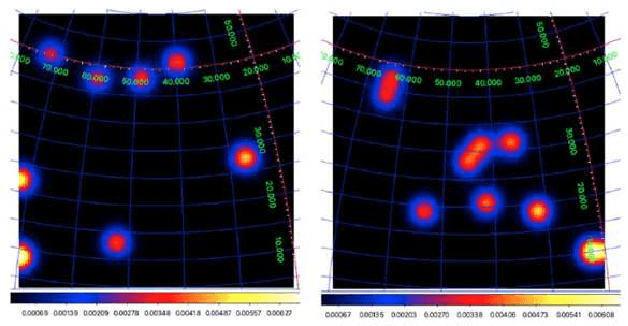
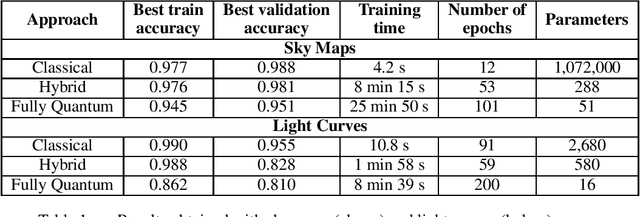
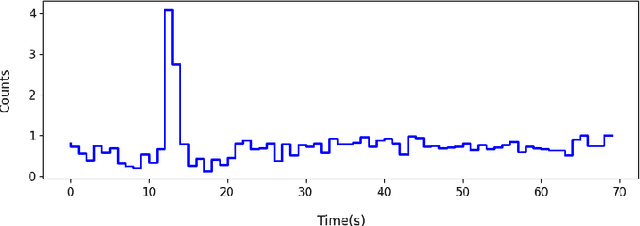
Quantum computing represents a cutting-edge frontier in artificial intelligence. It makes use of hybrid quantum-classical computation which tries to leverage quantum mechanic principles that allow us to use a different approach to deep learning classification problems. The work presented here falls within the context of the AGILE space mission, launched in 2007 by the Italian Space Agency. We implement different Quantum Convolutional Neural Networks (QCNN) that analyze data acquired by the instruments onboard AGILE to detect Gamma-Ray Bursts from sky maps or light curves. We use several frameworks such as TensorFlow-Quantum, Qiskit and PennyLane to simulate a quantum computer. We achieved an accuracy of 95.1% on sky maps with QCNNs, while the classical counterpart achieved 98.8% on the same data, using however hundreds of thousands more parameters.
Euclid: Identification of asteroid streaks in simulated images using deep learning
Oct 05, 2023Up to 150000 asteroids will be visible in the images of the ESA Euclid space telescope, and the instruments of Euclid offer multiband visual to near-infrared photometry and slitless spectra of these objects. Most asteroids will appear as streaks in the images. Due to the large number of images and asteroids, automated detection methods are needed. A non-machine-learning approach based on the StreakDet software was previously tested, but the results were not optimal for short and/or faint streaks. We set out to improve the capability to detect asteroid streaks in Euclid images by using deep learning. We built, trained, and tested a three-step machine-learning pipeline with simulated Euclid images. First, a convolutional neural network (CNN) detected streaks and their coordinates in full images, aiming to maximize the completeness (recall) of detections. Then, a recurrent neural network (RNN) merged snippets of long streaks detected in several parts by the CNN. Lastly, gradient-boosted trees (XGBoost) linked detected streaks between different Euclid exposures to reduce the number of false positives and improve the purity (precision) of the sample. The deep-learning pipeline surpasses the completeness and reaches a similar level of purity of a non-machine-learning pipeline based on the StreakDet software. Additionally, the deep-learning pipeline can detect asteroids 0.25-0.5 magnitudes fainter than StreakDet. The deep-learning pipeline could result in a 50% increase in the number of detected asteroids compared to the StreakDet software. There is still scope for further refinement, particularly in improving the accuracy of streak coordinates and enhancing the completeness of the final stage of the pipeline, which involves linking detections across multiple exposures.