 Add to Chrome
 Add to Firefox
 Add to Edge
Euclid Quick Data Release (Q1). AgileLens: A scalable CNN-based pipeline for strong gravitational lens identification
Apr 08, 2026
We present an end-to-end, iterative pipeline for efficient identification of strong galaxy--galaxy lensing systems, applied to the Euclid Q1 imaging data. Starting from VIS catalogues, we reject point sources, apply a magnitude cut (I$_E$ $\leq$ 24) on deflectors, and run a pixel-level artefact/noise filter to build 96 $\times$ 96 pix cutouts; VIS+NISP colour composites are constructed with a VIS-anchored luminance scheme that preserves VIS morphology and NISP colour contrast. A VIS-only seed classifier supplies clear positives and typical impostors, from which we curate a morphology-balanced negative set and augment scarce positives. Among the six CNNs studied initially, a modified VGG16 (GlobalAveragePooling + 256/128 dense layers with the last nine layers trainable) performs best; the training set grows from 27 seed lenses (augmented to 1809) plus 2000 negatives to a colour dataset of 30,686 images. After three rounds of iterative fine-tuning, human grading of the top 4000 candidates ranked by the final model yields 441 Grade A/B candidate lensing systems, including 311 overlapping with the existing Q1 strong-lens catalogue, and 130 additional A/B candidates (9 As and 121 Bs) not previously reported. Independently, the model recovers 740 out of 905 (81.8%) candidate Q1 lenses within its top 20,000 predictions, considering off-centred samples. Candidates span I$_E$ $\simeq$ 17--24 AB mag (median 21.3 AB mag) and are redder in Y$_E$--H$_E$ than the parent population, consistent with massive early-type deflectors. Each training iteration required a week for a small team, and the approach easily scales to future Euclid releases; future work will calibrate the selection function via lens injection, extend recall through uncertainty-aware active learning, explore multi-scale or attention-based neural networks with fast post-hoc vetters that incorporate lens models into the classification.

Dark Energy Survey Year 3 results: Simulation-based $w$CDM inference from weak lensing and galaxy clustering maps with deep learning. I. Analysis design
Nov 06, 2025Data-driven approaches using deep learning are emerging as powerful techniques to extract non-Gaussian information from cosmological large-scale structure. This work presents the first simulation-based inference (SBI) pipeline that combines weak lensing and galaxy clustering maps in a realistic Dark Energy Survey Year 3 (DES Y3) configuration and serves as preparation for a forthcoming analysis of the survey data. We develop a scalable forward model based on the CosmoGridV1 suite of N-body simulations to generate over one million self-consistent mock realizations of DES Y3 at the map level. Leveraging this large dataset, we train deep graph convolutional neural networks on the full survey footprint in spherical geometry to learn low-dimensional features that approximately maximize mutual information with target parameters. These learned compressions enable neural density estimation of the implicit likelihood via normalizing flows in a ten-dimensional parameter space spanning cosmological $w$CDM, intrinsic alignment, and linear galaxy bias parameters, while marginalizing over baryonic, photometric redshift, and shear bias nuisances. To ensure robustness, we extensively validate our inference pipeline using synthetic observations derived from both systematic contaminations in our forward model and independent Buzzard galaxy catalogs. Our forecasts yield significant improvements in cosmological parameter constraints, achieving $2-3\times$ higher figures of merit in the $\Omega_m - S_8$ plane relative to our implementation of baseline two-point statistics and effectively breaking parameter degeneracies through probe combination. These results demonstrate the potential of SBI analyses powered by deep learning for upcoming Stage-IV wide-field imaging surveys.
REWAFL: Residual Energy and Wireless Aware Participant Selection for Efficient Federated Learning over Mobile Devices
Sep 24, 2023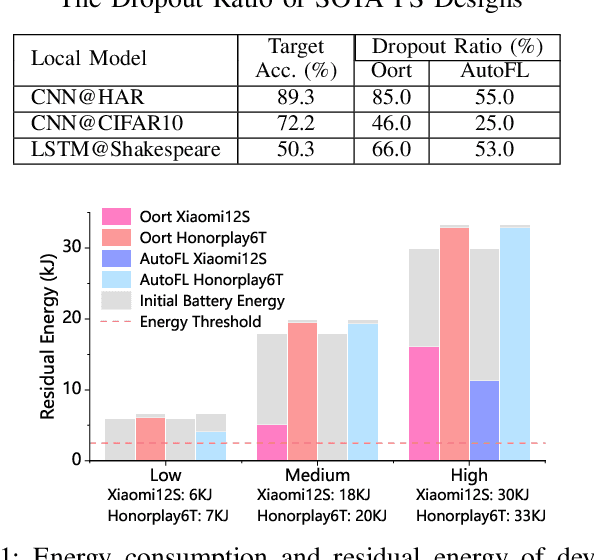
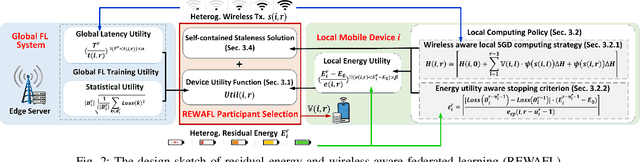
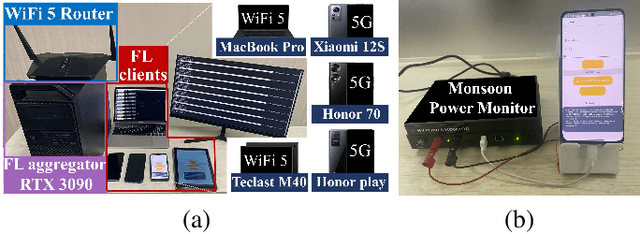
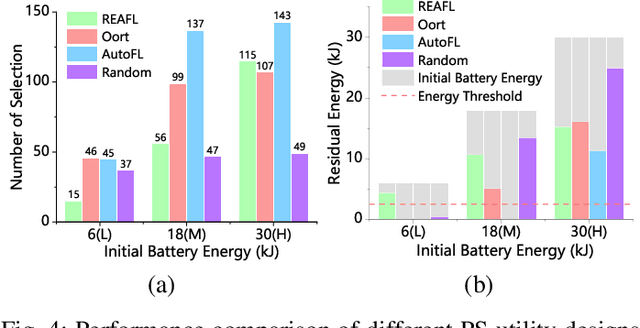
Participant selection (PS) helps to accelerate federated learning (FL) convergence, which is essential for the practical deployment of FL over mobile devices. While most existing PS approaches focus on improving training accuracy and efficiency rather than residual energy of mobile devices, which fundamentally determines whether the selected devices can participate. Meanwhile, the impacts of mobile devices' heterogeneous wireless transmission rates on PS and FL training efficiency are largely ignored. Moreover, PS causes the staleness issue. Prior research exploits isolated functions to force long-neglected devices to participate, which is decoupled from original PS designs. In this paper, we propose a residual energy and wireless aware PS design for efficient FL training over mobile devices (REWAFL). REW AFL introduces a novel PS utility function that jointly considers global FL training utilities and local energy utility, which integrates energy consumption and residual battery energy of candidate mobile devices. Under the proposed PS utility function framework, REW AFL further presents a residual energy and wireless aware local computing policy. Besides, REWAFL buries the staleness solution into its utility function and local computing policy. The experimental results show that REW AFL is effective in improving training accuracy and efficiency, while avoiding "flat battery" of mobile devices.
A Visual Embedding for the Unsupervised Extraction of Abstract Semantics
Dec 16, 2016


Vector-space word representations obtained from neural network models have been shown to enable semantic operations based on vector arithmetic. In this paper, we explore the existence of similar information on vector representations of images. For that purpose we define a methodology to obtain large, sparse vector representations of image classes, and generate vectors through the state-of-the-art deep learning architecture GoogLeNet for 20K images obtained from ImageNet. We first evaluate the resultant vector-space semantics through its correlation with WordNet distances, and find vector distances to be strongly correlated with linguistic semantics. We then explore the location of images within the vector space, finding elements close in WordNet to be clustered together, regardless of significant visual variances (e.g. 118 dog types). More surprisingly, we find that the space unsupervisedly separates complex classes without prior knowledge (e.g. living things). Afterwards, we consider vector arithmetics. Although we are unable to obtain meaningful results on this regard, we discuss the various problem we encountered, and how we consider to solve them. Finally, we discuss the impact of our research for cognitive systems, focusing on the role of the architecture being used.