 Add to Chrome
 Add to Firefox
 Add to Edge
CONFER: Conflict-Aware Evidence Negotiation for Regime-Calibrated Weak Supervision in Multimodal Emotion Recognition
Aug 08, 2026
Multimodal emotion recognition often treats self-reported labels as reliable supervision while overlooking self-report unreliability and cross-modal conflict. We propose \textbf{CONFER}, a graph-based conflict-aware evidence negotiation framework for weakly supervised multimodal emotion recognition. CONFER represents each modality expert as a node with a predictive belief, boundary-based uncertainty, and runtime reliability estimated from historical out-of-fold performance and current-sample uncertainty. Uncertainty-aware compatibility and reliability-directed asymmetric edge weights govern iterative message-passing negotiation, followed by peer-supported prediction readout. Conflict reduction, residual disagreement, and mean modality uncertainty further characterize three regimes---Consensus, Dissent, and Ambiguity---for sample-specific weak-label calibration. We evaluate CONFER on AMIGOS, MAHNOB-HCI, and DEAP under subject-dependent 10-fold and strict leave-one-subject-out (LOSO) protocols. CONFER achieves competitive performance, reaching \textbf{0.873} accuracy on AMIGOS-V and \textbf{0.854} accuracy on MAHNOB-V under strict LOSO evaluation. Further analyses show larger negotiation gains on high-conflict samples and improved robustness to weak-label corruption, indicating that cross-modal conflict provides useful information for both directional modality coordination and supervision-reliability estimation.

BioKD: Selective Physiology-to-Video Knowledge Distillation via Reliability Gate for Emotion Recognition
Aug 06, 2026To address the limitations of video-based emotion recognition under ambiguous or socially masked behavioral cues, as well as the poor deployability of physiological signals, this paper proposes a reliability-aware physiology-to-video knowledge distillation framework, termed BioKD. The proposed framework leverages physiological signals as privileged information during training to guide a video-based student model in learning deep affective representations, while relying solely on non-intrusive video inputs at inference time. To cope with the high noise and instability of physiological teacher supervision caused by inter-subject variability, signal artifacts, and temporal inconsistency, BioKD incorporates a sample-wise reliability-aware gating mechanism together with a progressive distillation strategy. By adaptively regulating the strength of knowledge transfer, the framework suppresses negative transfer induced by unreliable physiological supervision and enables more stable cross-modal distillation. Experiments on DEAP and AMIGOS show that BioKD consistently outperforms representative baselines under both trial-wise and subject-wise evaluation protocols for valence and arousal recognition. For example, BioKD achieves 68.01\% on DEAP (trial-wise arousal) and 65.29\% under the more challenging subject-wise setting, demonstrating improved performance under a subject-independent evaluation setting. Further analyses show that BioKD effectively mitigates overconfident teacher errors and outperforms an entropy-only weighting strategy, confirming the importance of explicitly modeling supervision reliability. In addition, BioKD introduces no additional inference-time overhead relative to the same video student architecture and removes the need for physiological sensing and multimodal synchronization.
Simple Primary Colour Editing for Consumer Product Images
Jun 06, 2020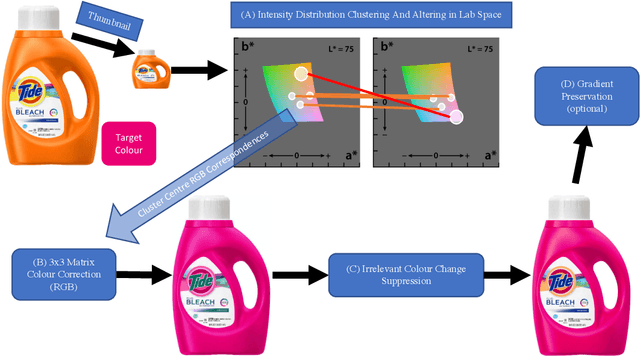
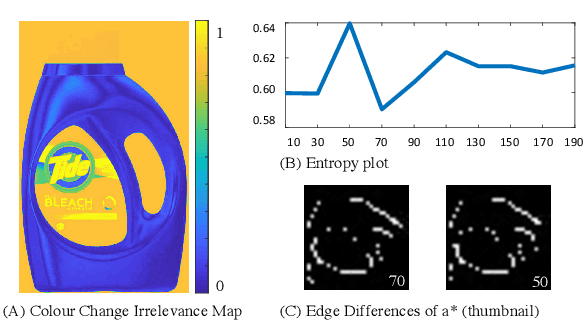
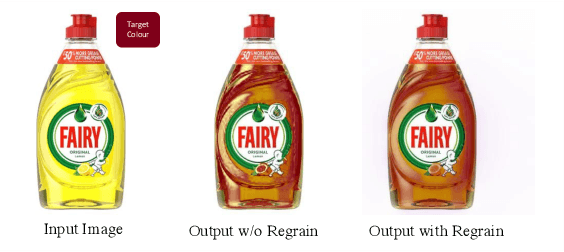
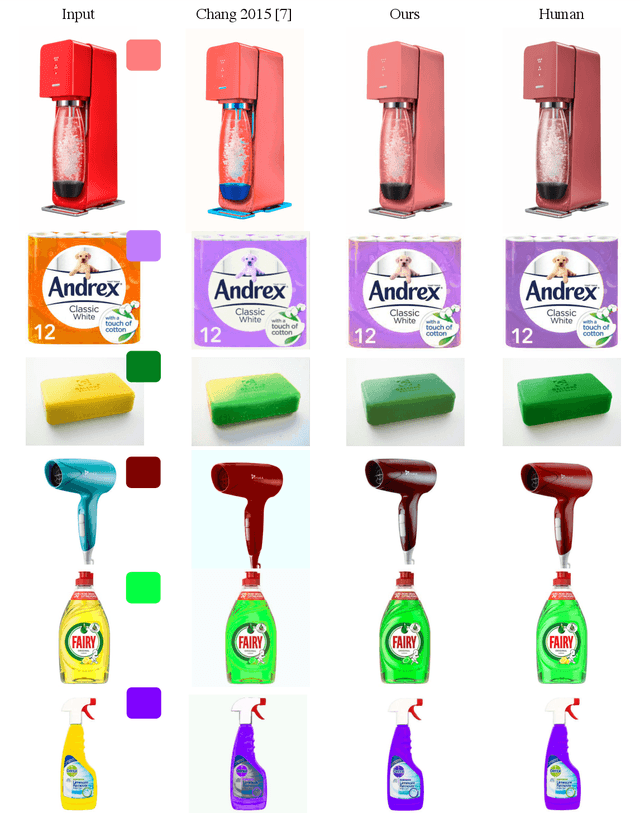
We present a simple primary colour editing method for consumer product images. We show that by using colour correction and colour blending, we can automate the pain-staking colour editing task and save time for consumer colour preference researchers. To improve the colour harmony between the primary colour and its complementary colours, our algorithm also tunes the other colours in the image. Preliminary experiment has shown some promising results compared with a state-of-the-art method and human editing.