 Add to Chrome
 Add to Firefox
 Add to Edge
Leveraging Graph Structure in Seq2Seq Models for Knowledge Graph Link Prediction
May 18, 2026
We introduce Graph-Augmented Sequence-to-Sequence (GA-S2S), a novel framework that integrates a T5-small encoder-decoder with a Relational Graph Attention Network (RGAT) to improve link prediction in knowledge graphs. While existing Seq2Seq models rely solely on surface-level textual descriptions of entities and relations and at best, flatten the neighborhoods of a query entity into a single linear sequence, thereby discarding the inherent graph structure, GA-S2S jointly encodes both textual features and the full $k$-hop subgraph topology surrounding the query entity. By integrating raw encoder outputs with RGAT's relation-aware embeddings, our model captures and leverages richer multi-hop relational patterns and textual information. Our preliminary experiments on the CoDEx dataset demonstrate that GA-S2S outperforms competitive Seq2Seq-based baseline models, achieving up to a 19\% relative gain in link prediction accuracy.

Inter-domain Multi-relational Link Prediction
Jul 09, 2021
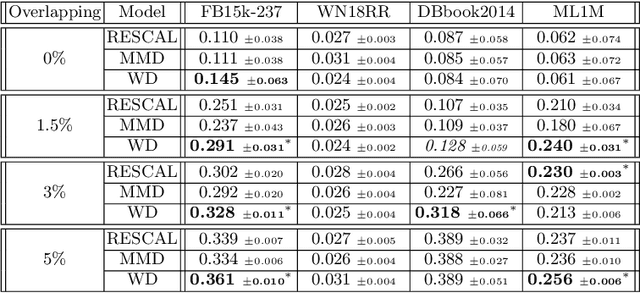
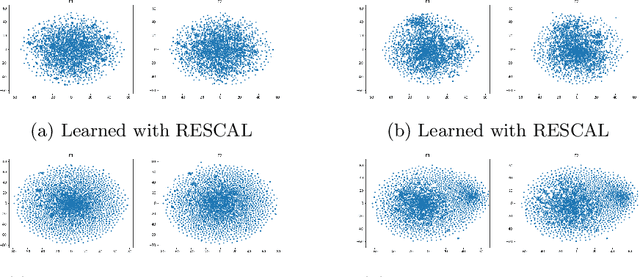
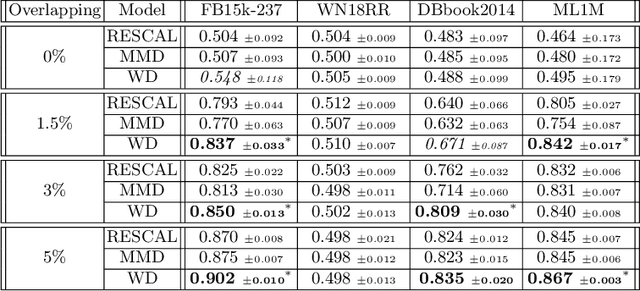
Multi-relational graph is a ubiquitous and important data structure, allowing flexible representation of multiple types of interactions and relations between entities. Similar to other graph-structured data, link prediction is one of the most important tasks on multi-relational graphs and is often used for knowledge completion. When related graphs coexist, it is of great benefit to build a larger graph via integrating the smaller ones. The integration requires predicting hidden relational connections between entities belonged to different graphs (inter-domain link prediction). However, this poses a real challenge to existing methods that are exclusively designed for link prediction between entities of the same graph only (intra-domain link prediction). In this study, we propose a new approach to tackle the inter-domain link prediction problem by softly aligning the entity distributions between different domains with optimal transport and maximum mean discrepancy regularizers. Experiments on real-world datasets show that optimal transport regularizer is beneficial and considerably improves the performance of baseline methods.