 Add to Chrome
 Add to Firefox
 Add to Edge
GreenScatter: Through-Canopy Soil Moisture Sensing with UAV-Mounted Radar
Apr 10, 2026
Soil moisture is a critical variable for managing irrigation, improving crop yield, and understanding field-scale hydrology. Radars mounted on unmanned aerial vehicles (UAVs) offer a promising means to monitor soil moisture over large fields with flexible, high-resolution coverage. However, during the growing season, canopy scattering and soil reflections become strongly coupled in the radar measurement. These coupled effects vary with crop structure or flight altitude, complicating the retrieval of soil moisture. To overcome this challenge, we present GreenScatter, a physics-based soil moisture retrieval framework for nadir-looking wideband UAV radars. GreenScatter introduces a microwave radiative transfer model that explicitly captures the dominant electromagnetic interactions between vegetation and soil, enabling accurate modeling of coherent ground backscatter through canopy. In parallel, it develops a radar cross-section (RCS) estimation method that transforms time-domain radar signals into calibrated wideband RCS spectra, isolating soil reflections while compensating for hardware and waveform effects. Together, these components enable robust soil moisture estimation through vegetation across varying canopy conditions and UAV configurations. Field experiments across multiple corn and soybean sites demonstrate consistent retrieval with an average volumetric water content (VWC) error of 4.49%.

Joint Soil and Above-Ground Biomass Characterization Using Radars
Apr 23, 2024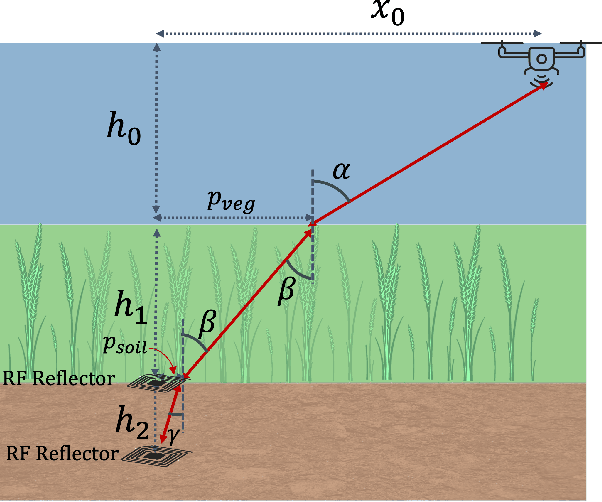
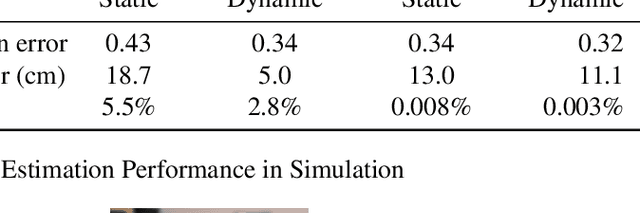

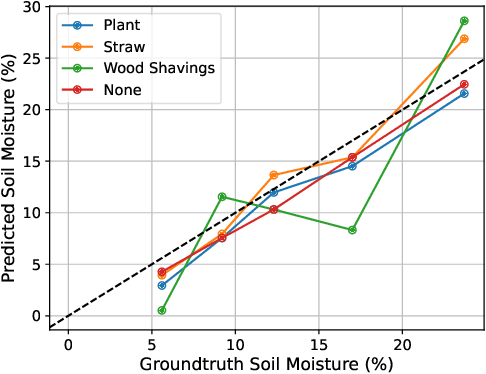
Soil moisture sensing through biomass or vegetation canopy has challenged researchers, even those who use SAR sensors with penetration capabilities. This is mainly due to the imposed extra time and phase offsets on Radio Frequency (RF) signals as they travel through the canopy. These offsets depend on the vegetation canopy moisture and height, both of which are typically unknown in agricultural and forest fields. In this paper, we leverage the mobility of an unmanned aerial system (UAS) to collect spatially-diverse radar measurements, enabling the joint estimation of soil moisture, above-ground biomass moisture, and biomass height, all without assuming any calibration steps. We leverage the changes in time-of-flight (ToF) and angle-of-arrival (AoA) measurements of reflected radar signals as the UAS flies above a reflector buried under the soil. We demonstrate the effectiveness of our algorithm by simulating its performance under realistic measurement noises as well as conducting lab experiments with different types of above-ground biomass. Our simulation results conclude that our algorithm is capable of estimating volumetric soil moisture to less than 1% median absolute error (MAE), vegetation height to 11.1cm MAE, and vegetation relative permittivity to 0.32 MAE. Our experimental results demonstrate the effectiveness of the proposed method in practical scenarios for varying biomass moistures and heights.