 Add to Chrome
 Add to Firefox
 Add to Edge
Translation from the Information Bottleneck Perspective: an Efficiency Analysis of Spatial Prepositions in Bitexts
Mar 20, 2026
Efficient communication requires balancing informativity and simplicity when encoding meanings. The Information Bottleneck (IB) framework captures this trade-off formally, predicting that natural language systems cluster near an optimal accuracy-complexity frontier. While supported in visual domains such as colour and motion, linguistic stimuli such as words in sentential context remain unexplored. We address this gap by framing translation as an IB optimisation problem, treating source sentences as stimuli and target sentences as compressed meanings. This allows IB analyses to be performed directly on bitexts rather than controlled naming experiments. We applied this to spatial prepositions across English, German and Serbian translations of a French novel. To estimate informativity, we conducted a pile-sorting pilot-study (N=35) and obtained similarity judgements of pairs of prepositions. We trained a low-rank projection model (D=5) that predicts these judgements (Spearman correlation: 0.78). Attested translations of prepositions lie closer to the IB optimal frontier than counterfactual alternatives, offering preliminary evidence that human translators exhibit communicative efficiency pressure in the spatial domain. More broadly, this work suggests that translation can serve as a window into the cognitive efficiency pressures shaping cross-linguistic semantic systems.

EDDA-Coordinata: An Annotated Dataset of Historical Geographic Coordinates
Feb 27, 2026This paper introduces a dataset of enriched geographic coordinates retrieved from Diderot and d'Alembert's eighteenth-century Encyclopedie. Automatically recovering geographic coordinates from historical texts is a complex task, as they are expressed in a variety of ways and with varying levels of precision. To improve retrieval of coordinates from similar digitized early modern texts, we have created a gold standard dataset, trained models, published the resulting inferred and normalized coordinate data, and experimented applying these models to new texts. From 74,000 total articles in each of the digitized versions of the Encyclopedie from ARTFL and ENCCRE, we examined 15,278 geographical entries, manually identifying 4,798 containing coordinates, and 10,480 with descriptive but non-numerical references. Leveraging our gold standard annotations, we trained transformer-based models to retrieve and normalize coordinates. The pipeline presented here combines a classifier to identify coordinate-bearing entries and a second model for retrieval, tested across encoder-decoder and decoder architectures. Cross-validation yielded an 86% EM score. On an out-of-domain eighteenth-century Trevoux dictionary (also in French), our fine-tuned model had a 61% EM score, while for the nineteenth-century, 7th edition of the Encyclopaedia Britannica in English, the EM was 77%. These findings highlight the gold standard dataset's usefulness as training data, and our two-step method's cross-lingual, cross-domain generalizability.
ATOM: AdapTive and OptiMized dynamic temporal knowledge graph construction using LLMs
Oct 26, 2025In today's rapidly expanding data landscape, knowledge extraction from unstructured text is vital for real-time analytics, temporal inference, and dynamic memory frameworks. However, traditional static knowledge graph (KG) construction often overlooks the dynamic and time-sensitive nature of real-world data, limiting adaptability to continuous changes. Moreover, recent zero- or few-shot approaches that avoid domain-specific fine-tuning or reliance on prebuilt ontologies often suffer from instability across multiple runs, as well as incomplete coverage of key facts. To address these challenges, we introduce ATOM (AdapTive and OptiMized), a few-shot and scalable approach that builds and continuously updates Temporal Knowledge Graphs (TKGs) from unstructured texts. ATOM splits input documents into minimal, self-contained "atomic" facts, improving extraction exhaustivity and stability. Then, it constructs atomic TKGs from these facts while employing a dual-time modeling that distinguishes when information is observed from when it is valid. The resulting atomic TKGs are subsequently merged in parallel. Empirical evaluations demonstrate that ATOM achieves ~18% higher exhaustivity, ~17% better stability, and over 90% latency reduction compared to baseline methods, demonstrating a strong scalability potential for dynamic TKG construction.
iText2KG: Incremental Knowledge Graphs Construction Using Large Language Models
Sep 05, 2024Most available data is unstructured, making it challenging to access valuable information. Automatically building Knowledge Graphs (KGs) is crucial for structuring data and making it accessible, allowing users to search for information effectively. KGs also facilitate insights, inference, and reasoning. Traditional NLP methods, such as named entity recognition and relation extraction, are key in information retrieval but face limitations, including the use of predefined entity types and the need for supervised learning. Current research leverages large language models' capabilities, such as zero- or few-shot learning. However, unresolved and semantically duplicated entities and relations still pose challenges, leading to inconsistent graphs and requiring extensive post-processing. Additionally, most approaches are topic-dependent. In this paper, we propose iText2KG, a method for incremental, topic-independent KG construction without post-processing. This plug-and-play, zero-shot method is applicable across a wide range of KG construction scenarios and comprises four modules: Document Distiller, Incremental Entity Extractor, Incremental Relation Extractor, and Graph Integrator and Visualization. Our method demonstrates superior performance compared to baseline methods across three scenarios: converting scientific papers to graphs, websites to graphs, and CVs to graphs.
Evaluating Named Entity Recognition Using Few-Shot Prompting with Large Language Models
Sep 04, 2024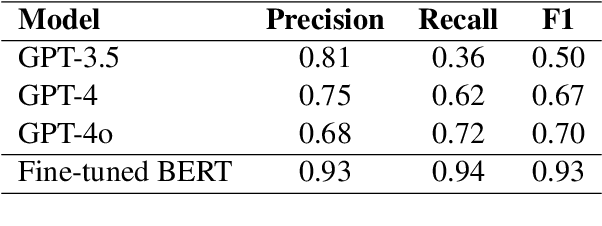
This paper evaluates Few-Shot Prompting with Large Language Models for Named Entity Recognition (NER). Traditional NER systems rely on extensive labeled datasets, which are costly and time-consuming to obtain. Few-Shot Prompting or in-context learning enables models to recognize entities with minimal examples. We assess state-of-the-art models like GPT-4 in NER tasks, comparing their few-shot performance to fully supervised benchmarks. Results show that while there is a performance gap, large models excel in adapting to new entity types and domains with very limited data. We also explore the effects of prompt engineering, guided output format and context length on performance. This study underscores Few-Shot Learning's potential to reduce the need for large labeled datasets, enhancing NER scalability and accessibility.