 Add to Chrome
 Add to Firefox
 Add to Edge
MinT: Managed Infrastructure for Training and Serving Millions of LLMs
May 13, 2026
We present MindLab Toolkit (MinT), a managed infrastructure system for Low-Rank Adaptation (LoRA) post-training and online serving. MinT targets a setting where many trained policies are produced over a small number of expensive base-model deployments. Instead of materializing each policy as a merged full checkpoint, MinT keeps the base model resident and moves exported LoRA adapter revisions through rollout, update, export, evaluation, serving, and rollback, hiding distributed training, serving, scheduling, and data movement behind a service interface. MinT scales this path along three axes. Scale Up extends LoRA RL to frontier-scale dense and MoE architectures, including MLA and DSA attention paths, with training and serving validated beyond 1T total parameters. Scale Down moves only the exported LoRA adapter, which can be under 1% of base-model size in rank-1 settings; adapter-only handoff reduces the measured step by 18.3x on a 4B dense model and 2.85x on a 30B MoE, while concurrent multi-policy GRPO shortens wall time by 1.77x and 1.45x without raising peak memory. Scale Out separates durable policy addressability from CPU/GPU working sets: a tensor-parallel deployment supports 10^6-scale addressable catalogs (measured single-engine sweeps through 100K) and thousand-adapter active waves at cluster scale, with cold loading treated as scheduled service work and packed MoE LoRA tensors improving live engine loading by 8.5-8.7x. MinT thus manages million-scale LoRA policy catalogs while training and serving selected adapter revisions over shared 1T-class base models.

Locating the Leading Edge of Cultural Change
Nov 22, 2024

Measures of textual similarity and divergence are increasingly used to study cultural change. But which measures align, in practice, with social evidence about change? We apply three different representations of text (topic models, document embeddings, and word-level perplexity) to three different corpora (literary studies, economics, and fiction). In every case, works by highly-cited authors and younger authors are textually ahead of the curve. We don't find clear evidence that one representation of text is to be preferred over the others. But alignment with social evidence is strongest when texts are represented through the top quartile of passages, suggesting that a text's impact may depend more on its most forward-looking moments than on sustaining a high level of innovation throughout.
Detecting text level intellectual influence with knowledge graph embeddings
Oct 31, 2024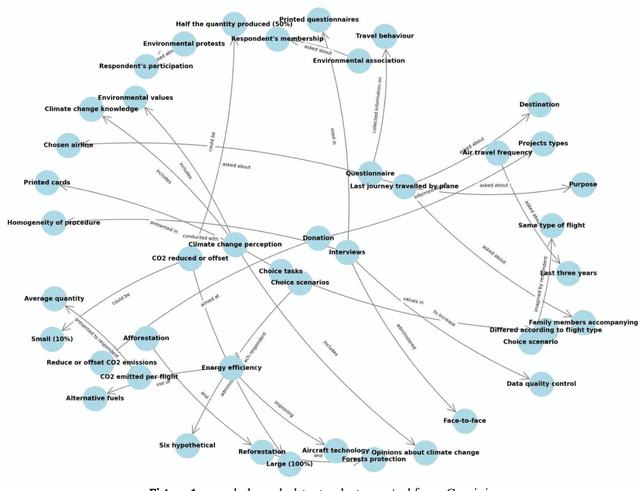
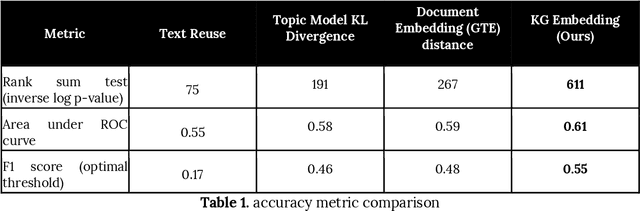
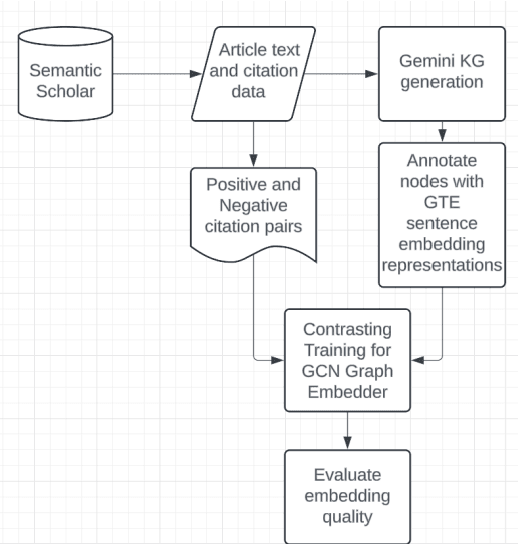
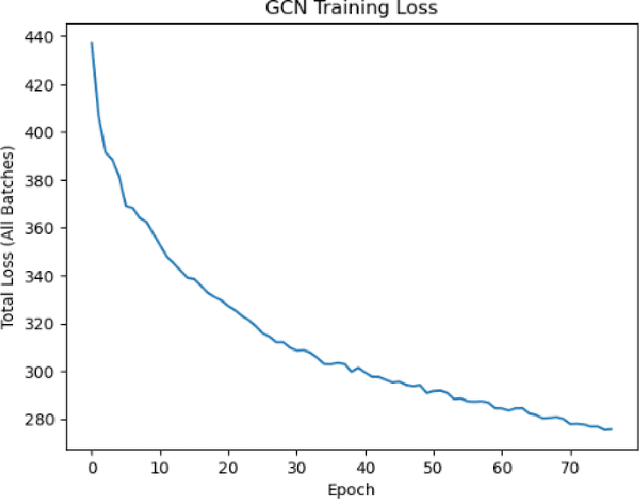
Introduction: Tracing the spread of ideas and the presence of influence is a question of special importance across a wide range of disciplines, ranging from intellectual history to cultural analytics, computational social science, and the science of science. Method: We collect a corpus of open source journal articles, generate Knowledge Graph representations using the Gemini LLM, and attempt to predict the existence of citations between sampled pairs of articles using previously published methods and a novel Graph Neural Network based embedding model. Results: We demonstrate that our knowledge graph embedding method is superior at distinguishing pairs of articles with and without citation. Once trained, it runs efficiently and can be fine-tuned on specific corpora to suit individual researcher needs. Conclusion(s): This experiment demonstrates that the relationships encoded in a knowledge graph, especially the types of concepts brought together by specific relations can encode information capable of revealing intellectual influence. This suggests that further work in analyzing document level knowledge graphs to understand latent structures could provide valuable insights.
Handwriting Recognition in Historical Documents with Multimodal LLM
Oct 31, 2024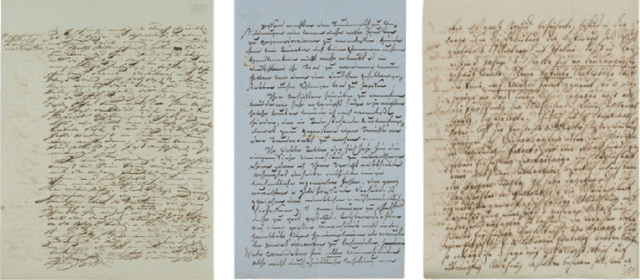
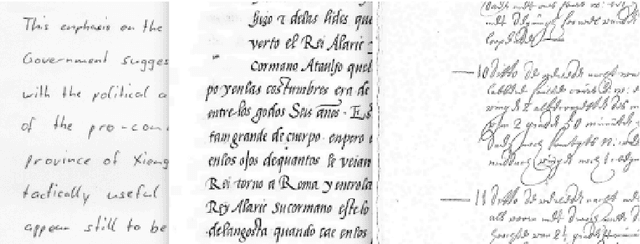
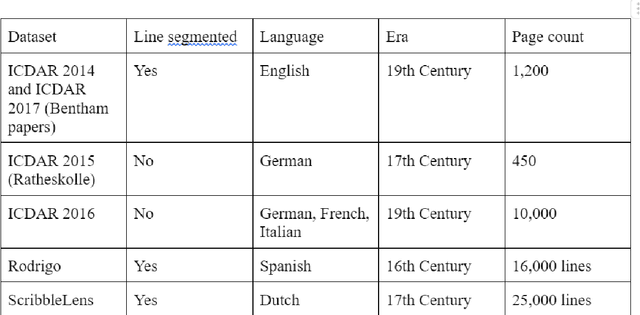
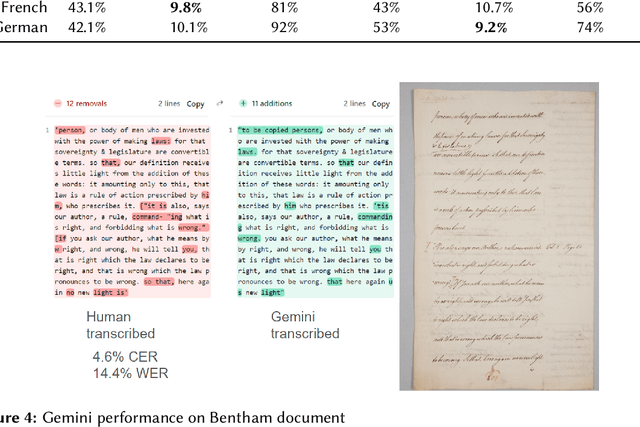
There is an immense quantity of historical and cultural documentation that exists only as handwritten manuscripts. At the same time, performing OCR across scripts and different handwriting styles has proven to be an enormously difficult problem relative to the process of digitizing print. While recent Transformer based models have achieved relatively strong performance, they rely heavily on manually transcribed training data and have difficulty generalizing across writers. Multimodal LLM, such as GPT-4v and Gemini, have demonstrated effectiveness in performing OCR and computer vision tasks with few shot prompting. In this paper, I evaluate the accuracy of handwritten document transcriptions generated by Gemini against the current state of the art Transformer based methods. Keywords: Optical Character Recognition, Multimodal Language Models, Cultural Preservation, Mass digitization, Handwriting Recognitio