 Add to Chrome
 Add to Firefox
 Add to Edge
DiV-INR: Extreme Low-Bitrate Diffusion Video Compression with INR Conditioning
Apr 09, 2026
We present a perceptually-driven video compression framework integrating implicit neural representations (INRs) and pre-trained video diffusion models to address the extremely low bitrate regime (<0.05 bpp). Our approach exploits the complementary strengths of INRs, which provide a compact video representation, and diffusion models, which offer rich generative priors learned from large-scale datasets. The INR-based conditioning replaces traditional intra-coded keyframes with bit-efficient neural representations trained to estimate latent features and guide the diffusion process. Our joint optimization of INR weights and parameter-efficient adapters for diffusion models allows the model to learn reliable conditioning signals while encoding video-specific information with minimal parameter overhead. Our experiments on UVG, MCL-JCV, and JVET Class-B benchmarks demonstrate substantial improvements in perceptual metrics (LPIPS, DISTS, and FID) at extremely low bitrates, including improvements on BD-LPIPS up to 0.214 and BD-FID up to 91.14 relative to HEVC, while also outperforming VVC and previous strong state-of-the-art neural and INR-only video codecs. Moreover, our analysis shows that INR-conditioned diffusion-based video compression first composes the scene layout and object identities before refining textural accuracy, exposing the semantic-to-visual hierarchy that enables perceptually faithful compression at extremely low bitrates.

Region-Adaptive Generative Compression with Spatially Varying Diffusion Models
Apr 01, 2026Generative image codecs aim to optimize perceptual quality, producing realistic and detailed reconstructions. However, they often overlook a key property of human vision: our tendency to focus on particular aspects of a visual scene (e.g., salient objects) while giving less importance to other regions. An ideal perceptual codec should be able to exploit this property by allocating more representational capacity to perceptually important areas. To this end, we propose a region-adaptive diffusion-based image codec that supports non-uniform bit allocation within an image. We design a novel spatially varying diffusion model capable of denoising varying amounts of noise per pixel according to arbitrary importance maps. We further identify that these maps can serve as effective priors on the latent representation, and integrate them into our entropy model, improving rate-distortion performance. Built on these contributions, our spatially-adaptive diffusion-based codec outperforms state-of-the-art ROI-controllable baselines in both full-image and ROI-masked perceptual quality.
Bridging the Gap between Gaussian Diffusion Models and Universal Quantization for Image Compression
Apr 03, 2025Generative neural image compression supports data representation at extremely low bitrate, synthesizing details at the client and consistently producing highly realistic images. By leveraging the similarities between quantization error and additive noise, diffusion-based generative image compression codecs can be built using a latent diffusion model to "denoise" the artifacts introduced by quantization. However, we identify three critical gaps in previous approaches following this paradigm (namely, the noise level, noise type, and discretization gaps) that result in the quantized data falling out of the data distribution known by the diffusion model. In this work, we propose a novel quantization-based forward diffusion process with theoretical foundations that tackles all three aforementioned gaps. We achieve this through universal quantization with a carefully tailored quantization schedule and a diffusion model trained with uniform noise. Compared to previous work, our proposal produces consistently realistic and detailed reconstructions, even at very low bitrates. In such a regime, we achieve the best rate-distortion-realism performance, outperforming previous related works.
Lossy Image Compression with Foundation Diffusion Models
Apr 12, 2024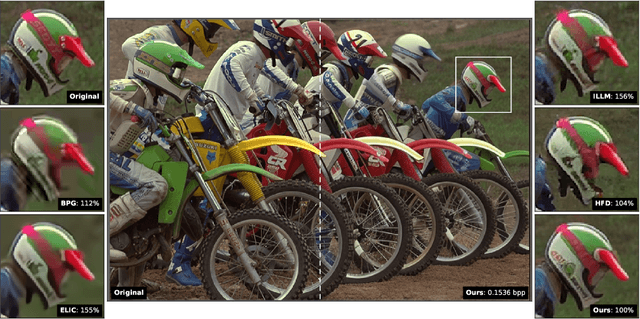
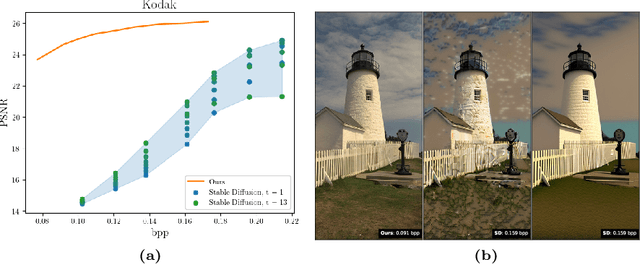
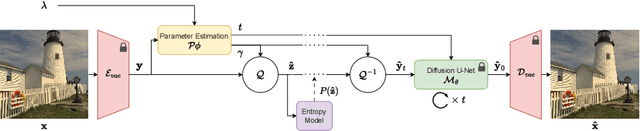
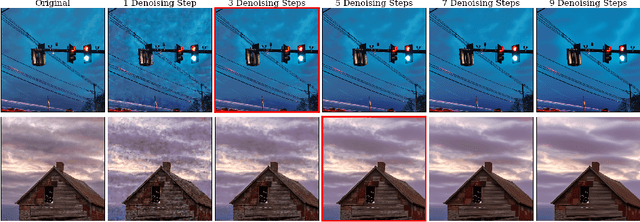
Incorporating diffusion models in the image compression domain has the potential to produce realistic and detailed reconstructions, especially at extremely low bitrates. Previous methods focus on using diffusion models as expressive decoders robust to quantization errors in the conditioning signals, yet achieving competitive results in this manner requires costly training of the diffusion model and long inference times due to the iterative generative process. In this work we formulate the removal of quantization error as a denoising task, using diffusion to recover lost information in the transmitted image latent. Our approach allows us to perform less than 10\% of the full diffusion generative process and requires no architectural changes to the diffusion model, enabling the use of foundation models as a strong prior without additional fine tuning of the backbone. Our proposed codec outperforms previous methods in quantitative realism metrics, and we verify that our reconstructions are qualitatively preferred by end users, even when other methods use twice the bitrate.
A Hybrid Neural Autoencoder for Sensory Neuroprostheses and Its Applications in Bionic Vision
May 26, 2022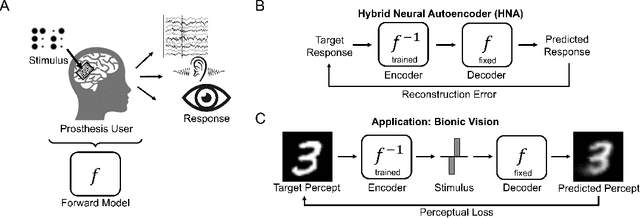
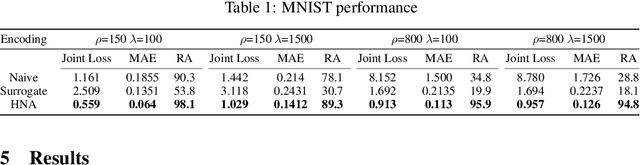
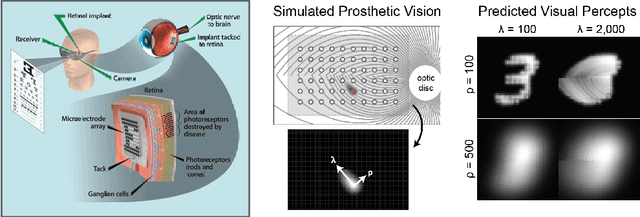
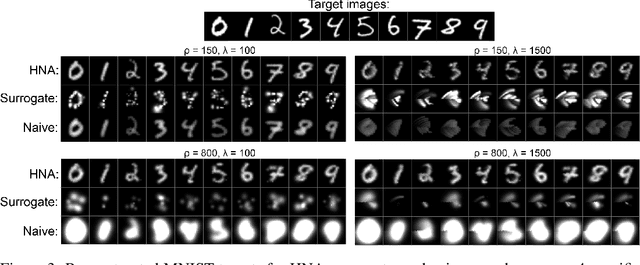
Sensory neuroprostheses are emerging as a promising technology to restore lost sensory function or augment human capacities. However, sensations elicited by current devices often appear artificial and distorted. Although current models can often predict the neural or perceptual response to an electrical stimulus, an optimal stimulation strategy solves the inverse problem: what is the required stimulus to produce a desired response? Here we frame this as an end-to-end optimization problem, where a deep neural network encoder is trained to invert a known, fixed forward model that approximates the underlying biological system. As a proof of concept, we demonstrate the effectiveness of our hybrid neural autoencoder (HNA) on the use case of visual neuroprostheses. We found that HNA is able to produce high-fidelity stimuli from the MNIST and COCO datasets that outperform conventional encoding strategies and surrogate techniques across all tested conditions. Overall this is an important step towards the long-standing challenge of restoring high-quality vision to people living with incurable blindness and may prove a promising solution for a variety of neuroprosthetic technologies.
Deep Learning-Based Perceptual Stimulus Encoder for Bionic Vision
Mar 10, 2022
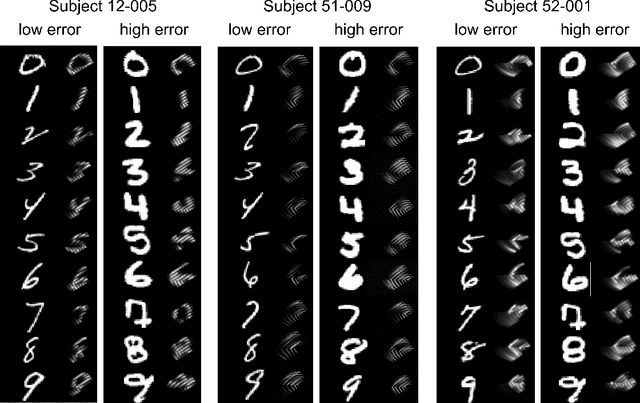
Retinal implants have the potential to treat incurable blindness, yet the quality of the artificial vision they produce is still rudimentary. An outstanding challenge is identifying electrode activation patterns that lead to intelligible visual percepts (phosphenes). Here we propose a PSE based on CNN that is trained in an end-to-end fashion to predict the electrode activation patterns required to produce a desired visual percept. We demonstrate the effectiveness of the encoder on MNIST using a psychophysically validated phosphene model tailored to individual retinal implant users. The present work constitutes an essential first step towards improving the quality of the artificial vision provided by retinal implants.