 Add to Chrome
 Add to Firefox
 Add to Edge
Benchmarks in Leipzig
Jun 04, 2026
Between April 1 and May 15, 2026, a group of 49 mathematicians compiled a dataset of research-level mathematics questions with known answers. Most of the work was done during the 3-day workshop *Benchmarks in Leipzig* with 35 participants at the Max Planck Institute for Mathematics in the Sciences in Leipzig, Germany. We present the resulting collection of 100 questions. We evaluated these questions in three stages: a single attempt by five state-of-the-art LLMs, followed by a 20-runs-per-model evaluation with three of these models, and finally a 3-run attempt with two heavy-thinking models. After Stage 1, 41 questions remained completely unsolved; after Stage 2, this count dropped to 16; and we concluded Stage 3 with only 2 unsolved questions. This demonstrates that the mathematical reasoning capabilities of LLMs are becoming impressive.

Log-concave density estimation in undirected graphical models
Jun 10, 2022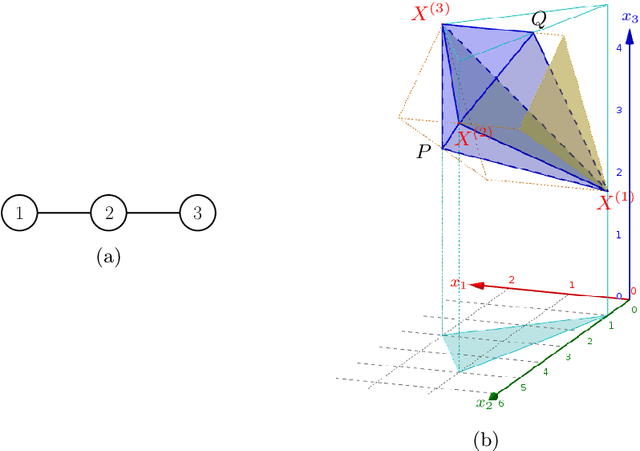

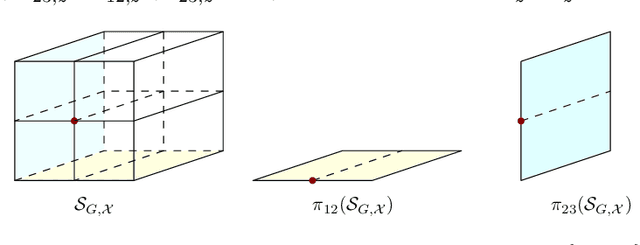
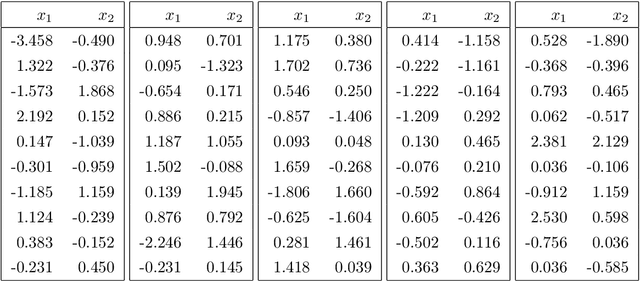
We study the problem of maximum likelihood estimation of densities that are log-concave and lie in the graphical model corresponding to a given undirected graph $G$. We show that the maximum likelihood estimate (MLE) is the product of the exponentials of several tent functions, one for each maximal clique of $G$. While the set of log-concave densities in a graphical model is infinite-dimensional, our results imply that the MLE can be found by solving a finite-dimensional convex optimization problem. We provide an implementation and a few examples. Furthermore, we show that the MLE exists and is unique with probability 1 as long as the number of sample points is larger than the size of the largest clique of $G$ when $G$ is chordal. We show that the MLE is consistent when the graph $G$ is a disjoint union of cliques. Finally, we discuss the conditions under which a log-concave density in the graphical model of $G$ has a log-concave factorization according to $G$.