 Add to Chrome
 Add to Firefox
 Add to Edge
Benchmarks in Leipzig
Jun 04, 2026
Between April 1 and May 15, 2026, a group of 49 mathematicians compiled a dataset of research-level mathematics questions with known answers. Most of the work was done during the 3-day workshop *Benchmarks in Leipzig* with 35 participants at the Max Planck Institute for Mathematics in the Sciences in Leipzig, Germany. We present the resulting collection of 100 questions. We evaluated these questions in three stages: a single attempt by five state-of-the-art LLMs, followed by a 20-runs-per-model evaluation with three of these models, and finally a 3-run attempt with two heavy-thinking models. After Stage 1, 41 questions remained completely unsolved; after Stage 2, this count dropped to 16; and we concluded Stage 3 with only 2 unsolved questions. This demonstrates that the mathematical reasoning capabilities of LLMs are becoming impressive.

Combinatorial and algebraic perspectives on the marginal independence structure of Bayesian networks
Oct 03, 2022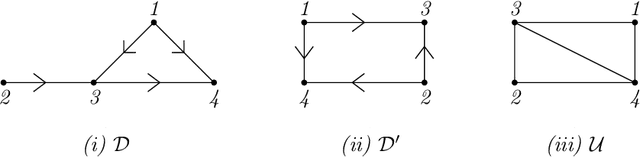
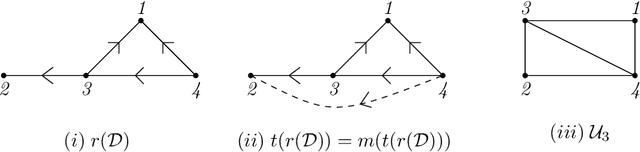
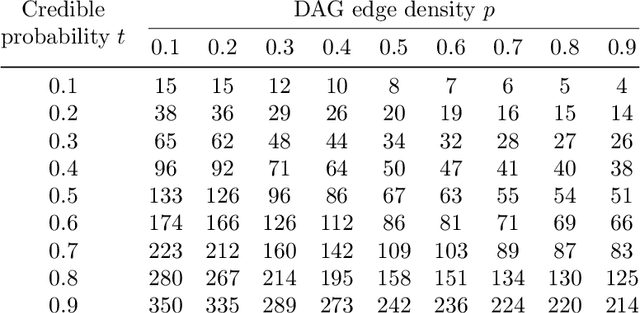
We consider the problem of estimating the marginal independence structure of a Bayesian network from observational data in the form of an undirected graph called the unconditional dependence graph. We show that unconditional dependence graphs correspond to the graphs having equal independence and intersection numbers. Using this observation, a Gr\"obner basis for a toric ideal associated to unconditional dependence graphs is given and then extended by additional binomial relations to connect the space of unconditional dependence graphs. An MCMC method, called GrUES (Gr\"obner-based Unconditional Equivalence Search), is implemented based on the resulting moves and applied to synthetic Gaussian data. GrUES recovers the true marginal independence structure via a BIC-optimal or MAP estimate at a higher rate than simple independence tests while also yielding an estimate of the posterior, for which the $20\%$ HPD credible sets include the true structure at a high rate for graphs with density at least $0.5$.
Causal Structure Learning with Greedy Unconditional Equivalence Search
Mar 01, 2022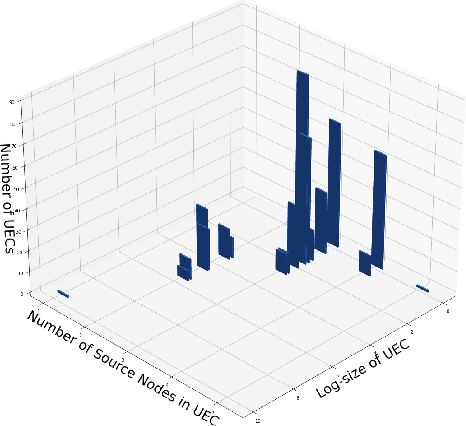
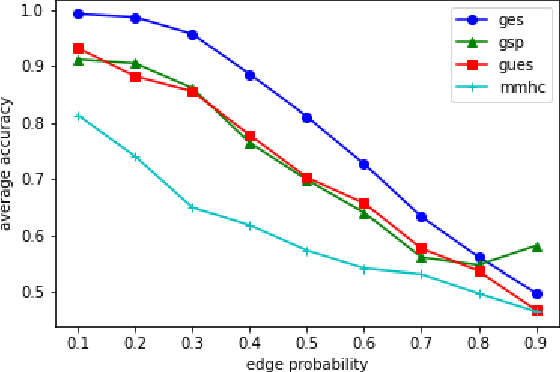
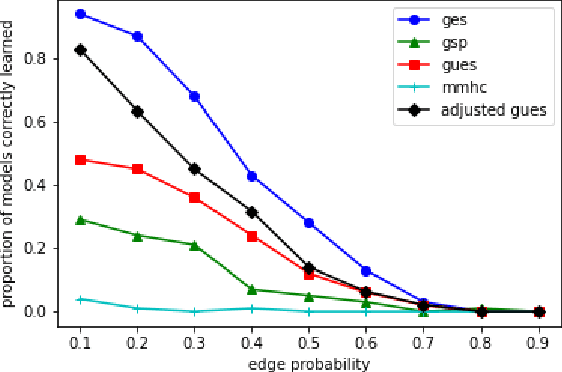
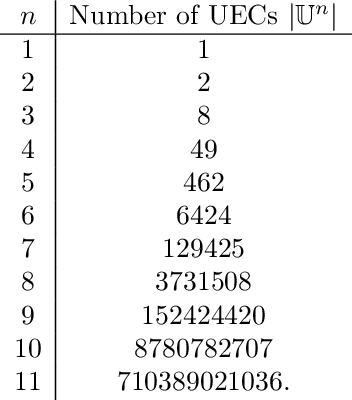
We consider the problem of characterizing directed acyclic graph (DAG) models up to unconditional equivalence, i.e., when two DAGs have the same set of unconditional d-separation statements. Each unconditional equivalence class (UEC) can be uniquely represented with an undirected graph whose clique structure encodes the members of the class. Via this structure, we provide a transformational characterization of unconditional equivalence. Combining these results, we introduce a hybrid algorithm for learning DAG models from observational data, called Greedy Unconditional Equivalence Search (GUES), which first estimates the UEC of the data using independence tests and then greedily searches the UEC for the optimal DAG. Applying GUES on synthetic data, we show that it achieves comparable accuracy to existing methods. However, in contrast to existing methods, since the average UEC is observed to contain few DAGs, the search space for GUES is drastically reduced.