 Add to Chrome
 Add to Firefox
 Add to Edge
One-shot learning for the complex dynamical behaviors of weakly nonlinear forced oscillators
Apr 16, 2026
Extrapolative prediction of complex nonlinear dynamics remains a central challenge in engineering. This study proposes a one-shot learning method to identify global frequency-response curves from a single excitation time history by learning governing equations. We introduce MEv-SINDy (Multi-frequency Evolutionary Sparse Identification of Nonlinear Dynamics) to infer the governing equations of non-autonomous and multi-frequency systems. The methodology leverages the Generalized Harmonic Balance (GHB) method to decompose complex forced responses into a set of slow-varying evolution equations. We validated the capabilities of MEv-SINDy on two critical Micro-Electro-Mechanical Systems (MEMS). These applications include a nonlinear beam resonator and a MEMS micromirror. Our results show that the model trained on a single point accurately predicts softening/hardening effects and jump phenomena across a wide range of excitation levels. This approach significantly reduces the data acquisition burden for the characterization and design of nonlinear microsystems.

Online structural health monitoring by model order reduction and deep learning algorithms
Mar 26, 2021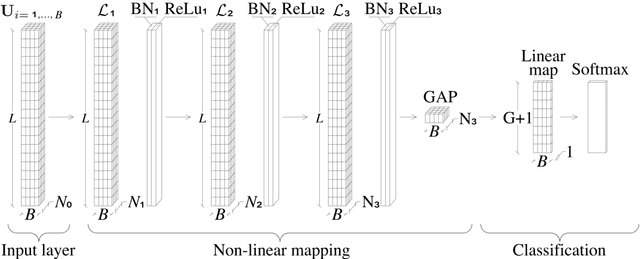
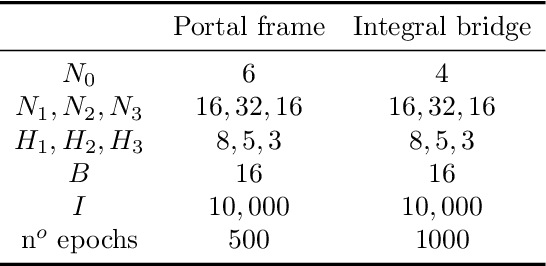
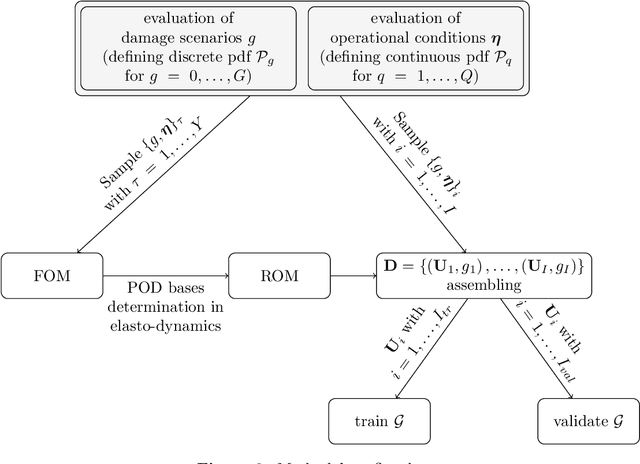
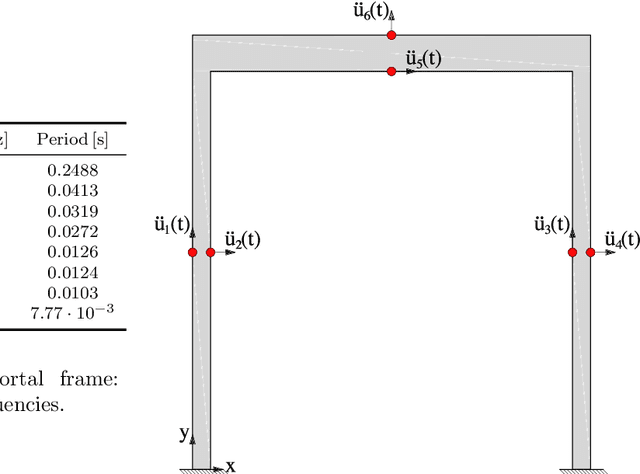
Within a structural health monitoring (SHM) framework, we propose a simulation-based classification strategy to move towards online damage localization. The procedure combines parametric Model Order Reduction (MOR) techniques and Fully Convolutional Networks (FCNs) to analyze raw vibration measurements recorded on the monitored structure. First, a dataset of possible structural responses under varying operational conditions is built through a physics-based model, allowing for a finite set of predefined damage scenarios. Then, the dataset is used for the offline training of the FCN. Because of the extremely large number of model evaluations required by the dataset construction, MOR techniques are employed to reduce the computational burden. The trained classifier is shown to be able to map unseen vibrational recordings, e.g. collected on-the-fly from sensors placed on the structure, to the actual damage state, thus providing information concerning the presence and also the location of damage. The proposed strategy has been validated by means of two case studies, concerning a 2D portal frame and a 3D portal frame railway bridge; MOR techniques have allowed us to respectively speed up the analyses about 30 and 420 times. For both the case studies, after training the classifier has attained an accuracy greater than 85%.
Fully convolutional networks for structural health monitoring through multivariate time series classification
Feb 12, 2020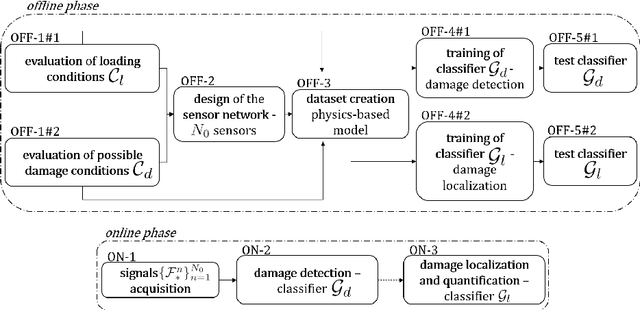
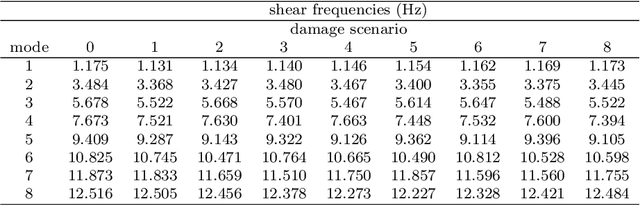
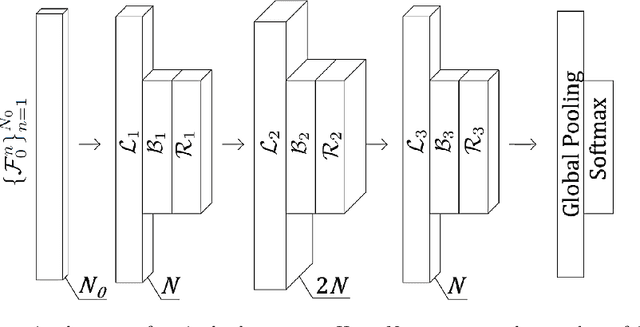
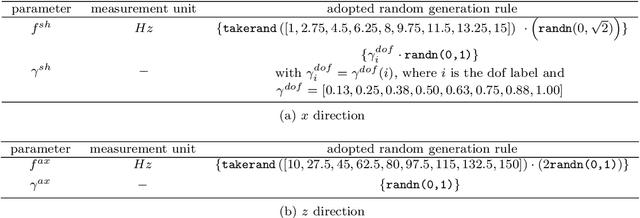
We propose a novel approach to Structural Health Monitoring (SHM), aiming at the automatic identification of damage-sensitive features from data acquired through pervasive sensor systems. Damage detection and localization are formulated as classification problems, and tackled through Fully Convolutional Networks (FCNs). A supervised training of the proposed network architecture is performed on data extracted from numerical simulations of a physics-based model (playing the role of digital twin of the structure to be monitored) accounting for different damage scenarios. By relying on this simplified model of the structure, several load conditions are considered during the training phase of the FCN, whose architecture has been designed to deal with time series of different length. The training of the neural network is done before the monitoring system starts operating, thus enabling a real time damage classification. The numerical performances of the proposed strategy are assessed on a numerical benchmark case consisting of an eight-story shear building subjected to two load types, one of which modeling random vibrations due to low-energy seismicity. Measurement noise has been added to the responses of the structure to mimic the outputs of a real monitoring system. Extremely good classification capacities are shown: among the nine possible alternatives (represented by the healthy state and by a damage at any floor), damage is correctly classified in up to 95% of cases, thus showing the strong potential of the proposed approach in view of the application to real-life cases.